

Last Updated on September 24, 2026 by Elegance
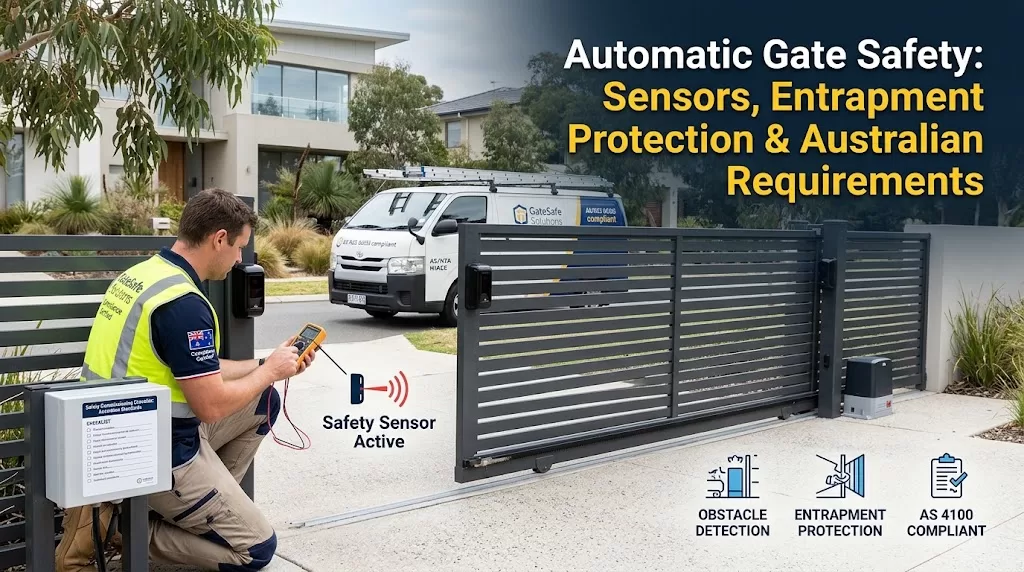
Good automatic gate safety in Australia depends on the complete system, not one sensor. Photocells can detect an obstruction across a beam, safety edges provide contact-sensitive protection, vehicle loops detect vehicles, and some operators provide obstacle-detection functions. The right combination depends on gate movement, surrounding structures, access controls and how people and vehicles use the entrance. For the entrance itself, see Elegance in Iron’s Custom Wrought Iron Driveway Gates Melbourne.
Automatic Gate Safety at a Glance
| Safety layer | Main job | Important limitation |
|---|---|---|
| Photoelectric beam | Non-contact detection across a defined path | Does not monitor every hazard zone |
| Safety edge | Contact detection at the protected edge | Acts only where the edge is installed |
| Vehicle loop | Vehicle detection for compatible control logic | Should not be treated as general pedestrian detection |
| Obstacle detection | Responds to abnormal resistance according to system design | Does not replace correct mechanics or other safeguards |
| Manual release | Allows manual operation when powered movement is unavailable | Not a normal-operation entrapment safeguard |
The question is not simply, “Does the gate have sensors?” The safeguards need to address the actual hazard zones around the installation.

Where Automatic Gate Hazards Occur
An automatic gate is a moving machine. Hazards can occur where the gate closes into an opening, passes fixed structures or creates narrowing spaces during movement.
Closing, Crushing and Shearing Areas
The relevant areas depend on the gate geometry. Posts, walls, fencing and other structures can change the clearances available as the gate travels. This is why custom wrought iron driveway gates should have the gate, operator, supports and safety devices considered as one system rather than treating automation as a separate accessory.
Photoelectric Beams: What Do They Detect?
Photoelectric sensors, commonly called photocells or gate safety beams, monitor a defined path between sensor components. When that path is interrupted, the control system receives a safety input. The resulting behaviour depends on the operator and configuration. The gate may stop, reverse or prevent a closing movement.
What Photocells Cannot See
A beam only monitors its detection path. Something outside that path may not interrupt it. Dirty sensor faces, vegetation, damage or misalignment can also affect operation. Photoelectric gate sensors are therefore one protection layer rather than evidence that every hazard has been addressed.
Safety Edges: Contact Protection
A gate safety edge provides contact-sensitive protection at the edge where it is installed. When activated, it sends a safety input to the control system, which responds according to the system design and configuration.
Beams and Edges Have Different Jobs
Photocells provide non-contact detection across a defined path. Safety edges respond to contact at their installed location. One should not automatically be assumed to perform the function of the other.
Vehicle Loops and Presence Detection
Inductive loops installed in or beneath a driveway can detect vehicles within a defined area. Depending on the system, they may support opening, exit, hold-open or safety logic.
A Vehicle Loop Is Not a General People Sensor
A loop designed around vehicle detection should not be assumed to detect pedestrians or pets. Entrances with mixed pedestrian and vehicle traffic need both types of movement considered during the safety assessment.
Obstacle Detection and Motor Force Monitoring
Some operators can monitor resistance or load and respond when movement does not occur as expected. The protective function depends on the actual operator, controller, settings and installation. Automatic gate obstacle detection should therefore be verified for the specific system rather than assumed simply because a motor controller is present.
Mechanical Condition Still Matters
Tracks, rollers, hinges, supports and alignment affect gate movement. A gate that binds or becomes difficult to move needs the cause investigated rather than having force increased until it moves. Force settings, controller programming and safety inputs should be left to an appropriately qualified technician or installer.
Swing vs Sliding Gate Safety
Swing and sliding gates move differently, so their hazard zones should not be treated as identical. The swing vs sliding driveway gates decision therefore affects the safety assessment as well as the entrance layout. For the full configuration comparison, see Swing vs Sliding Driveway Gates Melbourne.
| Gate type | Areas requiring assessment |
|---|---|
| Swing gate | Full leaf arc, closing area, hinge/post interfaces, nearby walls, vehicles and pedestrian paths |
| Sliding gate | Driveway opening, leading/closing edge, travel and return area, and interfaces with posts, fencing or other structures |
Swing Gate Movement
A swing leaf travels through an arc. Swing gate safety sensors need to be considered around the actual movement and surrounding structures rather than copied from another installation. Leaf configuration also changes the movement pattern; see Single vs Double Driveway Gates.
Sliding Gate Movement
Sliding gate safety includes the opening as well as the areas through which the gate travels beside the boundary. Protecting the driveway opening alone does not automatically address every interface along that movement.
Auto-Close, Remotes and Smartphone Control
Automatic closing can begin without someone deliberately pressing a close button at that moment. Remote or smartphone operation can also allow a gate to move while the user has limited visibility of the entrance.
Convenience Should Not Bypass Safety
Access-control features should work with the safety system. If behaviour changes unexpectedly after programming, accessory installation or servicing, arrange professional assessment rather than bypassing a sensor to restore movement.
Manual Release and Power Failure
Owners should know what happens when normal powered operation is unavailable. A manual-release arrangement can allow the gate to be moved according to the operator manufacturer’s instructions. Some systems may also incorporate battery backup. For power-source planning, see Solar vs Mains Powered Automatic Gates.
Know the Procedure Before an Emergency
The correct manual-release procedure should be explained at handover. Do not wait for a blackout or equipment failure to find out how access works.

Children, Pets and High-Traffic Entrances
Children, animals and pedestrians do not necessarily move through an entrance like vehicles. Tell the installer if the site regularly involves:
- children or pets
- frequent pedestrian movement
- multiple vehicles
- automatic closing
- remote operation from out of sight
- deliveries or unfamiliar visitors.
These conditions help identify which hazards need attention without assuming one device suits every entrance.
Australian Gate Safety Requirements
Australian Standards and other requirements may be relevant to automatic gate equipment or installations. Their application should be verified rather than inferred from a competitor website or generic checklist. Standards Australia states that its standards are voluntary on their own, although they can become mandatory when incorporated into legislation or another binding requirement.
“On their own, standards are voluntary.”
Source: Standards Australia, What is a Standard?, section “Standards and the Law”. View the live source.
This quotation comes from the “Standards and the Law” section of Standards Australia’s What is a Standard? page. The same section explains that State and Commonwealth governments may refer to Australian Standards or joint Australian/New Zealand Standards in legislation, and that a standard can become mandatory when that happens. The page does not display a separate publication date. This directly supports this article’s requirement to verify which current standard or legal requirement applies to a particular automatic-gate installation instead of treating every Australian Standard as automatically mandatory in every context.
What Needs to Be Verified?
Before relying on a claim that an installation is “compliant”, establish:
- which current Standard or requirement applies
- whether it applies to the equipment, installation or both
- whether it is mandatory in that context
- whether the particular installation has actually been assessed against it.
For a specific installation, applicable requirements and the safety design should be verified by an appropriately qualified gate-automation professional.
What Can a Homeowner Safely Check?
Homeowners can observe basic conditions without opening control equipment, rewiring devices or changing safety settings.
| Homeowner can observe | Leave to a qualified technician / installer |
|---|---|
| Obvious obstruction in the gate’s travel area | Force or obstacle settings |
| Visible damage to equipment | Sensor or control wiring |
| Dirty or obstructed sensor faces | Controller programming |
| Vegetation blocking a beam | Electrical/control fault diagnosis |
| Unexpected gate behaviour | Bypassing or altering safety inputs |
| Availability of manual-release instructions | Internal control-board work |
Never bypass a sensor simply because it prevents the gate from closing. Persistent faults need diagnosis.
Warning Signs That Need Professional Attention
Arrange professional attention if the gate:
- reverses or stops unexpectedly
- continues moving when a known safety device should respond
- strikes an object before responding
- moves irregularly or binds
- has damaged or misaligned safety equipment
- behaves differently after electrical or control work.
Safety devices form part of the automation scope, so gate automation cost in Melbourne should be considered around the complete system rather than the motor alone. For the full pricing breakdown, see How Much Does Gate Automation Cost in Melbourne?
What to Prepare for a Gate Safety Assessment
Before an assessment, prepare:
- photos of the complete entrance
- gate type and opening arrangement
- photos of existing sensors and controls
- nearby walls, posts and fencing
- access-control features in use
- details of unexpected behaviour
- information about pedestrian, pet and vehicle use.
Do not remove covers or alter settings to collect this information.
Frequently Asked Questions
Do Automatic Gates Need Safety Sensors?
The appropriate safeguards depend on the gate, operator, hazard zones, site use and applicable requirements. A professional assessment should determine the protection rather than assuming one sensor arrangement suits every installation.
What Is a Gate Safety Beam?
It is a photoelectric device monitoring a defined path. If something interrupts that path, the controller receives a safety input and responds according to the system configuration.
What Happens if a Safety Beam Is Blocked?
Depending on the operator and configuration, the gate may refuse to close, stop or reverse. Do not bypass the beam to make the gate operate.
Do Sliding and Swing Gates Need Different Safety Devices?
They can require different protection because their movement and hazard zones differ. Safeguards should be selected around the actual gate geometry and surrounding structures.
Can an Automatic Gate Close on a Car or Person?
A moving gate can create collision or entrapment hazards if a person or vehicle is not detected or safeguards do not respond as intended. Layered protection is used to address identified risks.
How Often Should Gate Safety Devices Be Tested?
Follow the operator, safety-device and installer maintenance instructions. Testing and servicing requirements depend on the equipment and installation rather than one universal interval.
What Should Happen During a Power Failure?
It depends on the system. The gate may have battery backup, require manual release or behave according to its operator design. The correct procedure should be explained at handover.
Make Safety Part of the Gate Specification
Automatic gate safety in Australia is a system-level issue involving gate geometry, the operator, controls, detection devices, surrounding structures and how the entrance is used. For a Melbourne installation, Elegance in Iron can assess these factors during a site measure, including the automation, access-control features and safety devices that need to be considered for the proposed entrance.


