

Last Updated on September 2, 2026 by Elegance
Neither swing nor sliding gates are universally better. The right choice comes down to your site. Swing gates need enough space in front of or behind the entrance for the gate leaf, or leaves, to move through an arc. Sliding gates need enough lateral run-back space along the fence line for the gate to slide clear of the opening. Slope, driveway geometry, boundary walls and how the space is actually used often decide which configuration is even practical, before questions of style or cost come into it. This guide compares both directly so you can work out which one fits your property.
For the broader custom gate range, see Elegance in Iron’s wrought iron gates.
Swing Gates vs Sliding Gates at a Glance
| Factor | Swing Gate | Sliding Gate |
|---|---|---|
| Opening movement | Arc | Sideways |
| Space required | Driveway depth | Side run-back |
| Sloping sites | Can be restrictive | May be considered depending on site |
| Installation complexity | Site-dependent | Often more moving components |
| Visual character | Traditional or classic | Clean, linear appearance |
| Automation | Available | Available |
| Maintenance | Hinges, alignment, motor | Track and rollers, alignment, motor |
| Best suited to | Property-specific | Property-specific |
This is a general comparison, not a recommendation for every property. A site assessment is the only way to confirm what will actually work for your driveway.

How Swing Driveway Gates Work
A single swing gate is one leaf that pivots open on hinges fixed to one side of the opening. It suits narrower entrances where one full-width leaf can swing clear without needing excessive depth, and it is generally the simpler of the two swing configurations to install and automate. A double swing gate splits the opening into two leaves, each swinging open from its own side. This halves the arc each leaf needs to travel, which can suit wider entrances or sites with limited depth on one side. Double swing gates are also common on larger or more formal entrances, where two symmetrical leaves suit the overall proportions of the property. In both cases, the gate needs to close and latch reliably, and the hinge side needs a post and footing capable of carrying the gate’s full weight over years of daily use, not just on the day it is installed.
How Sliding Driveway Gates Work
A tracked sliding gate runs along a ground-mounted track, guided by rollers, and generally needs clear run-back space at least similar to the driveway opening width, with additional allowance potentially required for the motor, stops and the specific gate design. Exact space requirements depend on the system. The track itself needs a stable, level base, since any settling or movement in the ground underneath can affect how smoothly the gate operates over time. A cantilever sliding gate is self-supporting and does not require a ground track, which avoids a trip hazard and keeps the ground clear underfoot. Because part of the gate’s frame counterbalances the section that spans the driveway, a cantilever gate typically needs roughly one and a half times the opening width in gate length alone, on top of the space that length needs to sit in. Both sliding formats depend on accurate alignment between the rollers, guides and the gate frame itself, which is one reason professional installation matters more with sliding systems than it might first appear.
For made-to-measure vehicle entrances, see wrought iron driveway gates Melbourne.
Space Requirements: The Biggest Difference
This is usually the deciding factor before anything else is considered.
- Swing gates need the arc itself to be clear of vehicles, walls, garden beds or a parked car waiting at the entrance
- A vehicle waiting at the gate should not sit in the arc’s path while the gate opens
- Driveway depth in front of and behind the gate line affects how comfortably a swing gate operates
- Posts, walls and fence lines near the opening can restrict how far a gate is able to swing
- Sliding gates need lateral run-back space along the boundary, roughly matching the gate’s width
- Existing fencing, garden beds or structures along that run-back line can rule out a sliding gate regardless of driveway depth A site that is tight on depth but has a long, clear fence line often suits sliding better. A site with a short fence line but generous driveway depth often suits swing better. Many properties do not clearly favour either, which is exactly why an assessment matters.
Which Gate Works Better on a Sloping Driveway?
There is no rule that sliding gates are always better for a sloping driveway. It depends on the direction of the slope, the overall driveway geometry, and how much level change occurs across the gate’s opening or its running line. A gate that swings across a slope can catch on the ground at certain points if the arc crosses a significant level change, particularly where the ground rises toward the hinge post. A sliding gate needs a level or carefully graded track, so a sloped run-back line can be just as problematic as a sloped swing arc, sometimes more so, since the entire track needs consistent grading rather than just the arc’s clearance. Neither configuration automatically solves a sloping site, and neither should be ruled out on slope alone without actually looking at the property. A proper site assessment is the only reliable way to determine which configuration, or what site-specific engineering solution, suits a particular slope.
Swing vs Sliding Gate Cost
Neither configuration is automatically cheaper. A sliding system often involves additional components such as track, rollers and support structure that a simple swing gate does not need. Automation adds cost to either configuration, and site preparation, such as levelling a run-back line or reinforcing posts for a heavier gate, can materially affect the final price. A simple swing gate is not automatically the cheaper option in every situation, particularly once site preparation and automation are factored in.
Which Is Easier to Automate?
Both swing and sliding gates can be automated. The right motor configuration depends on the gate’s weight, its opening geometry, and how much clearance the site allows for the automation hardware itself, such as ram arms for a swing gate or a drive unit and rack for a sliding gate. Automated gates also require appropriate safety systems and professional specification. Safety sensors, force management, access controls and emergency operation should be assessed as part of the complete automation system rather than treated as optional accessories, whichever configuration the gate uses. Power supply availability at the gate and any access control requirements, such as intercoms or keypads, also factor into which setup suits the site. A site with power already run to the gate location has more flexibility either way, while a site needing new power run can add cost to either configuration equally.
Maintenance Differences
Both configurations need regular attention, just at different points in the system.
| Gate Type | Common Maintenance Points |
|---|---|
| Swing gate | Hinges, alignment, motor arms, stops and hardware |
| Sliding gate | Track, rollers, debris clearance, alignment, motor and drive components |
Sliding gates in particular need their track kept clear of leaves, dirt and debris, since a blocked track can affect how smoothly the gate runs regardless of how well the motor itself is maintained.
Security and Privacy Considerations
Gate configuration alone does not determine how secure or private an entrance is. A well-built swing gate and a well-built sliding gate can offer comparable security when other factors are equal, since neither shape is inherently stronger or weaker as a barrier.
“use fence types that are low height or partially transparent.”
Source: Victorian Government, Urban Design Guidelines for Victoria — 6.4 Barriers and fences, section 6.4.3 (updated 28 October 2025; live checked 30 August 2026). View the live source.
The guidance explains that low or transparent front boundaries can preserve informal surveillance between private property and the street. That supports the point here that privacy and security are related, but a visually closed gate is not automatically a more secure overall boundary.
What actually matters more is gate height, the size of any gaps someone could reach through or climb, the quality of hardware and locking, whether the gate is automated with appropriate access control, and how the gate integrates with the surrounding fencing or boundary. A gate is only ever one part of the property’s overall boundary, and a strong gate next to a weak fence line does not achieve much on its own.
For security-focused entrance options, see security gates Melbourne. For coordinated boundary work, see wrought iron fences Melbourne.
Which Looks Better?
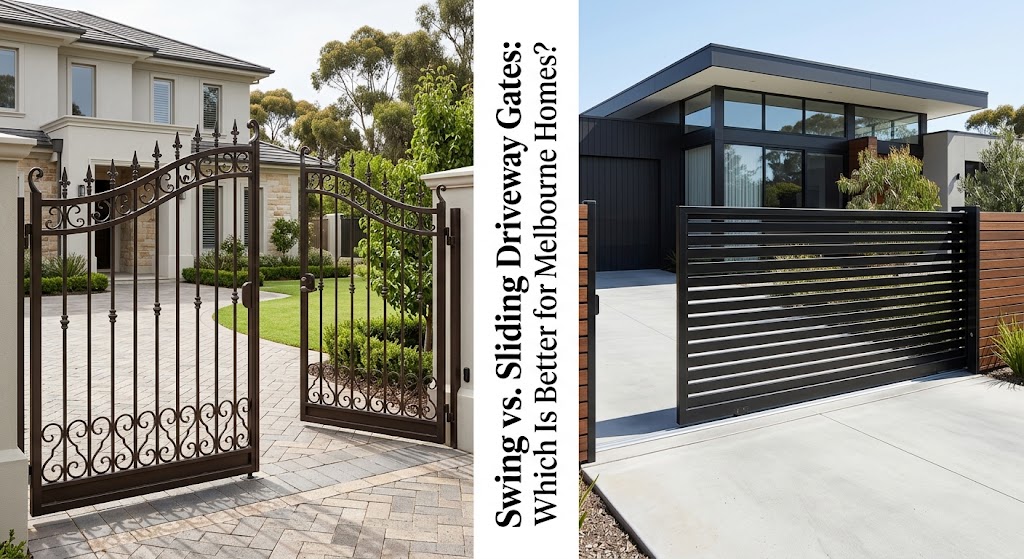
This comes down to the home and personal taste more than an objective rule. Swing gates, particularly double swing gates with decorative wrought iron detailing, often suit traditional or heritage-inspired properties, where the classic opening action matches the architecture. Sliding gates tend to suit contemporary properties, where a clean, linear appearance and long horizontal lines complement a more minimal facade. Neither look is inherently better. It is worth considering which visual language actually matches your home before deciding on configuration for aesthetic reasons alone.

Which Should You Choose?
Consider a swing gate when:
- Your driveway has enough depth for the arc to open without obstruction
- Your property has a traditional or heritage-inspired design
- Your fence line does not offer enough clear run-back space for sliding Consider a sliding gate when:
- Your driveway is shallow and cannot accommodate a swinging arc
- You have a long, clear fence line suited to a running track
- Your property has a contemporary design suited to a linear gate Final suitability should always be assessed against your actual site rather than a general preference. A proper measure and inspection of your entrance, fence line and driveway depth is the most reliable way to settle the question.
For current location coverage, see wrought iron service areas Melbourne.
Frequently Asked Questions
Are sliding gates better than swing gates?
Neither is universally better. Sliding gates suit sites with limited depth but a clear fence line, while swing gates suit sites with enough depth for the arc. The right choice depends on the property.
Which gate is better for a sloping driveway?
It depends on the slope’s direction and the driveway’s geometry, not the gate type alone. Both configurations can be affected by slope, so a site assessment is the reliable way to decide.
Which is cheaper: a sliding or swing gate?
Neither is automatically cheaper. Sliding systems often need additional components like track and rollers, while site preparation and automation can affect either configuration’s total cost.
Do sliding gates need more space?
Sliding gates need lateral run-back space along the fence line. A tracked gate generally needs space similar to the opening width, while a cantilever gate typically needs more because of its counterbalance section. Swing gates instead need clear space for their opening arc.
Can both swing and sliding gates be automated?
Yes. Both can be automated, with the right motor and safety equipment selected based on the gate’s weight, opening geometry and available power supply.
Which driveway gate requires more maintenance?
Both need regular maintenance. Swing gates rely on hinges and alignment, while sliding gates depend on a clear, well maintained track and rollers, which need periodic clearing of debris.


