

Last Updated on October 12, 2026 by Elegance
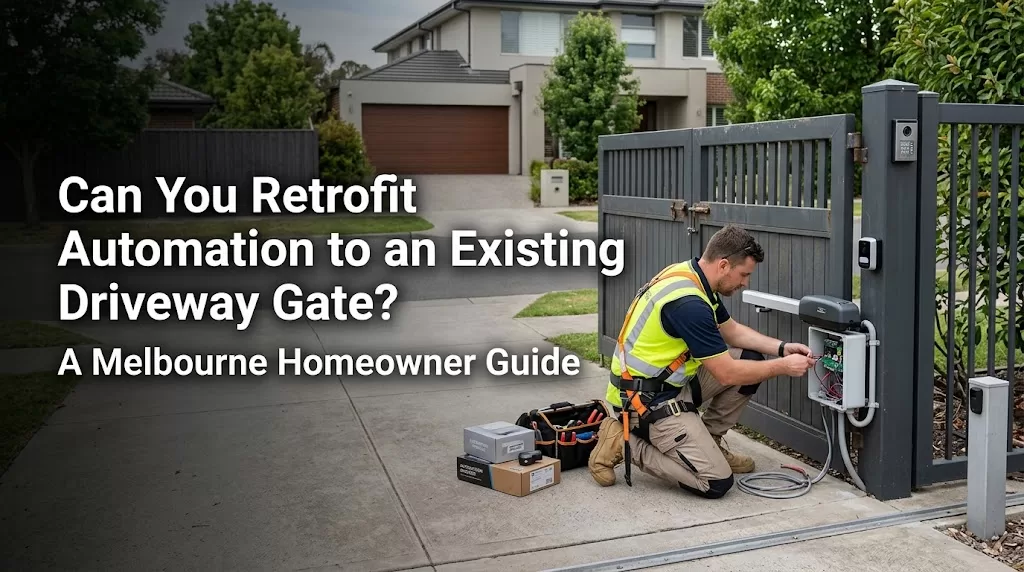
Yes, many existing driveway gates can be automated, but the gate needs to be mechanically sound and compatible with a suitable operator and safety system. A retrofit automation to existing driveway gate project should therefore start with the gate itself, not a motor catalogue. For homeowners also considering a new entrance, explore wrought iron driveway gates Melbourne before comparing complete retrofit and replacement scopes.
Swing and sliding gates require different mounting arrangements, movement space and hardware checks. Before automation is selected, the existing frame, posts or supports, hinges or running gear, power access and surrounding site all need to be assessed. The swing vs sliding driveway gates guide explains the different clearance and running-space requirements.
Quick answer: can an existing driveway gate be automated?
A well-functioning manual gate is often a reasonable starting point for automation. The gate should move predictably, have suitable supports and leave enough room for the operator, safety equipment and any required access controls.
Manufacturer installation instructions also matter. Current CAME guidance, for example, requires the gate structure and hinges to be suitable and moving components to operate without unwanted friction before an operator is installed. The selected motor then has its own mounting geometry and operating limits.
| Existing condition | Likely direction | What needs confirming |
|---|---|---|
| Gate is sound and moves smoothly | Good retrofit candidate | Geometry, operator space, power and safety |
| Gate has worn hinges, rollers or minor alignment faults | Remedial work first | Repair scope before motor selection |
| Posts, frame or running gear are unstable | Further assessment required | Structural and mechanical suitability |
| Major repairs overlap with several gate components | Compare retrofit with replacement | Complete project scope |
| Power or operator space is unresolved | Site planning first | Supply route, controls and mounting layout |
This is preliminary guidance only. Photos and basic measurements can help start the conversation, but operator geometry, structural suitability and the final safety arrangement need to be established for the actual gate and site.

Retrofit readiness checklist
A retrofit assessment should look at the complete moving gate rather than treating the motor as an isolated upgrade.
Start with safe observation of the gate
If the gate already operates normally by hand, note whether it travels smoothly and closes consistently. Also record visible changes such as a leaf sitting lower than before, a latch no longer lining up or a sliding gate becoming noisy at one part of its travel.
Do not force, lift or repeatedly move a gate that is binding, derailed, visibly unstable or badly corroded. Those conditions need competent inspection before further operation. Close checks of hinges, rollers, supports and other moving components belong with the installer or appropriate specialist.
Check the frame and supports
The frame needs to remain sufficiently rigid for controlled powered movement. Look for obvious corrosion at structural joints, distortion, damaged welds or other visible deterioration and report those observations during the assessment.
Posts and pillars matter just as much. A gate that moves because its support is leaning or unstable should not simply receive a stronger motor. Where support capacity is uncertain, appearance alone cannot confirm that it is suitable.
Record the movement and site constraints
For a swing gate, note the number of leaves, approximate leaf dimensions, opening direction, slope and the available swing area. A single swing gate uses one leaf to span the opening, while a double gate divides the opening between two leaves and requires two operator arrangements.
For a sliding gate, record the available run-back, visible track or cantilever arrangement and any areas where the gate catches or changes behaviour. Gate weight, wind-exposed infill and frequency of use also influence operator selection, but those technical values should be confirmed professionally where required.
Retrofitting a swing gate
A project to automate an existing swing gate depends heavily on hinge condition, support stability and the space available for both the leaf and operator.
Hinge and post geometry affect motor selection
Swing operators do not fit independently of the hinge position. The distance between the hinge axis and the post or pier face, the available side and rear space, the desired opening angle and the leaf dimensions all influence which mounting arrangements are possible.
Manufacturer manuals set those limits for individual operators. They should be checked for the selected model rather than transferring a bracket layout or clearance from another motor.
Linear, articulated-arm and underground operators solve different mounting problems. Selecting between them is an installer decision based on the gate and site; the retrofit should not begin by assuming one motor type will fit.
Check the full swing path
The gate needs physical room to complete its travel. Check the planned arc against parked vehicles, walls, landscaping, steps, rising paving and the normal position of vehicles waiting inside the property.
Slope matters here as well. A gate can have sound posts and hinges yet still lose usable ground clearance as it opens across rising ground. That is a movement and site issue rather than proof that the gate structure itself has failed.
Retrofitting a sliding gate
Sliding gates exchange a swing arc for a lateral travel path, but the existing running system becomes a major part of retrofit feasibility.
Track, rollers and drive position
For a tracked sliding gate, the wheels, track, guides and supporting surface need to allow consistent movement across the complete opening and run-back. Persistent debris, damaged track, worn rollers or misalignment should be addressed before automation is added.
The drive rack—the toothed component that transfers movement from the motor to the gate—also needs a suitable location and attachment arrangement. Its presence does not compensate for poor running gear.
The installer also needs to confirm the gate’s moving weight and the intended motor location rather than estimating capacity from appearance.
Cantilever gates need a different assessment
A cantilever gate is supported through its carriage system rather than wheels running along a driveway track. Existing carriages, support arrangements, guide hardware and the run-back area therefore form part of the automation assessment.
Do not assume a tracked-gate operator arrangement can simply be transferred to a cantilever gate. The selected automation and supporting hardware need to suit the existing system.
When the existing gate needs repairs or reinforcement first
Automation adds powered, repeated operation. Existing faults that are manageable during occasional manual use can become more obvious once the gate begins cycling automatically.
Mechanical faults to resolve first
Remedial work may be needed where the assessment finds:
- sagging or poorly aligned leaves
- damaged or worn hinges
- deteriorated rollers, track or guides
- corrosion affecting structural parts of the frame
- leaning or unstable supports
- a bent or twisted gate frame
- binding during travel
- poor closing-stop or latch alignment
A person having to lift, pull sideways or force a manual gate is evidence of a mechanical problem. Automation should follow correction of the cause rather than being used to overpower it.
When the repair scope changes the decision
One repair does not necessarily make replacement sensible. The comparison changes when several major elements need attention at the same time—for example, frame repairs together with unstable supports, worn moving hardware and site work required for automation.
At that point, compare the complete retained-gate proposal with a replacement proposal on equivalent scope rather than comparing the price of a motor with the price of a new gate.
Power, safety sensors and access control
Automation also needs a planned power and control system. This should be assessed alongside the mechanical gate so cabling, controls and safety devices are not treated as late additions.
Supply source, operating voltage and backup are different questions
The normal energy source may be mains electricity or, for compatible systems and suitable sites, a solar arrangement. Separately, an operator or control system may run internally at a particular operating voltage. A low-voltage motor does not mean the property has no electrical-supply requirements. For power-source selection, see solar vs mains-powered automatic gates.
Backup is another separate question. Compatible systems may use a battery arrangement to support operation during an outage, but availability and behaviour depend on the equipment selected.
For fixed mains electrical installation work in Victoria, Energy Safe Victoria advises homeowners to engage a registered electrical contractor, with the electrical work carried out by appropriately licensed electrical workers.
OFFICIAL SAFETY GUIDANCE · ENERGY SAFE VICTORIA
“Never do your own electrical or gasfitting work.”
Energy Safe Victoria advises homeowners to use qualified tradespeople for electrical work. This supports the distinction made above between a visual or mechanical pre-assessment of the gate and any fixed mains electrical installation required by the retrofit.
Source: Energy Safe Victoria, Working with tradespeople (reviewed 8 September 2026). Read the official guidance.
Safety devices depend on the installation
Photocells use a defined detection path. They can detect an interruption across that beam, but one beam does not monitor every possible hazard around a moving gate.
The installer should assess the movement area and determine the required safety arrangement before the equipment layout is finalised. Safety devices are then installed, configured and checked as part of the finished automation system. For the separate safety-design considerations, read automatic gate safety sensors and entrapment protection.
Access control should be planned with the gate
Remote controls may be sufficient for a straightforward household entrance. Other properties may need a keypad, intercom, smartphone access or a combination of methods.
Access control can affect power, cabling, communications and control-board requirements, so decide what users actually need before the final system is specified.
What the retrofit process looks like
A professional retrofit is more than attaching a motor to an existing gate.
- Initial gate and site assessment — establish the gate type, visible condition, movement, supports and site constraints.
- Mechanical assessment — check hinges or running gear, alignment, stops and any faults affecting repeatable movement.
- Remedial work where required — correct identified gate or support problems before automation proceeds.
- Operator and system selection — match the automation to the gate’s configuration, dimensions, mounting layout, use and site.
- Power, controls and safety planning — establish the supply route, access-control requirements and appropriate safeguards.
- Professional installation — mount the operator and applicable brackets or drive rack, then complete the required control and power connections. Fixed mains electrical work in Victoria should be arranged through an appropriately registered electrical contractor.
- Setup and safety checks — configure movement and installed safety functions for the completed system without exceeding the manufacturer’s stated installation requirements.
- Commissioning and handover — demonstrate the installed controls, explain the system’s power-failure or manual-release arrangement, and provide the operating and maintenance information relevant to the equipment.
Hazard assessment starts during planning. It should influence equipment and layout before the installation reaches the commissioning stage.
Retrofit vs replace: how to decide
The practical comparison is between two complete project scopes, not between a motor and a new gate.
Retrofitting is worth assessing when
The existing gate is mechanically sound or requires limited, clearly defined remediation; its geometry can accept suitable automation; and retaining the existing design still fits the homeowner’s plans.
This is particularly relevant for a custom or decorative gate that remains in good condition and is worth preserving.
Replacement deserves closer consideration when
The existing frame, supports and moving hardware all require significant work, the gate does not suit the required automation geometry, or the owner wants changes that would substantially alter the entrance anyway.
Compare proposals on the same basis. Check what each includes for retained or replaced gate components, mechanical repairs, automation equipment, power or civil work, safety devices, access controls, installation and handover. A motor-only price is not a complete retrofit comparison. For broader pricing factors, see gate automation cost in Melbourne.

Questions to ask before requesting a quote
Useful preliminary information helps the first assessment focus on feasibility rather than guessing.
Information to prepare
Gate condition
- photos of the gate from both sides
- approximate width and height
- swing, tracked sliding or cantilever configuration
- visible faults, corrosion, sagging or unusual movement
Site and services
- photos of posts, pillars, track or support areas
- available swing area or sliding run-back
- nearest known power location
- slope, drainage or access constraints
- any known heritage, boundary or other site restrictions
Use and controls
- approximate daily use
- remotes, keypad, intercom or smartphone access required
- preferred behaviour during a power outage
These details are for preliminary discussion. The installer still needs to establish technical matters such as gate weight where necessary, operator mounting geometry, support suitability and the final safety arrangement.
Questions worth asking
Ask the proposed installer:
- What mechanical repairs are required before automation?
- Is the existing gate and support arrangement suitable to retain?
- Which operator arrangement fits the gate geometry, and why?
- What power or civil work is included or excluded?
- Which safety devices and controls are included in the proposal?
- What will be demonstrated and supplied at handover?
That makes competing proposals easier to compare without reducing the decision to the motor model alone.
FAQs
Can any existing driveway gate be automated?
No. The gate needs suitable mechanical condition, supports, movement space and operator mounting geometry. Photos and approximate dimensions can establish whether an assessment is worthwhile, but a gate that looks sound can still have mounting or support limitations that only become clear on site.
Can an old wrought iron gate be converted to automatic?
Potentially. Age alone does not determine suitability; frame condition, hinges or running gear, supports, movement and available automation space matter more. A well-kept custom gate may be worth retaining, while deterioration at several structural or moving components can shift the comparison towards replacement.
Can both swing and sliding gates be retrofitted?
Yes, both configurations can potentially be automated, but the required checks differ. A mechanically sound swing gate can still have unsuitable hinge or operator geometry, while a sound sliding gate may have insufficient run-back or an unsuitable motor/rack position.
Does the gate need new posts before automation?
Not automatically. Existing posts or pillars need to be assessed in the context of the gate and proposed automation; appearance alone does not establish their capacity. Where construction or condition is uncertain, ask what records or further assessment are needed before the posts are accepted for the retrofit.
Can I keep my existing gate and just add a motor?
Sometimes, but the quote should cover more than the motor. Ask whether mechanical remediation, brackets or rack, power work, safety equipment, controls, commissioning and handover are included so you are comparing the complete retrofit scope.
Do I need mains power for gate automation?
Not every system uses the same energy arrangement. Suitable projects may use mains supply or compatible solar equipment, while operating voltage and battery backup are separate specifications. Ask how the proposed system receives power during normal use and how gate access works during an outage.
When is replacing the gate better than retrofitting it?
Replacement deserves closer consideration when retaining the gate requires extensive combined work to the frame, supports, moving hardware and automation layout. Compare complete retrofit and replacement proposals with the same inclusions so the decision reflects the whole project rather than the cost of one motor.


