
Last Updated on October 1, 2026 by Elegance
The glass in a custom iron door does more work than most homeowners expect. It’s not simply a window in the middle of the ironwork; it’s what actually determines how much privacy you get, how much light reaches your foyer, and how the whole entry reads from the street.
Choosing the best glass for iron doors means weighing privacy, light, and style against each other, since no single option maximizes all three at once. Glass selection is one of the decisions homeowners underestimate most when designing a custom iron door because it affects privacy, natural light, and the overall character of the entrance. Our broader roundup of wrought iron front door design ideas for Melbourne covers how glass fits into the wider design picture.
Clear Glass: The Classic Choice
Clear glass lets in the maximum amount of natural light and shows off the intricate ironwork pattern better than any other option, since nothing obscures the view of the metalwork itself. It creates a genuinely grand, open feeling in a foyer, particularly on doors with detailed scrollwork or geometric patterns worth showing off.
The obvious trade-off is privacy: clear glass offers very little privacy unless the entry is naturally sheltered or positioned away from public view. Weighing frosted vs clear glass for entry doors really comes down to that single trade-off, since frosted sacrifices some visibility to gain privacy while clear does the opposite. Clear glass suits grand foyers, homes with a private or set-back entrance, or any situation where light matters more than screening the view — an approach that suits modern wrought iron doors particularly well.
Frosted and Satin Glass: Privacy Without Sacrificing Light
Frosted and satin glass are among the most popular privacy options for front doors, created through sandblasting or acid etching, which roughens the surface just enough to scatter light rather than transmit a clear image. The result is privacy without losing the soft, diffused light that still makes its way into the hallway.
The trade-off is that heavier frosting can slightly obscure the ironwork’s own detailing and limits the view outward as much as inward. This option suits busy streets, homes close to the sidewalk, and rooms like bedrooms or home offices where privacy genuinely matters more than the view.

Textured and Patterned Glass: Style and Character
Textured glass for iron doors adds a custom, high-end feel that neither fully clear nor fully frosted glass can replicate on its own. Patterns like rain glass, hammered glass, reeded glass, and wavy Aquatex-style textures all create genuine visual interest while blurring the view enough for privacy.
Heavier textures can distort light more noticeably than a lighter pattern, so it’s worth seeing a physical sample before committing to a heavier design. In many custom iron door projects, textured glass is where homeowners find the best middle ground: it gives the door character without making the entry feel exposed. A solution we often see homeowners choose is a textured or frosted band at eye level with clearer glass above and below it, balancing privacy exactly where it matters most. This kind of considered detailing is exactly what we walk through in how a custom door is made.
Low-E and Energy-Efficient Glass
Energy efficient door glass, including Low-E coatings and insulated or double-pane glass, regulates indoor temperature and protects flooring and furniture near the entry from UV fading over time. The trade-off is a slightly higher upfront cost and, depending on the specific coating, a subtle tint that changes how the glass looks compared to standard clear glass.
This option earns its cost in homes with extreme heat or cold, or entries that get heavy direct sun exposure for much of the day, since the insulation genuinely reduces strain on heating and cooling systems. Single-pane glass is usually thinner and more affordable, while insulated double-pane options add energy efficiency and noise reduction at a higher cost.
Security Considerations for Iron Door Glass
Quality custom iron doors typically use tempered or laminated safety glass because standard glass is not suitable for an exposed entry point. Laminated glass in particular holds together even when cracked, which adds a real security benefit beyond what tempered glass alone provides.
“shatters into small blunt cube-like granules that are far less dangerous than jagged shards”
This is from NSW Government’s official guidance on toughened glass safety standards, explaining what happens if toughened (tempered) glass breaks. The page notes that in Australia, glass used in doors and other human-impact locations must comply with AS 1288 and AS/NZS 2208, the Australian Standards covering glass selection and safety glazing materials, and that these standards apply to Grade A safety glass — the toughened and laminated category typically specified for entry doors. It’s the regulatory backbone behind why “tempered or laminated” isn’t just a preference for iron door glass, but the baseline safety expectation.— NSW Government, Building Commission NSW, “Toughened glass safety standards”
Double-pane options add better insulation and meaningfully reduce outside noise, which is worth considering even if energy efficiency alone isn’t your top priority.
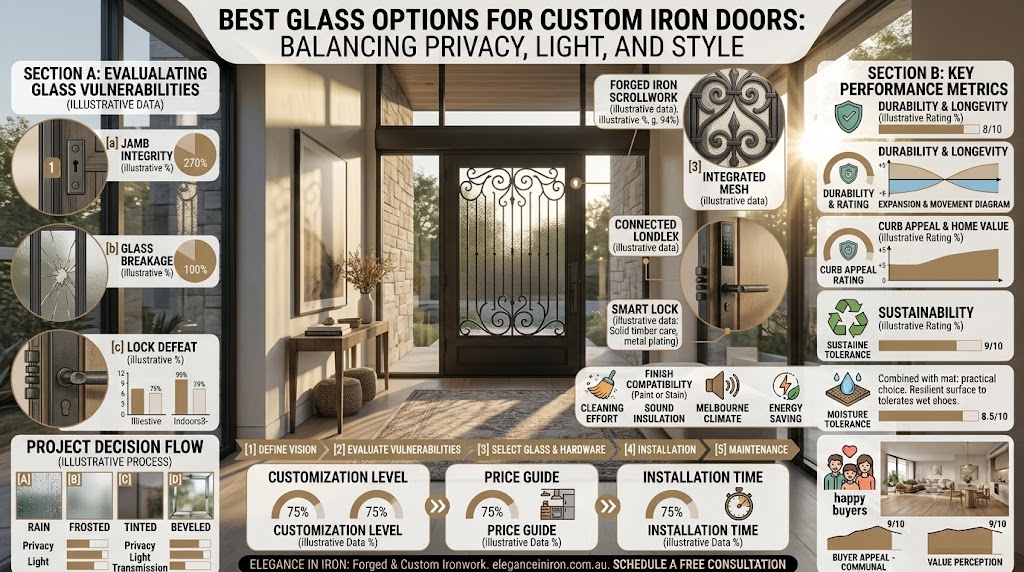
How to Choose the Right Glass for Your Iron Door
Understanding custom iron door glass options makes it easier to choose the right balance. A few straightforward questions narrow the decision quickly.
| Question | If Yes, Consider |
|---|---|
| Is the door facing a busy street? | Frosted or textured glass |
| Is the foyer naturally dark? | Clear glass |
| Is the design modern? | Clear or fluted glass |
| Is the design rustic or traditional? | Rain or hammered glass |
| Does the entry get heavy direct sun? | Low-E or insulated glass |
Frequently Asked Questions
What is the most private glass option for an iron door?
Frosted or heavily textured glass, like rain or hammered patterns, offers the most privacy while still letting in diffused natural light.
Does frosted glass block too much light?
No. Frosted glass still allows a meaningful amount of light through; it’s diffused rather than blocked, which softens the light rather than eliminating it.
Can I combine different glass types on one iron door?
Yes, a common approach is a frosted or textured band at eye level with clearer glass above or below it, balancing privacy where it matters most with openness elsewhere.
Is Low-E glass worth the extra cost?
For homes with heavy sun exposure or extreme climates, yes, since the energy savings and UV protection tend to offset the higher upfront price over time.
Do all iron doors need tempered or laminated glass?
Yes. Any glass installed in an iron entry door should be tempered or laminated for safety and security, regardless of the style chosen.
What glass works best for a modern iron door?
For modern iron doors, clear or fluted glass usually works best because both maintain clean lines while keeping the design feeling minimal. Our comparison of single vs double entry doors covers how glazing choices shift between configurations too.
Finding the Right Balance for Your Entry
The best glass for iron doors depends on how your entry actually functions: how much privacy you need, how much light you want, and how the door fits the architecture of your home. Clear glass maximizes light and shows off the ironwork, frosted and textured options trade some visibility for privacy and character, and Low-E glass earns its cost in demanding climates.
Whichever direction you lean, durability and safety ratings matter as much as the look, so tempered or laminated glass should be non-negotiable regardless of style. Avoiding common pitfalls here is covered in our guide to mistakes to avoid when buying a wrought iron door. Contact Elegance In Iron to see glass samples and find the right balance for your entry.


I’m currently designing an entryway for a coastal project and considering double-glazed (IGU) frosted glass with a Low-E coating. Given that iron frames can act as thermal bridges, does using double glazing significantly reduce interior condensation during cold Melbourne winters compared to single-paned tempered glass? Also, does the extra weight of double glazing impact the hinge requirements for heavy custom doors?
This breakdown of privacy vs. light transmission is spot on. We are looking at operable (swing-out) glass panels for an iron entry door to allow airflow without opening the main door. From a long-term maintenance perspective, do textured or heavy laminated glass options compromise the rubber seals or hinges on those hinged glass frames over time due to the added weight? How well do these operable setups handle driving rain compared to fixed glass installations?