

Last Updated on October 1, 2026 by Elegance
A front door isn’t secure just because it looks heavy or has a deadbolt. What makes a front door secure is really a system: the material, the frame, the hardware, and the installation, all working together.
A strong slab in a weak frame fails just as easily as a flimsy door. That’s the mistake most homeowners make when shopping for a secure front door.
A secure front door depends on six things:
- Door material
- Locking system
- Frame strength
- Glass protection
- Hinge security
- Installation quality
Here’s how each of these secure front door features actually affects your home’s security.

Door Material: Solid vs. Hollow
When comparing the best materials for secure front doors, hollow-core doors are the weakest option because there is very little material inside to resist force.
Solid-core wood and solid iron doors perform much better because their density absorbs and spreads impact instead of allowing the door to fail quickly.
| Door Type | Security Level | Best Use |
|---|---|---|
| Hollow core | Low | Interior doors |
| Solid core wood | High | Residential entrances |
| Iron door | Very high | Premium security-focused entries |
The solid core vs wood front door security question really comes down to priorities. Hardwood offers strength with warmth and design flexibility, while heavy-gauge iron provides even greater resistance against repeated force. Our guide on the best metal for windows and doors covers how iron compares with steel and aluminium on strength.
The Locking System: Beyond the Basic Lock
Good door hardware security starts with the deadbolt: a quality deadbolt needs a bolt throw of at least one inch. A shorter throw gives an intruder less resistance to work against.
“should always be a minimum of 1″ in length”
This is from a Seattle Police Department Crime Prevention Bulletin on door security. The full guidance describes a deadbolt “throw” as the part that actually extends into the door jamb, and confirms this minimum length as a basic standard for effective deadbolts on exterior doors. The same bulletin notes that the strike plate — not the deadbolt itself — is almost always the weakest point in a door’s security, since standard strike plates are typically secured with short screws into thin doorframe moulding rather than the structural wall stud behind it.— Seattle Police Department, Crime Prevention Coordinator, “Home Security: Door Security”
The strike plate matters just as much as the deadbolt. Standard strike plates are held in with screws often under an inch long, and those pull out of the wood jamb easily under force.
Reinforced or box strike plates change that. Screws around three inches long reach past the thin jamb material and into the actual wall stud.
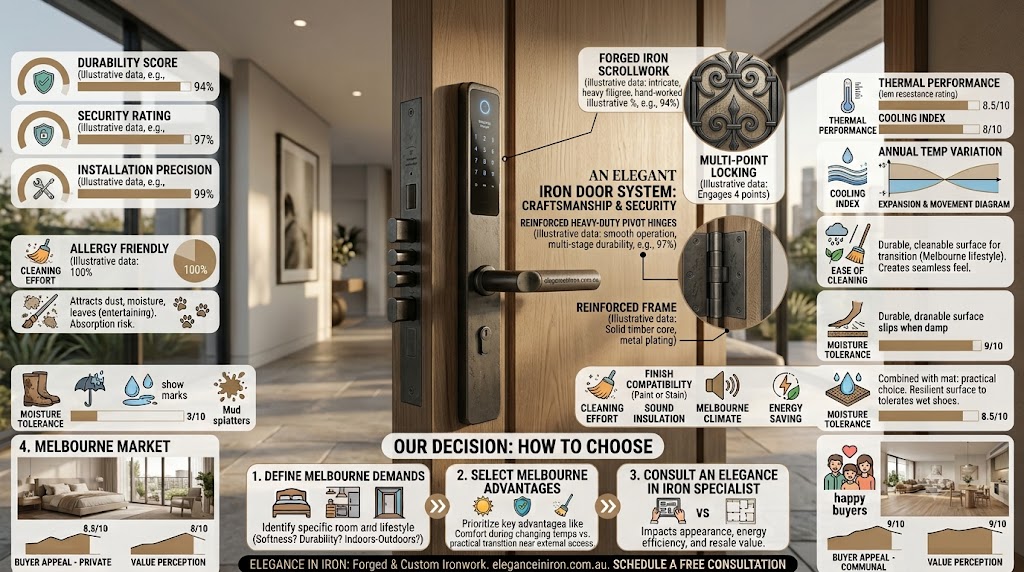
Multi-point locking systems take this further. They engage the frame at several points rather than one, which is why they’re a genuine high-security upgrade often found on premium custom doors.
Frame Strength: The Often-Overlooked Weak Link
Why It Fails
A door is only as strong as the frame it’s set into, and this is where most forced entries actually succeed. Standard wood jambs are vulnerable to splitting and cracking under repeated impact, especially once the wood has weathered or aged.
What Improves It
Homeowners searching for how to reinforce a front door usually start with the jamb. A steel wrap or heavy-duty fasteners spread the force of an attempted break-in across a much larger area, rather than concentrating it on a small strip of wood. This is the upgrade that gets overlooked most, since a homeowner focused on the lock rarely thinks to check what’s actually holding it in place.

Glass and Sidelights: Balancing Aesthetics and Safety
Glass near an entry door creates a genuine trade-off between natural light and security, particularly when a panel sits close enough to the lock mechanism that someone could break it and reach through.
Laminated or impact-resistant glass addresses that risk directly, since it holds together even when cracked rather than shattering into an opening. Sidelights deserve the same consideration as the door itself; a beautiful but unprotected glass panel next to a secure door can undermine the whole system. This is a key consideration covered in our roundup of wrought iron front door design ideas for Melbourne.
Hinge Security
Hinges matter most on outward-swinging doors, since the pins sit exposed on the outside where an intruder can access them directly. Inward-swinging doors have this vulnerability built out by default, simply because of which way the door opens.
Where hinges do face outward, non-removable or security pin hinges, sometimes called setscrew or safety stud hinges, stop the door from being lifted off even if someone tries to pop the pins. It’s a small, inexpensive detail that gets skipped constantly, mostly because it isn’t visible until someone is specifically looking for it.
Installation: The Invisible Security Feature
Even the best door and hardware fail if installed with short screws or a poorly leveled frame, since a gap or misalignment gives every other security feature less to work with.
Secure door frame installation matters more for custom entry systems specifically, where the door, frame, and hardware are all being fitted together for the first time rather than swapped into an existing, pre-checked opening. Our overview of how a custom door is made covers how this fitting process works from design through to final installation.
Installation is often overlooked because the mistakes are hidden after the door is installed.
Security Checklist Table
These measurements are the basic standards to check when evaluating door security.
| Security Feature | Minimum Standard to Look For |
|---|---|
| Deadbolt bolt throw | At least 1 inch |
| Strike plate screws | Around 3 inches, reaching the wall stud |
| Door material | Solid-core wood or solid iron, not hollow-core |
| Frame reinforcement | Steel wrap or heavy-duty fasteners at the jamb |
| Hinges (outward-swinging doors) | Non-removable or security pin hinges |
| Glass near the lock | Laminated or impact-resistant |
Frequently Asked Questions
What is the most important part of front door security?
The frame, more often than the lock itself, since most forced entries succeed by breaking the jamb rather than defeating the deadbolt.
How long should strike plate screws be?
Around three inches, long enough to reach past the door jamb and into the actual wall stud behind it.
Does a hollow-core door make my home less secure?
Yes. Hollow-core doors offer very little resistance to kicking or ramming, regardless of how good the lock attached to them is.
Are multi-point locking systems worth it?
For homeowners prioritizing security, yes, since they engage the frame at multiple points rather than relying on a single lock to hold the whole door.
Is glass near a front door a security risk?
It can be, particularly if it’s close enough to the lock to reach through if broken, which is why laminated or impact-resistant glass matters in that location.
Should I install a security door myself?
For custom entry systems especially, professional installation is worth it, since even excellent hardware underperforms if the frame isn’t set correctly. See our comparison of single vs double entry doors and whether wrought iron doors are worth the investment for your entry.
Security Is a System, Not a Single Feature
What makes a front door secure isn’t one standout feature. It’s material density, hardware quality, and structural integrity all working together as a system.
A heavy door with a weak frame, or a strong lock with flimsy strike plate screws, both fail the same way: the weakest link determines the outcome, not the strongest one. Contact Elegance In Iron to discuss a custom secure entry door built as one properly engineered system.


