

Last Updated on September 18, 2026 by Elegance
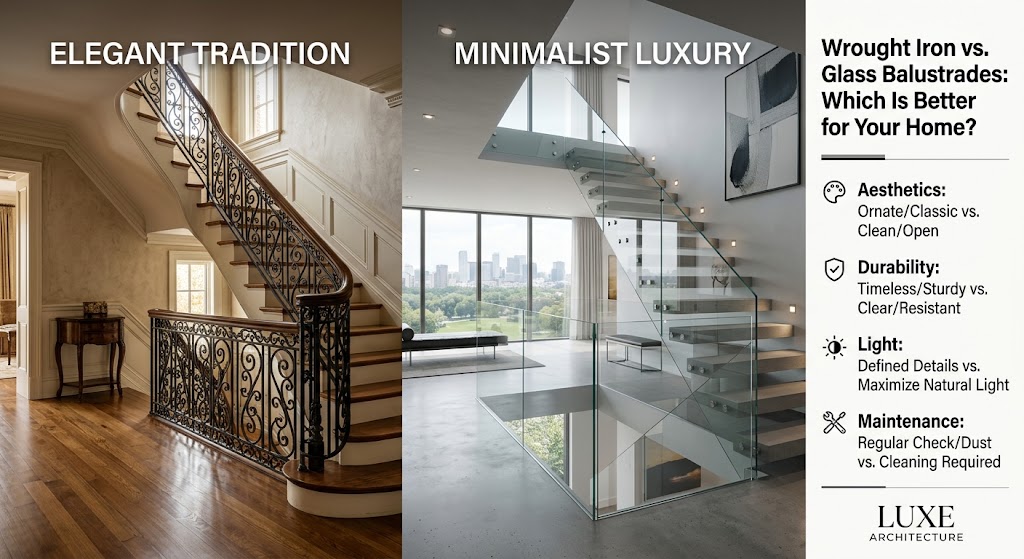
When comparing wrought iron vs glass balustrade options, neither material is universally better. Glass has a clear advantage where preserving a view and reducing visual obstruction are the main priorities. Wrought iron offers more decorative freedom and can suit projects where the balustrade itself is intended to become an architectural feature.
The practical choice also depends on cleaning tolerance, outdoor exposure, finish or glazing specification, hardware, repair strategy and the building requirements that apply to the project. Both can form a compliant barrier when correctly designed and installed; neither material is automatically compliant simply because of what it is made from.
Wrought Iron vs Glass Balustrade: Quick Comparison
| Factor | Wrought Iron | Glass |
|---|---|---|
| Visual openness | Semi-open; pattern, posts and spacing remain visible | High visual openness, although edges, posts or fixings may remain visible |
| Architectural character | Decorative, restrained, traditional or contemporary | Usually visually recessive and well suited to view-focused designs |
| Cleaning visibility | Fingerprints and water marks are generally less visually dominant | Fingerprints, dust and water spotting are more visible |
| Maintenance type | Inspect finish, joints, fixings and corrosion | Clean glass and inspect panels, fixings, posts and hardware |
| Customisation | Profiles, motifs, spacing, colour and finish | Panel layout, framing, tint/frosting and hardware system |
| Outdoor exposure | Protective system and maintenance must suit the environment | Glass and supporting hardware/fixings must suit exposure and design loads |
| Privacy / screening | Varies with pattern density | Clear glass provides little privacy unless a different glazing treatment is specified |
| Repair / replacement | Some damaged components may be repairable depending on design and condition | Cracked or broken panels generally require panel replacement |
| Best-fit context | Feature stairs, period detailing, decorative or highly customised work | View-focused balconies, minimal interiors and low-visual-impact barriers |
Appearance and Architectural Style
Wrought iron can carry a strong architectural presence. Scrollwork, shaped pickets, restrained geometric patterns, decorative panels and custom rail details can make the balustrade part of the design rather than simply a transparent safety edge.
That does not mean iron belongs only in period homes. A simplified metal pattern with clean vertical lines can work in contemporary architecture just as easily as ornate work can suit Victorian, Edwardian or other heritage-influenced properties.
Glass takes the opposite approach. Clear panels allow the surrounding architecture, staircase, garden or view to remain the visual focus. A frameless system may minimise visible structure, while semi-frameless or framed designs introduce more posts and hardware.

Views, Light and Visual Openness
Glass is normally the stronger choice when an uninterrupted outlook is the priority. A balcony facing a garden, city view or water can retain a more open visual field with transparent panels than with a repeated metal pattern.
Wrought iron remains visually permeable, but it does not disappear. Even a simple vertical design creates a rhythm across the view, and more decorative patterns create a stronger foreground element.
Glass also has trade-offs. Reflections can change through the day, edges and framing remain visible, and clear surfaces reveal fingerprints, dust and water spots. The most open-looking system is therefore not automatically the lowest-maintenance one.
Cleaning and Maintenance
Glass needs routine cleaning if maintaining a clear, polished appearance matters. Frequency depends on location, weather, nearby vegetation, children, pets and how noticeable water spotting or fingerprints are to the homeowner.
Wrought iron usually hides everyday fingerprints better, but that does not make it maintenance-free. Exterior metalwork should be inspected for coating damage, loose components, corrosion around joints and fixings, and areas where water can remain trapped.
The Victorian Building and Plumbing Commission advises owners to visually inspect balconies, decks and balustrades regularly and notes that cracked or broken glass panels should be replaced. For a broader inspection guide, see balustrade safety.
Durability and Outdoor Exposure
Both systems can perform outdoors when the complete specification suits the site. The more useful question is not “Which material lasts longer?” but “What protects this particular system in this environment?”
For wrought-iron or steel components, the protective coating system, surface preparation, detailing, drainage and inspection all affect corrosion performance. Coastal air, persistent moisture and damaged finishes can increase corrosion risk. For the underlying mechanism, see does wrought iron rust.
Where finish selection is still being considered, powder coating vs galvanizing for exterior metalwork compares two different protective approaches without treating either one as universally best.
Glass itself does not rust, but the panel is only one part of the barrier. Posts, spigots, channels, fasteners, anchors, sealants and supporting structure still need to be appropriate for the site. Panel type, thickness, edge condition and installation method are specification issues rather than assumptions that can be made from appearance.
Safety and Compliance in Victoria
Material choice does not remove the need to satisfy the building requirements that apply to a required barrier. As of 1 May 2026, Victoria has adopted NCC 2025. The applicable barrier provisions, structural requirements and project-specific approvals should be checked for the actual building class, location and scope of work.
Glass barriers also bring glazing-specific requirements. Standards Australia describes AS 1288:2021 as the framework for selecting and installing glass in buildings, including special applications such as barriers and assemblies.
“sets out the requirements for choosing and installing glass in buildings.”
Source: Standards Australia, Spotlight on: Glass in buildings — Selection and installation, 24 February 2025. View source.
The practical point is that a glass balustrade must be specified as a complete glazing and barrier system. Wrought iron also needs a complete compliant barrier design; the material label alone does not establish safety for either option.
This comparison intentionally does not reproduce detailed height, opening or climbability figures. Those belong to the separate regulatory content cluster and should be checked against the requirements applying to the actual project at the time of design.
Design Flexibility and Custom Detailing
Wrought iron gives the designer more freedom to make the barrier visibly expressive. Profiles, scrollwork, geometric motifs, spacing, posts, handrails, colour and finish can be coordinated with the building rather than selected as a standard panel appearance.
Glass offers a different type of flexibility. The design can vary through framed, semi-frameless or frameless arrangements, panel dimensions, hardware, tinted or frosted options and the way the glazing meets adjacent materials.
The two materials can also be combined. A metal frame with glass infill can preserve much of the visual openness of glass while introducing stronger architectural definition. Whether that hybrid approach is suitable depends on engineering, fixing and glazing details, not appearance alone.

Cost: Compare the Drivers, Not a Fixed Price
Neither material is reliably the cheaper choice on every project. Glass and iron have different cost drivers, and a meaningful comparison requires matching the actual scope.
- total length and height of the barrier;
- stairs, curves, corners and changes in level;
- custom metal fabrication or decorative detailing;
- glass type, panel geometry and edge requirements;
- posts, channels, spigots, handrails and other hardware;
- protective finish system for exterior metalwork;
- substrate and fixing conditions;
- site access and installation complexity; and
- engineering, documentation or approval requirements where applicable.
A project-specific quote is more useful than a generic per-metre comparison that does not specify what is included.
Which Should You Choose?
Choose wrought iron first when the barrier is intended to contribute decorative character, the property has strong period or architectural detailing, or a one-off custom pattern is central to the design.
Choose glass first when preserving a view or reducing visual obstruction is the dominant priority and the household is comfortable with more visible day-to-day cleaning.
For a coastal or exposed location, do not decide from material alone. Ironwork needs a corrosion-protection system suited to the exposure, while glass systems need hardware, fixings, glazing and structural design appropriate for the same environment.
For a feature staircase, either can work. Wrought iron creates a stronger decorative element; glass can make the stair feel visually lighter. The architecture of the room should lead the decision.
Final Decision Checklist
- How important is an unobstructed view from this exact location?
- Do you want the balustrade to recede visually or become an architectural feature?
- How much visible day-to-day cleaning are you comfortable with?
- Is the location coastal, wet or highly exposed?
- Do you want a one-off decorative pattern or a minimal transparent barrier?
- What current building, structural and glazing requirements apply?
- How will damaged components or panels be accessed and replaced later?
- Would a metal-and-glass combination suit the architecture better?
Once those priorities are clear, a discussion with a wrought iron balustrades melbourne specialist can focus on the actual property, exposure, design intent and maintenance expectations rather than choosing a material from appearance alone.
Frequently Asked Questions
Is wrought iron or glass better for a balcony balustrade?
Glass usually has the advantage when protecting the view is the main priority. Wrought iron is often the stronger design choice when the barrier itself should contribute decorative or architectural character. The final system still needs to suit the site’s exposure and compliance requirements.
Which balustrade is easier to maintain: wrought iron or glass?
They require different maintenance. Clear glass makes fingerprints, water spots and dust more visible, while exterior ironwork needs periodic inspection of coatings, joints, fixings and any signs of corrosion. Neither should be described as maintenance-free.
Is glass balustrading safer than wrought iron?
Not automatically. Safety depends on the complete barrier design, structural capacity, openings, fixings, installation and, for glass, the specified glazing system.
Which balustrade suits a heritage Melbourne home?
Custom wrought iron often integrates naturally with period detailing because the pattern and profiles can be designed around the architecture. Glass can still be appropriate where a more visually recessive barrier is desired, subject to planning and building requirements.
Can wrought iron balustrades still provide an open view?
Yes. Simple vertical patterns and restrained detailing can preserve substantial visual openness, although the metalwork remains visible in a way that clear glass generally does not.


If a home has a more traditional façade but a modern interior, would a wrought iron balustrade usually work better than glass, or can frameless glass still suit that type of design? I’m also curious whether one option tends to affect natural light noticeably more than the other.
For an outdoor balcony in Melbourne, how would you compare wrought iron vs glass balustrades in terms of long-term maintenance and weather exposure? I like the open look of glass, but I’m wondering whether wrought iron would be easier to maintain over many years.