

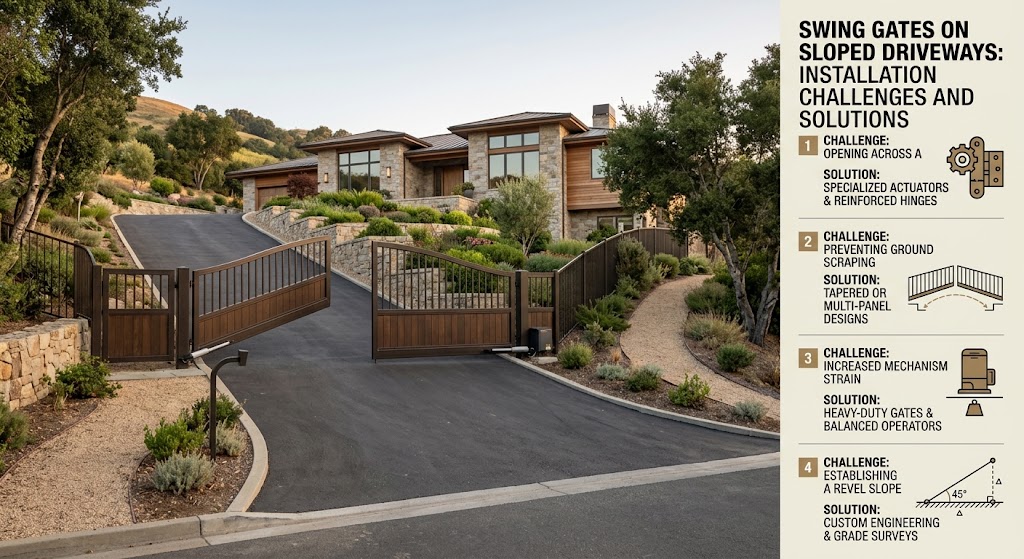
Last Updated on September 21, 2026 by Elegance
A swing gate on a sloped driveway can work, but it depends on which way the driveway slopes, how steep the grade is, the swing direction, ground clearance through the arc, and how the gate is automated. A gentle, evenly graded driveway can be straightforward for a correctly designed swing gate. A steep uphill, downhill, or cross-sloping site usually needs custom gate geometry, hinge design, or automation settings rather than an off-the-shelf configuration. The best way to know whether a swing gate will work is to assess the driveway layout, slope, and available clearance before choosing the design.
Quick Answer: Can Swing Gates Work on Sloping Driveways?
In many cases, yes, with qualifications. A swing gate can be designed to work on a sloped driveway once the slope direction, gradient, opening arc, ground clearance, and automation are matched to the site. The steeper or more uneven the slope, the more the gate depends on custom geometry rather than a standard configuration, and very steep or heavily cross-sloped sites are sometimes better solved with a different gate configuration entirely.

First, Identify How the Driveway Slopes
Before choosing a gate, it helps to know which of three slope types applies, since each creates a different clearance or geometry problem. The same driveway can create very different gate challenges depending on whether the slope runs with the direction of travel or across the gate opening.
| Slope Type | What It Means | Main Challenge for a Swing Gate |
|---|---|---|
| Uphill toward the house | Driveway rises from the street | The rising surface can intersect the swing arc unless clearance or hinge geometry accommodates it |
| Downhill toward the house | Driveway falls from the street | Clearance and safe stopping positions still need to be checked through the full arc |
| Cross-slope across the opening | Ground drops from one side of the opening to the other | Each leaf meets a different ground level, complicating a level bottom edge and closed-gate alignment |
Why a Standard Swing Gate Can Struggle on a Slope
Understanding how a swing gate on a sloped driveway behaves starts with clearance, movement, and the direction of the slope. A standard swing gate is usually designed around a near-level opening arc. On a slope, that assumption can break down: the bottom edge needs enough ground clearance as it swings, but the ground height changes through the arc.
Conventional hinge geometry does not make the gate face follow a rising driveway surface. If clearance is inadequate and the gate drags or strikes the ground, that can place additional stress on hinges, posts and, where automated, the drive system. On a conventional vertical hinge, the driveway slope primarily creates a clearance problem rather than automatically creating a gravity load. Where rising hinges or other geometry lift the gate vertically during movement, that lift becomes an additional automation consideration.
Design Options for a Sloped Driveway
There are several ways to make a swing gate work on a slope, but each option solves a different problem. Raked gate panels can help where the ground level changes across the width of the closed opening, because the bottom or rail geometry can be designed around that cross-slope. They do not automatically solve a driveway that rises into the gate’s swing arc.
Rising-hinge assemblies, which lift the gate as it opens, can create extra clearance on some sites but are not a universal fix for every slope, gate weight or automation system. Swing direction and leaf split, a single leaf versus a divided double-leaf gate, also change how much ground each leaf crosses during its arc. Whichever approach is used, the final geometry needs to be confirmed against measured site dimensions rather than a general description of the driveway.
What Changes When the Gate Is Automated?
Automating a swing gate on a slope adds another layer of assessment based on the actual gate geometry and site conditions rather than a generic configuration. The operator needs to suit the finished gate’s leaf dimensions, mass, hinge geometry and operating conditions.
“The limits to this measurement allow you to pick the most suitable operator”
Source: CAME, Swing Gate Operators (live checked 6 September 2026). View the manufacturer source.
CAME uses this wording when explaining the relationship between the post/rotation-axis dimension and operator selection. It supports the broader point here: automation should be selected around the actual gate geometry, not from gate weight alone.
Where rising hinges or other geometry lift the leaf during opening, the drive may need to handle that additional vertical movement as well as the gate’s normal swing. Stops, force settings, and safety devices such as obstacle detection must be specified and commissioned for the actual installation. A manual release and suitable backup operation should also be considered where loss of power would prevent normal access. Automated systems should be designed and installed in accordance with current manufacturer instructions and the applicable Australian requirements for the installation, including the applicable edition of AS/NZS 60335.2.103 for electric gate drives.
When a Sliding Gate May Be the Better Configuration
On some sloped sites, a sliding configuration can avoid the swing-clearance problem because the gate travels parallel to the boundary rather than through an arc across the driveway. This can suit sites where the driveway rises sharply into the available swing area or where inward clearance is limited. A sliding gate still needs its own assessment of side return, crossfall along the travel path, supporting structure and surface preparation.
For the broader configuration decision rather than this slope-specific question, see swing vs sliding driveway gates.

What Should Be Measured Before Choosing a Gate?
A useful preliminary check covers:
- Opening width, measured at the top, middle, and bottom
- Gradient and direction of the slope through the opening
- Cross-fall across the width of the opening
- Available swing arc, or side return for a sliding alternative
- Fence-line and run-back space
- Drainage at the base of the opening
- Driveway surface and condition
- Vehicle clearance and usual parking position
- Power availability for automation
For the wider measurement process, see wrought iron gate measurements. These measurements support an initial discussion, but final dimensions and geometry still need to be confirmed on site.
Planning a Swing Gate for a Sloped Melbourne Driveway
Because every sloped driveway creates different clearance and movement challenges, the design should reflect the property’s slope, available space, and how the gate will operate. For a swing gate on a sloped driveway, a custom-measured approach usually provides a more reliable result than trying to adapt a standard gate design. A site measure allows the slope to be assessed alongside the gate design, hinges and automation as one specification rather than as separate afterthoughts.
Explore wrought iron driveway gates for the commercial driveway-gate service. If automation is part of the project, the guides to automated vs manual wrought iron gates and gate automation cost in Melbourne cover those decisions in more detail.
Frequently Asked Questions
Can a swing gate open uphill on a sloped driveway?
Sometimes, but uphill opening is often the most clearance-sensitive arrangement because the ground rises into the gate’s arc. It may require additional bottom clearance, rising-hinge geometry or another custom solution. Whether automation must work against gravity depends on the hinge and pivot geometry, not the driveway slope alone.
What type of gate is best for a steep driveway?
There’s no universal answer. A sliding configuration can avoid the swing-clearance problem on some steep or uneven sites, but the right choice depends on available side space, slope direction, crossfall and the measured layout.
Can an automatic swing gate work on a slope?
It can, provided the operator, hinge geometry, force settings, safety devices and gate clearances are specified for the actual installation rather than assuming a flat-ground configuration will perform the same way.
Do rising hinges solve every sloped-driveway gate problem?
No. Rising hinges can create additional clearance on some sites, but they also change the gate’s movement and automation requirements. Very steep or cross-sloped sites may still need a different configuration or custom engineering.
What measurements are needed before a sloped-driveway gate is designed?
Opening width, slope gradient and direction, cross-fall, available swing arc or side return, ground clearance and vehicle clearance are the main starting points, confirmed during a site measure.


If a driveway has a fairly steep uphill slope, how do you normally decide between using rising hinges and changing to a sliding gate altogether? Is there a certain gradient where a swing gate becomes impractical even with custom hinge geometry?
For an automated swing gate on a sloped driveway, does the slope usually affect the type or power of the gate motor you would recommend, or is the hinge geometry and weight of the gate more important when selecting the operator?