

Last Updated on October 5, 2026 by Elegance
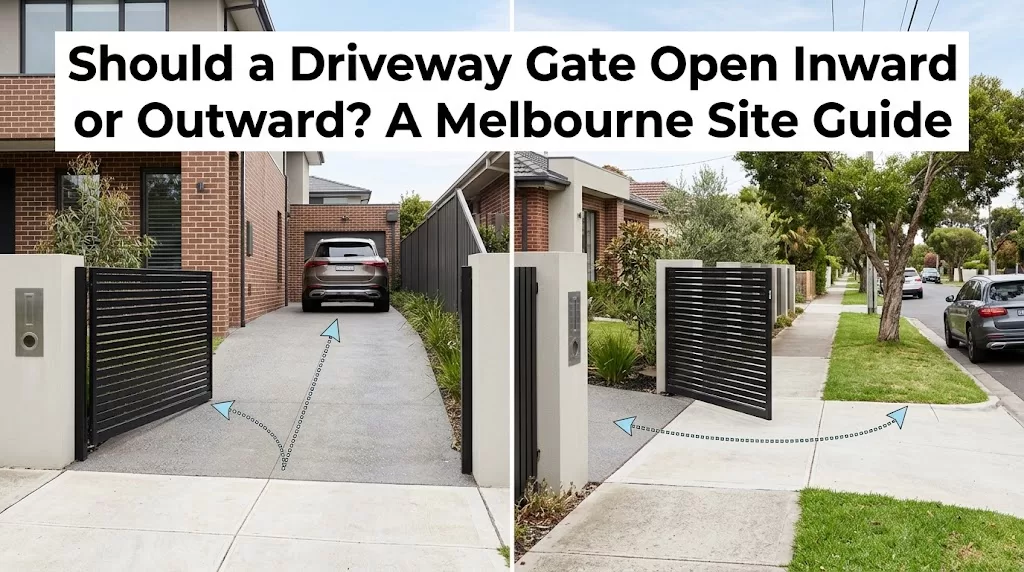
Should a driveway gate open inward or outward? Inward opening is often the simpler starting point because the gate moves into private property. However, an uphill driveway, limited internal space or parked vehicle can make that arc impractical. Outward opening may then be worth assessing if the gate can remain within suitable private space without creating boundary or access conflicts. For the broader service context, see custom wrought iron driveway gates.
The right driveway gate swing direction comes from plotting the full swing arc against the driveway, vehicles, slope and property boundary.
Inward vs Outward Driveway Gates at a Glance
| Site factor | Inward-opening gate | Outward-opening gate |
|---|---|---|
| Swing area | Uses space inside the property | Needs suitable private space in front of the gate |
| Boundary | Easier to contain within private property | Arc must be checked against the title boundary, footpath/road reserve and setback |
| Upward slope | Ground clearance may restrict the inward arc | May avoid an internal uphill clearance conflict |
| Internal parking | Vehicles can obstruct the arc | Can preserve more internal driveway depth |
| Vehicle waiting space | Gate position affects where a vehicle can wait inside | Setback must leave a practical waiting position |
| Street-side movement | Usually keeps the arc away from the street side | Needs closer attention around pedestrians, cyclists and vehicles |
| Main question | Is the full private inward arc clear? | Can the full outward arc remain within suitable private space without conflicting with the boundary or public movement area? |
Why Inward Opening Is Often the Starting Point

Keep the Swing Within Private Space
An inward opening driveway gate swings away from the street and into the property. Elegance in Iron’s current driveway-gate guidance uses a level driveway with sufficient inward setback as the starting point for assessing a swing gate.
That does not mean inward opening suits every property. It still needs enough usable private space.
Plot the Entire Arc
Driveway depth alone does not establish usable swing gate clearance.
Plot the gate arc with the vehicle where it normally parks or waits. Garage walls, angled fences, retaining walls, landscaping and other obstructions can reduce the usable space even where the driveway initially appears large enough.
When Outward Opening May Be Considered
Limited Space Behind the Gate
An outward opening driveway gate can be considered where an inward arc conflicts with a garage, parked vehicle, curved driveway or another internal obstruction.
On a curved driveway, check whether the leaf cuts across the usable vehicle path as it swings rather than looking only at the available depth.
An Uphill Driveway Can Change the Choice
Where the driveway rises toward the house, an inward-moving leaf may encounter the rising surface.
The practical question is whether suitable clearance can be maintained through the proposed arc. If not, outward opening, altered gate geometry or another configuration may need to be explored.
Detailed slope solutions belong in the separate swing gates on sloped driveways guide.
Property Boundary, Footpath and Pedestrian Exposure
Know Where Private Property Ends
For Victorian properties, it is useful to distinguish the private driveway or accessway within the property from the crossover and road-reserve area connecting it with the road. That external area may include a footpath, nature strip or kerb.
Space outside the gate may therefore look usable without actually being private space available for an outward swing.
Confirm the Boundary Before Designing the Arc
Do not treat a fence line, kerb or footpath edge as proof of the title boundary.
Verified External Source
“gates must not swing out over the title boundary or footpath/road reserve”
This wording appears on the City of Stonnington — Fences page in the council’s list of front-fence and boundary requirements. In the same section, the council states that retaining-wall work must not cross the title boundary and that fence structures, including footings, must remain within the property. This directly supports the caution in this article that an outward gate layout should not be finalised by assuming that visible space near the footpath is available private land. The rule cited here is from Stonnington; property-specific controls should still be checked with the relevant council for the actual site.
Source: City of Stonnington, Fences. View live source
Some Melbourne councils expressly state that gates must not swing over the title boundary or footpath/road reserve. The controls applying to the individual property should still be verified before an outward layout is finalised.
Gate Setback and Vehicle Waiting Space
Setting a gate farther inside the property can change the inward vs outward gate decision.
A private setback may provide enough room for an outward arc while keeping the leaf inside the property. But the new gate position also changes where a vehicle can wait while the gate is closed.
Check whether the waiting vehicle can remain in a practical position without obstructing the footpath or road reserve. Visibility matters too: can someone approaching along the footpath or driveway clearly see the space through which the gate moves?
How Opening Direction Affects Automation
Can an Automatic Gate Open Outward?
Potentially, yes. Compatible automatic swing gates can open outward, but direction can change where the automation hardware sits relative to the hinges and posts.
Motor position, bracket geometry and clearance need to suit the proposed layout. Once the swing direction is established, the separate linear vs articulated swing gate motors guide can help with the operator decision. For broader budgeting, see gate automation cost in Melbourne.
Single vs Double Gates and the Swing Arc
For the same entrance width, dividing the opening between two leaves reduces the arc radius of each leaf compared with one full-width leaf. That can help where driveway depth or nearby obstructions constrain the swing.
It does not make double gates automatically suitable. Posts, the centre meeting point, slope and automation still need to work with the site.
For the configuration decision, see single vs double driveway gates.
Check Who Uses the Swing Area
The space the gate moves through should be considered alongside the paths used by residents, visitors, pedestrians, cyclists and vehicles.
This matters particularly near the street side of the property or where walls, landscaping or the gate itself limit visibility.
Detailed automated-gate safety measures belong in the automatic gate safety guide. Here, the priority is identifying who or what may occupy the gate path.
What If Neither Direction Works?
A swing gate should not be forced into a driveway without enough usable space.
Where neither direction provides adequate clearance, a sliding gate may preserve driveway depth by moving parallel to the boundary. It needs sufficient side return and suitable site conditions of its own.
The next step is to compare swing vs sliding driveway gates, or another site-suitable configuration, rather than choosing between two impractical swing directions.
A Quick Gate-Direction Decision Flow
1. Is there enough clear private space for the full inward arc?
If yes, assess inward opening first.
2. If not, what blocks it?
Plot the slope, parked or waiting vehicle, garage, retaining wall, fence, landscaping and driveway shape.
3. Is there enough private setback for an outward arc?
Check the title boundary, footpath/road reserve, vehicle waiting space and street-side users.
4. Neither direction works?
Assess sliding or another configuration suited to the site.
Inward vs Outward Gate: Which Direction Fits Your Site?
| Site condition | What to assess |
|---|---|
| Level driveway with clear private swing space | Assess inward swing first |
| Inward arc conflicts with slope or fixed obstruction | Check clearance; compare outward setback or another configuration |
| Curved or angled layout restricts leaf movement | Plot the full inward arc; compare outward, relocation or sliding |
| Vehicle normally occupies the inward arc | Reconsider gate position, parking or configuration |
| Inward arc is blocked but private setback exists in front | Assess outward opening against boundary, waiting space and pedestrian conditions |
| Outward arc approaches a footpath or road reserve | Do not finalise the layout until the boundary and applicable controls are verified |
| Neither direction provides adequate clearance | Assess sliding or another site-suitable configuration |
| Existing gate is being automated | Check direction, hinges, posts, vehicle use and motor geometry |
Check Property-Specific Controls Before Fabrication
Heritage overlays or other applicable property controls may affect gate position, height, appearance or proposed works. An owners corporation may also have relevant requirements.
What applies varies by property, so verify relevant controls before fabrication rather than relying on a general Melbourne rule.

Site Checklist Before Choosing the Gate Direction
Before confirming the gate opening direction, record:
- title boundary and proposed gate setback
- driveway width, shape, slope and crossfall
- clear inward and outward swing arcs
- angled fences, retaining walls, landscaping and other obstructions
- normal vehicle parking position
- vehicle waiting space with the gate closed
- footpath, nature strip and road reserve
- sight lines at the entrance
- single or double-leaf configuration
- automation requirements and, if relevant, available power.
Useful photos include street and inside views, both posts or piers, the proposed swing arc, nearby obstructions, garage and normal vehicle position. For a broader measurement checklist, see wrought iron gate measurements.
Elegance in Iron’s current driveway-gate guidance asks homeowners for these site views and details during preliminary planning, before final fabrication dimensions are verified through a professional site measure. The wider project sequence is covered in driveway gate installation.
Frequently Asked Questions
Should Driveway Gates Open Inward or Outward?
Inward opening is often the practical starting point where there is sufficient private swing space. Outward opening may suit sites where slope or internal obstructions prevent an inward arc, provided the boundary, setback, vehicle waiting area and surrounding gate path allow it.
Can Automatic Gates Open Outwards?
Yes, where the site and equipment allow it. Outward movement can change motor position, bracket geometry and clearance, so the automation must suit the actual gate layout.
Can a Gate Swing Over a Footpath?
Some Melbourne councils expressly state that gates must not swing over the title boundary or footpath/road reserve. Confirm the title boundary and controls applying to the specific property before finalising an outward swing near public space.
What If My Driveway Slopes Upward From the Street?
An upward slope can reduce clearance beneath an inward-moving gate. Plot the proposed swing against the driveway surface before comparing inward, outward or alternative configurations.
Does Outward Opening Need Different Automation?
It can. Outward movement may change motor and bracket positions, hinge geometry and available clearance. Confirm the automation layout after deciding the gate direction.
Is a Sliding Gate Better if There Is No Swing Space?
It may be. A sliding gate avoids using driveway depth for a swing arc, although it requires adequate side return and suitable site conditions.
Can a Double Gate Open in Different Directions?
Mixed-direction leaves should not be treated as a standard solution. An unusual arrangement would need to be deliberately designed around both gate paths, hinges, posts, automation and safety requirements.
Choose the Direction From the Site
Whether a driveway gate should open inward or outward comes down to the space available for the complete gate path. Plot the swing against the slope, parked and waiting vehicles, setback, verified boundary, sight lines and street-side movement before deciding.
Elegance in Iron designs, fabricates and installs custom wrought iron driveway gates for Melbourne properties, with final fabrication dimensions verified during a professional site measure. The practical next step is to establish the site’s geometry first, then confirm the gate configuration and automation around that measured layout.


