

Last Updated on October 27, 2026 by Elegance
To choose a self-closing gate closer, match it to the gate’s weight, width, hinge arrangement, mounting space and latch. Then compare how each unit controls closing speed, not just whether it can pull the gate shut. A closer can’t repair a sagging gate, and self-closing doesn’t mean self-latching.
This guide is for Melbourne homeowners fitting a closer to a manual pedestrian gate, new or existing. Whatever you fit relies on sound structure and hardware, so stiff hinges or an unstable post need repair first. For powered vehicle entrances, see our Automatic Gate Safety: Sensors, Entrapment Protection & Australian Requirements.
Closer, Hinge, Latch and Lock Do Different Jobs
Each does a different job.
- Hinges support the gate’s weight and allow the leaf to swing around its hinge axis.
- A closer supplies or controls the movement that returns an opened gate towards its closed position.
- A latch catches the gate when it reaches the receiving post or frame, holding it closed.
- A lock restricts unauthorised opening through a key, code or another access mechanism.
Some products combine the hinge and closer into one assembly. You still need a latch if the gate must stay closed.
A gate can swing back into position yet stop just short of engaging its latch. It may look closed without being secured. Equally, a latch can engage without the gate being locked.
Reliable latching depends on closing force, hinge alignment, latch position and the receiving post working together. Closing alone proves neither security nor compliance with any standard.
Official Victorian building safety guidance · verified quotation
“have self-latching and self-closing gates”
This wording is from the “If you are planning to get a pool or spa” section of the Building and Plumbing Commission (Victoria) guidance titled “Pool safety barriers.” That section explains that Victorian pool and spa barriers are governed by the Building Regulations 2018 and must meet AS 1926.1-2012. It illustrates why this article distinguishes returning a gate to its closed position from positive latch engagement: a general-purpose closer alone does not prove that a pool barrier or its complete gate assembly meets the applicable requirements. For existing barriers, the same government guidance recommends checking with the local council or building surveyor about alterations. Primary source: Building and Plumbing Commission, “Pool safety barriers”.
For access security, compare gate lock options (see Best Lock Options for a Secure Gate) separately from the mechanism that returns the gate to its closed position.

Compare Spring Hinges, Hydraulic Closers and Hinge Closers
A self-closing hinge and a separate gate closer are not always interchangeable. Their capacities, mounting requirements and control features depend on the model.
| Arrangement | Selection focus | Avoid assuming |
|---|---|---|
| Self-closing hinge | Gate limits, hinge compatibility and available closing force | Every hinge controls closing speed |
| Separate gate closer | Mounting faces, swing geometry and movement control | It fits every existing hinge layout |
| Hydraulic hinge closer | Integrated support, closing action and mounting specifications | One capacity applies to all models |
| Latch or lock | Reliable engagement and access requirements | A closer replaces the latch |
Spring hinges
A self-closing hinge uses stored spring energy to return the gate towards its closed position. Some have adjustable spring tension, yet tension alone can’t control speed through the whole swing.
On a straightforward pedestrian gate they can work well, provided the product’s specifications match the gate and its supports.
Separate hydraulic gate closers
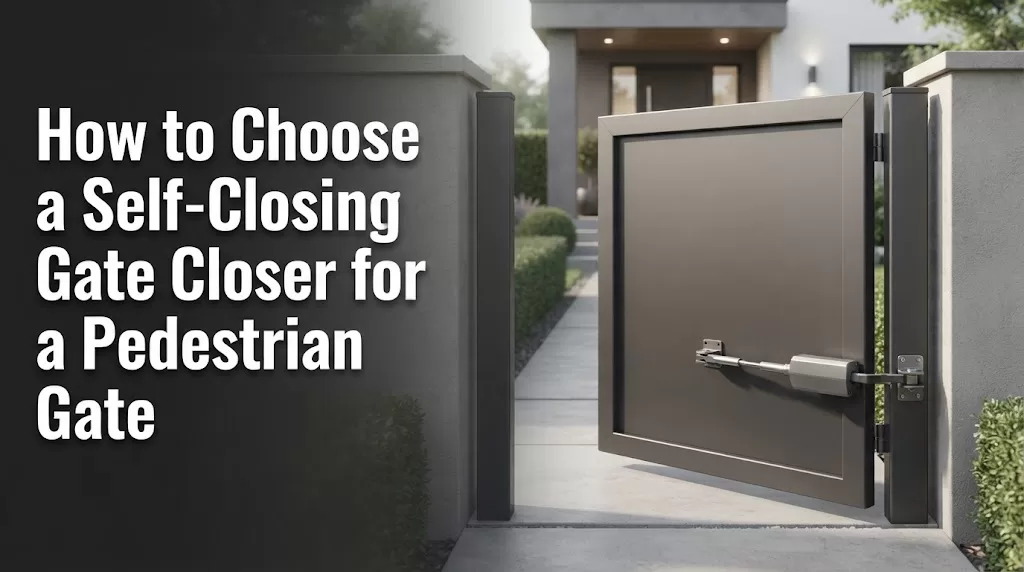
A separate closer works alongside the gate’s hinges rather than replacing them. Some models use a spring for closing energy and hydraulic damping to regulate movement, so spring-powered and hydraulically controlled aren’t opposing categories. Locinox describes its gate closers this way, and several of its models offer adjustable closing speed and final action.
Integrated hydraulic hinge closers
D&D Technologies’ SureClose ReadyFit is an example of an externally mounted hydraulic hinge-closer. Its published specifications include particular gate dimensions, mounting requirements and hinge-to-post gaps.
Another integrated closer will have different limits, so read the exact model sheet.
Read the Weight and Width Limits Together
A weight rating on its own won’t tell you which closer to buy.
A gate’s width changes how its load acts through the hinges and closer. Height, construction, hinge position and the way the leaf opens also affect which product suits it.
A heavy, narrow gate and a lighter, wide one load the hardware differently.
Record these details for your gate, then compare them with each candidate’s current Australian technical sheet, limits and installation drawings:
| Specification | Information to record |
|---|---|
| Gate weight | Actual or professionally assessed mass in kilograms |
| Gate width and height | Leaf dimensions in millimetres |
| Hinge arrangement | Type, position and hinge-axis geometry |
| Opening direction | Inward or outward swing, viewed from the street side |
| Mounting surfaces | Gate frame and post material, size and condition |
| Gate-to-post gap | Measured clearance at the proposed mounting position |
| Opening requirements | Required swing angle and surrounding clearance |
| Latch | Type, alignment and engagement requirements |
| Expected use | Household traffic and exposure conditions |
If the data sheet doesn’t cover your combination of dimensions and mounting conditions, ask the supplier or installer instead of relying on one weight figure.
For planning the clear opening before choosing hardware, see What Size Should a Pedestrian Gate Be?.
Check the Gate Before Adding a Closer
A closer returns a gate that already works; it can’t make up for a mechanical defect.
Before selecting hardware, watch the gate in ordinary, safe use. Don’t dismantle the hinges or force a damaged gate through its swing.
Look for:
- Stable supports: Posts and fixings show no obvious movement or deterioration.
- Free movement: The gate swings without catching, binding or scraping.
- Alignment: Uneven gaps can mean the leaf has dropped or twisted.
- Hinge condition: Watch for looseness, unusual resistance or visible damage.
- Latch engagement: The latch and receiving keep meet squarely.
If the gate sags, rubs or pulls its post out of alignment, arrange a structural or hardware assessment first.
For a broader checklist of dimensions, ground clearance and hinge-side details, refer to Wrought Iron Gate Measurements: What Homeowners Need to Know.
Hypothetical: the gate closes but misses its latch
An existing metal pedestrian gate swings freely towards its post but stops short of latching. Adding closing force isn’t the first fix. Assess the latch, keep, gate alignment and final movement, because the fault may sit in the receiving hardware. More force would close the gate harder without correcting the cause.
Mounting Space, Closing Control and Access
Even a closer with adequate rated capacity may not fit the entrance.
Match the manufacturer’s mounting drawing to the hinge-side space, gate frame, post material and size, mounting faces and nearby walls. The closer or its arm can project into the walkway.
The full opening arc matters, especially at compact entrances where steps, fences or planting restrict movement.
For narrow frontages, our Front Gate Ideas for Small Homes: Designing for Scale guide discusses entrance proportions and practical access.
How should the gate close?
The closer should let people open the gate comfortably, then return it under control.
Look for the manufacturer’s information on:
- Opening effort and resistance.
- Closing-speed control, where provided.
- Final closing action near the latch.
- Required opening angle and clearances through the full swing.
Where a unit offers a final closing action to help the gate reach its latch, it must still suit the latch and gate geometry.
A forceful return doesn’t prove the installation is correct or meets any accessibility requirement.
Hypothetical: a solid gate at an exposed entrance
Suppose a solid pedestrian gate faces an open, windy approach and the homeowner wants a controlled return. Ask for the closer’s operating limits, opening-effort information and mounting drawing, and assess the gate’s wind exposure and supports. Choosing by advertised weight capacity alone would miss how wind loading and opening effort affect daily use.
Weather Exposure, Retrofit and Handover
Outdoor hardware faces rain, temperature changes, airborne dirt and, in some locations, corrosive conditions.
Melbourne entrances vary from relatively sheltered courtyard gates to exposed side passages. Weigh the closer’s corrosion resistance, materials, finish and operating limits against the actual location.
Don’t assume any closer is windproof. Wind changes the forces on a gate, most of all on a solid leaf.
For an existing gate, confirm whether the proposed unit works with the current hinges, latch, frame and post. Some retrofits need different mounting hardware or alterations, which an installer should assess.
For compact pedestrian side entries and related hardware considerations, see Best Side Gate Ideas for Modern Homes in Melbourne.
Before accepting the completed work, request:
- The product’s model identification and technical information.
- An explanation of its normal closing and latching behaviour.
- Manufacturer maintenance instructions.
- Details of any compatibility limits or outstanding concerns.
- Guidance on when changes in operation require an inspection.
Keep these records for future servicing.
For the general care of external ironwork, read How to Maintain Wrought Iron Furniture & Gates (Complete Guide); the selected closer itself still requires its manufacturer’s maintenance instructions.

Self-Closing Gate Closer Checklist and Final Recommendation
Match the whole gate assembly to the manufacturer’s requirements, then choose the closer.
Before purchasing, confirm:
- The gate moves freely and its supports are sound.
- Weight, width and height fall within the model’s specifications.
- The hinge geometry and mounting faces fit the product.
- There is clearance for the required opening movement.
- The closing behaviour works with the latch.
- Opening effort suits the intended users.
- Outdoor exposure is within the manufacturer’s operating limits.
- The installer can provide product and maintenance information.
For a new, made-to-measure entrance, explore our Wrought Iron Pedestrian Gates range.
For an existing gate, have its condition and dimensions assessed before choosing between replacement hinges and a separate closer.
Frequently Asked Questions
Is a closer the same as a self-closing hinge?
Not always. A separate closer returns the gate while ordinary hinges keep supporting it. A self-closing hinge builds closing force into the hinge itself, and some integrated hydraulic hinge-closers also control movement. Which suits your gate depends on the model’s specifications and the mounting position.
Can a closer be fitted to an existing metal gate?
Yes, but only after checking its condition and mounting compatibility. The gate must move freely, have stable supports and offer the required mounting surfaces and clearances. An installer should compare the hinge layout, gate dimensions and latch with the closer’s technical instructions before recommending a retrofit.
Will a closer fix a sagging gate?
No. A sagging gate may have worn hinges, loose fixings, a distorted frame or an unstable post, and a closer doesn’t correct any of them. Have the cause assessed and repaired before choosing self-closing hardware.
Does a self-closing gate also lock?
No, not by itself. A closer moves the gate towards shut, a latch holds it closed and a lock controls access. A gate can return fully without engaging its latch, and a latched gate can still be unlocked. Check each function separately.
Can a garden-gate closer be used for a pool gate?
In Victoria, pool barrier gates must be self-closing and self-latching and are covered by separate rules (Building Regulations 2018 and AS 1926.1). A closer’s label or capacity doesn’t show compliance, so have the whole barrier, including latch and hardware, checked by your council or a building surveyor.


