

Last Updated on September 18, 2026 by Elegance
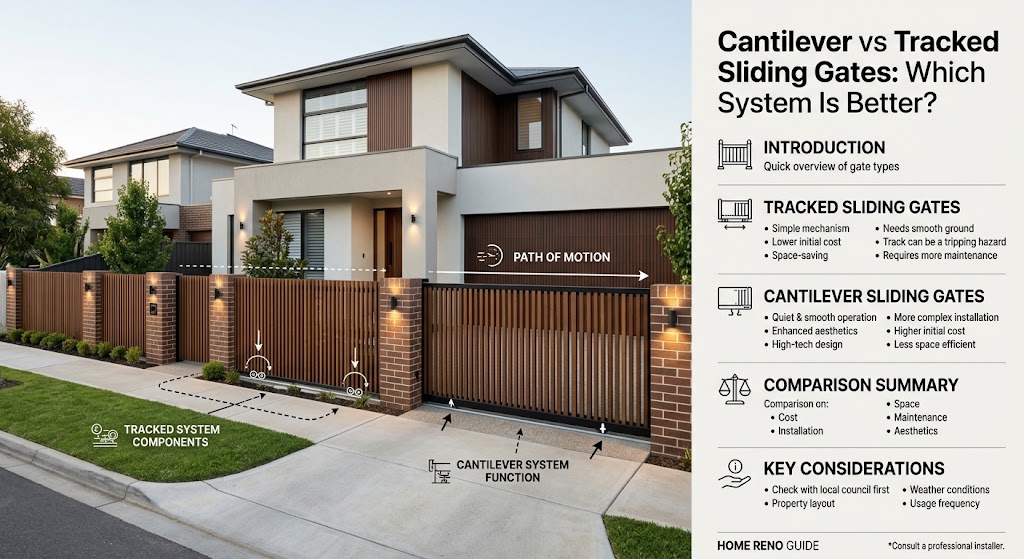
A cantilever sliding gate hangs clear of the ground on support posts and roller carriages, while a tracked sliding gate runs on wheels along a rail fixed into the driveway surface. Cantilever vs tracked sliding gate: which is better usually comes down to what your driveway surface does underneath the moving gate. A stable, well drained surface generally suits a ground track. An uneven, sloped or debris-prone entry usually suits a cantilever design better. Available run-back space, automation plans and how much ongoing upkeep you are prepared to do also factor into the decision. Below, we walk through how each system works, what Melbourne driveway conditions favour, and what to check before a sliding gate system is specified.

Cantilever vs tracked sliding gates: quick comparison
When you weigh up a cantilever vs tracked sliding gate for your driveway, the differences usually come down to a handful of practical factors. The table below sets out how a cantilever gate vs track gate compares across each one.
| Factor | Tracked sliding gate | Cantilever sliding gate |
|---|---|---|
| Support method | Wheels running along a fixed ground track | Roller carriages mounted on support posts set back from the opening |
| Ground track | Track fixed into the driveway across the full opening | No ground track across the opening |
| Surface dependence | Needs a stable, level, well prepared surface under the track | Less dependent on the driveway surface itself |
| Debris sensitivity | Track can collect leaves, stones and grit | Debris in the opening has little effect on gate movement |
| Structural support | Load carried mainly by the track and its footing | Load carried by robust posts and a counterbalance section |
| Run-back requirement | Roughly matches the opening width | Typically extends well beyond the opening width |
| Maintenance profile | Periodic track cleaning and alignment checks | Roller carriage and support post hardware checks |
| Best when | Driveway is level, stable and well drained | Ground track would be hard to keep clear or level |
How a tracked sliding gate works
A tracked sliding gate moves on a set of wheels fixed to the bottom of the gate frame. Those wheels run along a track set into the driveway across the full width of the opening, guiding the gate in a straight line as it opens and closes. Because the gate’s weight passes through the wheels and into the track, the condition of the driveway surface and how accurately the track is aligned have a direct effect on how smoothly the gate travels. A track that is out of level, cracked or partly buried in debris can make the gate bind, judder or run unevenly, and persistent binding also adds wear to the wheels and drive mechanism over time.
How a cantilever sliding gate works
A cantilever sliding gate is suspended clear of the ground. It runs on roller carriages mounted to support posts set back from the driveway opening, so the gate leaf never touches the driveway surface as it slides. To stay supported while extended across the opening, the gate frame includes a counterbalance section, sometimes called a tail, behind the clear opening. This means a cantilever system normally needs additional gate length and side run-back beyond the driveway opening itself. The exact counterbalance and run-back requirement depends on the gate system, leaf dimensions, weight, infill, wind exposure, hardware and structural design, so it should be confirmed from the selected system rather than assumed from a fixed ratio.
Driveway surface, drainage and debris
Surface condition affects both systems, just in different ways. A tracked gate depends on the driveway staying reasonably clear along the track line, and leaves, stones, mud and general grit can work their way into the track and affect how the wheels roll. This is worth checking closely on older driveways, where the surface was never built with a gate track in mind. A cantilever gate keeps the opening itself clear, which helps where debris tends to collect, but it is not maintenance free. Standing water, poor drainage or a shifting subgrade near the support posts can still affect how the gate performs over time, so drainage should be assessed for either configuration, not just the track path.
Foundations, structural support and available space
The biggest difference in a cantilever gate vs track gate comparison shows up in where the gate’s weight is actually carried, rather than in how the gate looks once installed. Because the entire gate leaf and its counterbalance are carried by the posts and roller carriages rather than the ground, cantilever posts typically need a more substantial footing, and the property needs enough side space to fit the extended gate length. On a sloping or reactive site, this can mean deeper or wider footings than a straightforward flat block would need. Tracked systems spread the load differently: the posts still carry some structural role, but a large part of the gate’s weight travels through the track and into the driveway itself, so a suitable, continuous travel path matters as much as the posts do. That extra structure on the cantilever side is also one of the main reasons it often involves additional cost considerations compared with a tracked system, since more posts, footings and hardware are typically involved; the exact difference still depends on the specific site, gate weight and hardware chosen, so it is best confirmed during a quote rather than assumed upfront.
Automation and day-to-day reliability
Both configurations can be automated, and in either case, smooth and repeatable movement is what makes daily automated use reliable. For the separate budget factors involved in the motor, controls and safety hardware, see gate automation cost in Melbourne. A gate that binds, drags or runs unevenly puts extra strain on the motor and its fittings over time.
“the weight of the gate leaf and the type of usage”
Source: FAAC, Sliding Gate Automation (live checked 9 September 2026). View the manufacturer source.
FAAC identifies gate-leaf weight and usage type as key operator-selection factors. That supports treating automation as part of the complete gate specification rather than choosing the motor independently of the gate, travel resistance and expected use.
The mechanical cause of that strain differs by system: a misaligned or debris filled track for a tracked gate, or a poorly set up roller carriage or support post for a cantilever gate. Over months of daily use, that difference tends to show up as more frequent servicing rather than a sudden failure, so it is worth keeping the underlying configuration in mind when discussing automation options.
Maintenance differences
A tracked gate’s main ongoing task is keeping the track clear and checking that it stays aligned, particularly after wet weather or where nearby trees drop leaves and debris. A cantilever gate shifts that maintenance to the roller carriages, guides, support hardware and alignment, which still need inspection even though there is no track across the driveway opening. The appropriate maintenance interval depends on the hardware, environment, use frequency and automation manufacturer’s instructions, so neither system should be treated as maintenance-free.

Which system suits which driveway?
Matching the system to the site is usually more useful than treating one option as universally better when it comes to cantilever vs tracked sliding gate decisions. If you are still deciding between the broader opening types first, see swing vs sliding driveway gates. These common scenarios cover most Melbourne driveways:
- Clean, level, paved entry with good drainage: a tracked sliding gate is often a straightforward, cost-effective fit.
- Debris-prone or uneven driveway where a ground track would be difficult to keep clear: a cantilever configuration usually performs more consistently.
- High use, frequently automated entrance: either system can work well, provided the track or post setup is properly maintained.
- Limited side space or run-back along the boundary: a tracked gate generally needs less additional length, which can matter on a tight block.
- Drainage constraints or a driveway prone to standing water: both systems need this addressed, but a cantilever gate avoids adding a track through the affected area. If your driveway does not fit neatly into one of these scenarios, a site assessment is the most reliable way to settle the question.
Questions to ask before choosing
Before a sliding gate system is specified, it helps to work through the following with whoever is measuring your site:
- What is the available run-back or side space along the boundary line?
- Does the driveway have any slope or crossfall across the opening?
- How well does the driveway drain, and is there any history of standing water?
- Is the entry prone to leaves, sand, gravel or other debris?
- What is the planned automation setup, and how often will the gate be used?
- What condition are the existing posts, piers or boundary structures in?
- Are there underground services near the proposed track or post positions?
- Is there a heritage overlay or other planning control that could affect the gate design? Working through these questions with a specialist before the gate is designed avoids surprises once fabrication begins, whichever cantilever vs tracked sliding gate configuration ends up suiting your entrance. A proper site assessment, covering slope, drainage, run-back space and automation needs, is what Elegance in Iron uses to shape thewrought iron driveway gates design around your specific conditions rather than a generic template.
Final thoughts
There is no single winner between a cantilever vs tracked sliding gate. A tracked gate can be a simple, economical fit where the driveway is level, well drained and easy to keep clear along the track line. A cantilever gate earns its keep on sites that are sloped, uneven or prone to leaves, sand and grit, where a ground track would be more trouble than it is worth. The right choice comes down to your own driveway surface, drainage, available run-back space and how much ongoing maintenance you want to take on. A site assessment is the most reliable way to settle it.
Frequently asked questions
Is a cantilever gate better than a tracked sliding gate?
When comparing cantilever vs tracked sliding gate options directly, neither system is universally better. A cantilever gate tends to suit sloped, uneven or debris-prone driveways, while a tracked gate can be a straightforward option on a clean, level, well drained entry with enough run-back space.
Does a cantilever gate need more side space?
Yes. A cantilever gate needs enough additional length behind the support posts to fit the counterbalance section, on top of the space needed for the opening itself, so available side space should be measured early in the design process.
Do tracked sliding gates have drainage problems?
A tracked gate is not automatically prone to drainage problems, but because the track sits at ground level, poor drainage or standing water near the track can affect how the gate runs, so drainage should still be checked during the site assessment.
Which sliding gate system needs less maintenance?
Both systems need some ongoing attention. A tracked gate mainly needs the track kept clear and aligned, while a cantilever gate shifts that maintenance to the roller carriages and support post hardware.
Can both cantilever and tracked gates be automated?
Yes, both configurations can be automated. The motor, gate weight, travel resistance and safety devices should be specified together as one system, regardless of which sliding configuration is used.


