

Last Updated on October 14, 2026 by Elegance
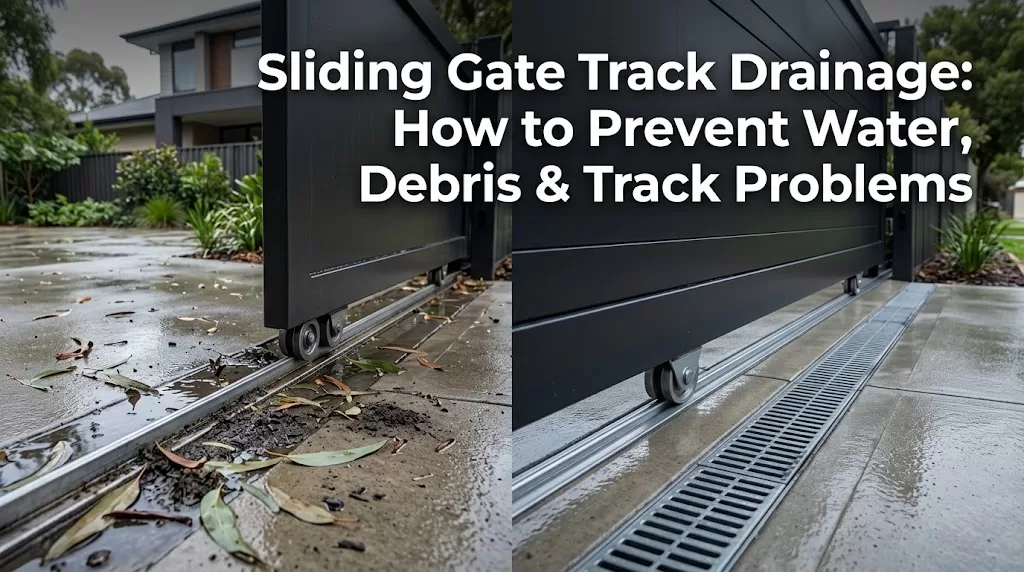
Sliding gate track drainage matters because a tracked gate depends on a stable, clear path at driveway level. Rain can move grit, mud, leaves and small stones onto the rail, increasing resistance at the wheels or exposing problems around the track base. For the wider entrance design and installation context, explore custom wrought iron driveway gates in Melbourne.
The right solution depends on where water comes from, where it can drain and how the driveway, track and run-back area are built. A motor cannot fix a stiff or poorly supported track; it only has to work against the extra resistance.

Quick answer: does a sliding gate track need drainage?
Yes. Sliding gate drainage is about keeping water and transported debris from interfering with the rail, wheels and supporting surface.
That does not mean every tracked gate needs a channel drain beside it. A driveway that already sheds water away from the gate may need no additional drain at the track. Another site may need drainage to be planned as part of the driveway and gate layout.
| What you notice | What it may indicate | Useful observation |
|---|---|---|
| Water remains across or beside the track | Runoff is collecting at the gate line | Where water arrives and where it goes after rain |
| Mud or grit keeps returning | Runoff is carrying material onto the rail | Nearby soil, gravel, garden beds or paving |
| Gate becomes noisy after rain | Track debris or increased resistance | Where the noise occurs and any visible debris |
| Wheel catches or gate hesitates | Obstruction, alignment or track condition | Stones, packed material or visible rail movement |
| Fault mainly appears after wet weather | Drainage may be contributing | Timing of the fault and what was visible at the time |
These signs narrow the problem. They do not prove that drainage, the wheels or the motor is the single cause.
Why water causes problems around a sliding gate track
Debris and grit enter the wheel path
A ground track sits directly in the driveway environment. Surface water can carry sand, grit, soil, mulch and leaves across it.
Official Victorian reference
“Stormwater can carry a wide range of pollutants, including sediments, oils, hydrocarbons and leaves.”
The Building and Plumbing Commission Victoria describes the material carried by stormwater generally. This supports checking where runoff is transporting sediment and leaves across a driveway, although the guidance is not a sliding-gate installation specification.
Source: Building and Plumbing Commission Victoria, Stormwater — read the official guidance.
Once sliding gate track debris builds up around the rail, the wheels no longer have the same clean travel path. That can make the gate rougher, noisier or harder to move.
The wheels transfer load into the track and base
The gate’s weight passes through its wheels into the rail and the structure beneath it. In practical terms, that roller load means the condition of the track support matters as well as the cleanliness of the rail.
Persistent ponding, cracking or movement around the track base can change how well that travel path is supported. The supporting ground beneath the base also needs to remain suitable for the installation.
No universal footing or subgrade detail applies to every driveway. The appropriate support depends on the gate and site design.
More resistance means more work for the operator
Water on a sliding gate track does not automatically damage the motor. The more common mechanical issue is indirect: water carries debris onto the rail, or changes around the track create additional resistance.
The operator then has to move the gate against that resistance. Gate weight and intended usage are among the factors manufacturers use when specifying sliding-gate operators, so the mechanical condition of the gate should be resolved rather than hidden by changing motor settings.
Wheels, alignment, the gate frame and its supporting structure can cause similar symptoms. Rain occurring at the same time as a fault is useful evidence, not proof of the cause.
Warning signs the track area is not draining properly
Drainage problems usually leave evidence around the gate before they become a major fault. The strongest clue is a pattern that keeps returning after rain.
Look for:
- water remaining along the rail after surrounding surfaces have drained
- a visible silt or mud line across the track
- grit, stones or mulch repeatedly collecting in the same section
- rougher or noisier travel after wet weather
- packed material around the wheel path
- runoff flowing from garden beds or loose surfaces towards the gate
- cracking or settlement around the track base
- visible movement of the rail
- a gate that appears to jump, bind or leave its normal wheel path
- water collecting around nearby automation or conduit locations
Recurring track contamination points towards the site as well as the gate. If you clean the same debris after every rain event, the useful question is where that material is coming from.
Suspected water ingress into powered equipment is different from rain touching the outside of outdoor equipment. If there are signs that water has entered electrical or automation components, or visible electrical damage is present, stop normal operation and arrange appropriate assessment. Do not open the enclosure yourself.
How drainage should be considered before the track is installed
A sliding gate track should be planned around the finished driveway rather than added without considering where water already travels.
Levels, crossfall and the runoff route
Crossfall is the sideways slope across a driveway. It influences whether water moves across, towards or away from the proposed gate line.
The first question is not simply, “How do we keep water off the rail?” It is also, “Where will that water go next?”
A site assessment should consider:
- current high and low points
- driveway crossfall
- where runoff enters the gate area
- where collected water can discharge
- existing drains
- nearby garden beds, soil and loose gravel
- the track position
- the gate’s run-back area
Moving water away from one metre of track only to create another low point beside the motor or gate return does not solve the site problem.
Channel drains need to work with the whole entrance
A channel drain can be useful where it forms part of the site design, but there is no rule that every tracked gate needs one.
Its position needs to work with the driveway levels, gate wheels, ground track and normal vehicle path. The design also needs somewhere appropriate for the collected water to go.
For that reason, channel-drain size, location and fall should come from the actual site requirements rather than a generic gate detail.
Run-back, motor position and future paving
The run-back is the side area into which the gate travels when opening. Drainage problems there can affect operation even if the vehicle opening remains clean.
Motor and conduit positions should also be considered against known low points and runoff paths, as well as the installation requirements of the selected equipment.
Future work matters too. New paving, concrete, asphalt, garden edging or landscaping can change finished levels and redirect runoff after the gate has been installed.
An older driveway may never have been designed around a ground-running gate. For Melbourne properties, it is useful to look at the entrance during or just after rain rather than judging drainage only on a dry site visit.
Track drainage vs cantilever gates
A cantilever gate removes the ground-running track from the driveway opening. This can be useful when the surface across the entrance repeatedly creates problems for a rail.
It does not remove the site’s drainage requirements. Water still needs an appropriate path, and the cantilever support area, posts, foundations and automation remain dependent on suitable ground and site conditions.
When drainage affects the choice:
- A tracked gate may suit the site when the rail can be properly supported, runoff does not create persistent ponding and the travel path can remain reasonably clear.
- A cantilever gate may be worth assessing when the driveway surface repeatedly creates problems for a ground track and there is suitable run-back space and support for a cantilever system.
Tracked sliding gate drainage is only one part of that decision. The full comparison also includes available space, supporting structures, driveway geometry, gate design and automation requirements.
For the broader system decision, the separate cantilever vs tracked sliding gates guide covers those factors in more detail.
What homeowners can safely maintain
Sliding gate track maintenance should stay simple and external. Before cleaning near an automated gate, follow the owner maintenance or shutdown precautions supplied for the installed equipment.
A gate being stationary does not necessarily mean it cannot move. Do not put your hands, tools or body into the travel area while unexpected powered movement remains possible, and do not improvise an isolation procedure that is not documented for your system.
Where the manufacturer’s owner guidance permits it, basic maintenance can include:
- observing where water travels after rain
- noting where silt or debris keeps returning
- removing loose leaves or stones that are safely accessible
- recording where a noise or hesitation was already noticed during normal operation
Do not run a gate again simply to see whether a serious problem repeats. Do not change track levels, wheel alignment or operator-force settings to compensate for poor movement.
For broader routine checks beyond drainage and track cleanliness, use the separate automatic gate maintenance guide.
When drainage becomes a professional repair or civil-work issue
Cleaning stops being the answer when the track, base or surrounding driveway has physically changed.
Stop using the gate for serious mechanical problems
Stop normal operation if the gate is derailed, unstable, severely binding or has obvious structural or track movement. Do not operate it again to confirm the symptom.
Professional gate assessment is also appropriate when:
- the track base has cracked or shifted
- wheels no longer follow the rail correctly
- the gate repeatedly becomes difficult to move after wet weather
- the rail has visibly moved
- runoff continually deposits material in the wheel path
- the problem started after paving, landscaping or other site work
Decide whether the gate or the site needs work
A technician can assess the gate, wheels, alignment and automation. Persistent ponding, subsidence or an unsuitable runoff path may also require drainage or civil-work input.
The two issues can exist together. Replacing or adjusting gate hardware will not correct a driveway that continues to move water and sediment through the same track area.
If water is suspected inside powered equipment, or there is visible electrical damage, stop normal operation and arrange prompt appropriate assessment rather than opening the motor or control equipment.

Planning sliding gate track drainage for a Melbourne driveway
A useful Melbourne site measure includes more than the width of the entrance. It should also show how the driveway behaves when wet.
Before an assessment, prepare:
- photos taken during or after rain showing ponding and runoff
- any obvious high or low points
- details of planned resurfacing, paving or landscaping
- available run-back space
- existing drains and visible runoff routes
- irrigation and nearby garden beds
- normal vehicle paths
- previous track movement or wet-weather faults
- any noise or binding location already observed
These details are useful for both new and existing gates. They help show whether the problem is likely to be a one-off obstruction, the gate hardware or a recurring site condition.
The how to measure for a driveway gate guide can help with preliminary site information, but final track, drainage, support and automation decisions should be confirmed during a professional site assessment.
If an existing gate has recurring drainage or track problems, or you are planning a new sliding or cantilever entrance, request a site measure from Elegance in Iron. The team designs, fabricates and installs custom driveway gates for Melbourne properties.
For a wider view of the project stages, see what to expect during a driveway gate installation.
Elegance in Iron’s Melbourne showroom is at 1367 Malvern Road, Malvern. Current published hours are 10 am–5 pm Monday to Friday and 10 am–3 pm Saturday. To discuss a site measure, call 0450 010 101.
FAQs
Can water damage a sliding gate track?
Water can affect a tracked gate in more than one way. It can carry abrasive debris into the wheel path, contribute to deterioration of susceptible materials or finishes, and accompany movement or deterioration around the supporting base. The actual effect depends on the track material, finish, condition and site.
Should a sliding gate track have a drain beside it?
Not necessarily. The decision depends on the driveway levels, where runoff comes from, where collected water can go and how a drain would interact with the track and vehicle path. A drain is useful only when it forms part of a workable drainage route.
Why does my sliding gate get noisy after heavy rain?
Rain can carry grit, mud or stones into the track, increasing resistance at the wheels. Follow the documented owner precautions before any permitted cleaning and do not repeatedly cycle a noisy gate. If the noise remains, report where it occurs and whether debris, rubbing or hesitation was already visible.
Can a cantilever gate solve a driveway drainage problem?
A cantilever gate can remove the ground track from the driveway opening, which avoids one point where water and debris can interfere with gate travel. It does not repair poor driveway drainage. Changing the gate arrangement and correcting the site’s water-management problem are separate decisions.
Should the track be level if the driveway slopes?
A tracked gate generally needs a properly prepared travel path, but driveway crossfall and gate travel geometry are different things. A sloping driveway therefore needs assessment before the rail arrangement is specified. The permitted track geometry comes from the selected gate system and site design, not a universal slope rule.
Can poor drainage make an automatic sliding gate stop or reverse?
Yes, indirectly. Debris or track movement associated with poor drainage can increase mechanical resistance, and some gate operators can respond to detected resistance or obstruction by stopping or reversing. Useful clues are where the problem was already observed, whether debris was visible and whether it followed wet weather; none proves drainage is the sole cause.


