

Last Updated on September 28, 2026 by Elegance
The linear vs articulated gate motor decision usually starts with hinge and post geometry. Compatible mounting geometry can favour a linear motor, while a deep hinge setback or wide pillar may make an articulated arm worth assessing. Gate size, wind exposure, opening direction, available clearance and daily use then narrow the choice. If the gate itself is being specified at the same time, see Custom Wrought Iron Driveway Gates Melbourne.
Neither swing gate motor type is universally better. The installer needs the hinge position, post dimensions, mounting clearance and leaf specification before confirming which operator will work correctly.

Linear vs Articulated Gate Motors at a Glance
| Factor | Linear / ram motor | Articulated arm motor |
|---|---|---|
| Movement | Straight-line actuator movement | Jointed arm folds and unfolds |
| Hinge setback / post geometry | Requires compatible linear mounting geometry | Can suit some deeper setbacks and wider piers |
| Mounting clearance | Needs correct mounting points and actuator travel | Needs clearance for the arm’s operating envelope |
| Gate size / weight | Model-specific limits | Model-specific limits |
| Opening angle | Depends on model and mounting geometry | Depends on model and mounting geometry |
| Appearance | Less visually prominent on many installations | More visible arm assembly |
| Duty cycle | Model-specific | Model-specific |
| Best starting question | Can the required mounting geometry be achieved? | Does the post/hinge arrangement favour a folding arm? |
How Does a Linear Gate Motor Work?
Straight-Line Movement
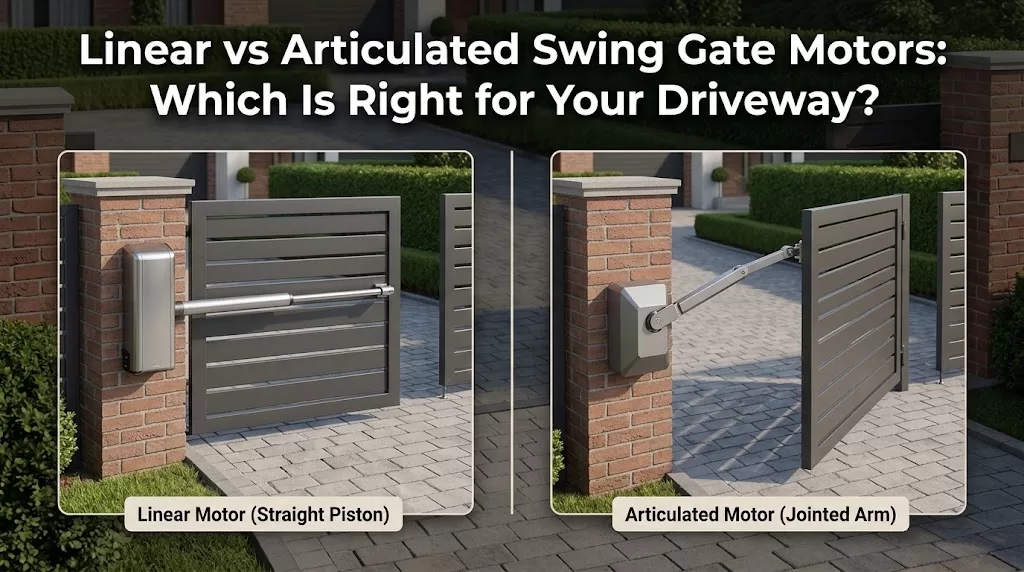
A linear gate motor, also known as a ram gate motor, mounts between the supporting structure and gate leaf. The actuator extends and retracts, turning straight-line movement into the gate’s swinging motion.
A linear swing gate motor can provide a relatively compact installation where the gate, hinge and post geometry give the actuator suitable mounting positions.
Manufacturer Mounting Geometry Matters
The hinge centre, rear motor mounting point and gate-side mounting point need to work within the geometry specified for the particular operator.
These dimensions vary between models, so there is no useful universal hinge-setback figure. Mounting geometry can also affect the opening angle available from a particular operator; an advertised maximum angle should not be assumed to apply to every installation.
How Does an Articulated Arm Gate Motor Work?
Why Articulated Arms Suit Some Deeper Setbacks
An articulated arm gate motor uses a jointed arm between the motor and gate leaf. As the gate moves, the arm folds and unfolds.
Wide masonry piers, recessed hinges or physical mounting obstructions are common reasons to assess an articulated swing gate operator, because its movement can accommodate some arrangements that are difficult for a straight actuator.
Verified External Source
“Articulated arm solutions are versatile and reliable.”
This sentence appears under the “Articulated arm systems” section of CAME’s official Swing gate operators page. In the same section, CAME explains that articulated-arm systems are designed to adapt to different installation layouts, including settings with larger pillars, and defines “C max” as the centre-distance between the inner corner of the post and the gate’s rotating axis. That manufacturer context is directly relevant here because post depth and hinge setback can change which operator geometry is practical. It does not mean an articulated arm is automatically correct for every wide pillar; the selected model’s limits and the measured site geometry still need to match.
Source: CAME, Swing Gate Operators. View live source
That is not a rule that “wide pillar equals articulated”. The actual hinge position, clearances and manufacturer’s permitted geometry still determine suitability.
Allow for the Arm’s Movement
An articulated arm needs enough space to move through its operating envelope.
Nearby walls, fencing, landscaping or other structures can restrict that movement. These clearances should be measured before choosing the operator.
Post, Pier and Hinge Geometry
Measure From the Hinge Centre
Pillar width alone does not determine motor choice. The useful measurement is where the hinge centre sits relative to the post or pier and the positions available for the motor and brackets. For the wider site-measure process, see wrought iron gate measurements.
This is particularly important when assessing a gate motor for masonry pillars.
Deep-Set Hinges and Wide Masonry Piers
A deeper hinge setback can make linear mounting geometry more difficult, which is why articulated operators are often assessed on substantial masonry piers.
The same gate leaf could therefore suit a linear operator on one set of posts and require a different solution on another. The gate has not changed; its mounting geometry has.
Mounting Strength Still Matters
Geometrically suitable does not automatically mean structurally suitable. The proposed motor position also needs an appropriate fixing and support arrangement for the selected operator.
This is why Elegance in Iron treats the motor, gate structure and supports as parts of the same specification. For new custom wrought iron driveway gates, planning those elements together provides more control than choosing automation after the gate and pillars are complete.
Gate Leaf Size, Weight and Wind Load
Check the Finished Gate, Not Weight Alone
Motor selection considers the gate leaf’s width, height and operating weight together with the operator’s permitted geometry and manufacturer limits.
A nominal gate-weight figure by itself cannot establish suitability. For double gates, the number and arrangement of powered leaves also affect the project; the separate single vs double driveway gates guide covers that configuration decision.
Infill Changes Wind Exposure
Solid or privacy infill increases the area presented to wind compared with a more open gate design.
Elegance in Iron already includes wind exposure and solid infill area in its automation assessment. On exposed Melbourne sites, the motor should therefore be specified for the finished gate rather than an open frame before infill is added.
Opening Angle, Swing Direction and Side Clearance
The required opening angle must be achievable with the operator’s permitted mounting geometry.
Swing direction matters too. An inward-opening and outward-opening gate can require different operator positions or bracket arrangements, so direction should be identified during the site measure rather than assumed later.
Nearby walls and other obstructions also matter. A linear actuator needs suitable mounting positions and travel, while an articulated arm needs clearance through its full movement.
If the driveway has not yet been assessed for a swing gate at all, resolve swing vs sliding driveway gates before comparing swing operators.
Duty Cycle and Daily Gate Use
Duty cycle is a model-specific operating limitation rather than an inherent advantage of linear or articulated motors.
The assessment should consider how often the gate is expected to move, including periods of concentrated use, rather than relying only on a rough daily total.
For entrances with higher traffic, compare the expected operating pattern with the specifications of the actual motor being considered.
Appearance and Visible Hardware
Linear actuators are less visually prominent on many installations, while an articulated operator has a more obvious jointed arm.
For decorative gates, that difference can influence the shortlist—but only after geometry, capacity and clearance have been resolved.
What If You Want the Motor Concealed?
Underground operators are another option where reducing visible automation hardware is a major design objective.
They bring different site considerations, including groundwork, drainage and future service access. They are therefore an alternative worth assessing where appearance justifies it, rather than a third contestant in this linear-versus-articulated comparison.
Motor Selection Is Only Part of the Automation System
The motor must work with the gate structure, supports, power arrangement, access controls and safety system.
Manual release and backup operation should also be considered when the motor is specified. For detailed moving-gate safety considerations, see automatic gate safety rather than treating the actuator itself as the safety system.
Serviceability matters as well. Ask whether the motor, manual release and key service points will remain accessible after fencing, landscaping and pillar finishes are completed. The broader project sequence is covered in driveway gate installation.
What Affects Swing Gate Automation Cost?
Motor type is only one cost variable. Gate condition, mounting requirements, electrical work, safety equipment and installation complexity can also affect the project.
Detailed pricing belongs to the existing gate automation cost in Melbourne guide.
Which Motor Type Fits Which Site?
| Site condition | Configuration to assess |
|---|---|
| Compatible hinge/post geometry with suitable linear mounting points | Assess a linear operator |
| Deep hinge setback or wide pier restricting linear geometry | Assess articulated-arm options |
| Restricted space for an articulated arm | Check compatible linear geometry |
| Large, heavy or substantially infilled leaf | Check model capacity, geometry and wind exposure |
| Higher-frequency entrance | Compare model-specific duty cycle |
| Outward-opening gate or restricted side-wall clearance | Check model-specific operator and bracket geometry |
| Existing gate with worn hinges, movement or poor alignment | Assess gate and supports before automation |
| Visible automation is a major design concern | Assess suitable linear or underground options |
The aim is not to match a motor category to a visual description of the driveway. It is to eliminate options that do not suit the measured geometry and finished gate.

What to Measure Before Choosing a Swing Gate Motor
For swing gate automation in Melbourne, prepare or identify:
- gate leaf width and height
- gate construction and infill
- gate weight, or information needed for the installer to establish it
- post or pier dimensions and hinge setback
- available motor mounting locations
- opening direction and required angle
- nearby walls, fencing or other obstructions
- expected operating frequency
- wind exposure
- available power
- condition and alignment of existing gates, hinges and supports.
These factors give the installer enough site context to compare the required geometry with the manufacturer’s limits for a specific operator.
Frequently Asked Questions
Is a Linear or Articulated Gate Motor Better?
Neither is universally better. Compatible hinge and post geometry often makes a linear operator worth assessing, while deeper hinge setbacks or wide piers may favour an articulated-arm assessment. Gate size, clearance and use still need checking.
Can a Linear Gate Motor Work on Brick Pillars?
Yes, potentially. Masonry does not automatically rule out a linear operator. Hinge setback, mounting geometry and the suitability of the proposed fixing/support arrangement all need assessment.
Are Articulated Gate Motors Suitable for Heavy Gates?
Some are. Leaf capacity and permitted installation geometry are model-specific, so a nominal weight rating alone does not establish suitability.
Which Swing Gate Motor Needs More Space?
An articulated operator needs clearance for its jointed arm. A linear operator has a different installation envelope and still needs suitable mounting positions and actuator travel. Nearby walls can restrict either solution.
Can I Choose a Motor Based Only on Gate Weight?
No. Leaf dimensions, hinge geometry, mounting arrangement, infill and wind exposure, opening requirements, operating frequency and—on retrofit projects—the condition of the existing gate and supports can all affect selection.
What Is a Ram Gate Motor?
A ram gate motor is a linear swing-gate operator. Its actuator extends and retracts between the support and gate leaf to produce the swinging movement.
When Is an Underground Gate Motor Used?
Underground operators may be considered where concealing automation hardware is important and the site suits below-ground installation. Groundwork, drainage and future service access also need consideration.
Can I Automate an Existing Swing Gate?
Often, but the existing gate should be assessed first. Its leaves, hinges, posts or piers, alignment, opening geometry, clearances, available power and automation requirements all influence the motor that can be specified.
Choose the Motor From the Site Measurements
The linear vs articulated gate motor decision becomes much clearer once the gate and supports are measured. Hinge setback, mounting geometry, leaf dimensions, wind exposure, swing direction, clearance and expected use provide more useful answers than choosing from motor appearance or gate weight alone.
For swing gate automation in Melbourne, Elegance in Iron assesses factors including gate dimensions and operating weight, configuration, wind exposure and infill, opening frequency, power and manual-release or backup requirements. A site measure can establish those conditions before the operator type and specific motor are confirmed.


