

Last Updated on September 23, 2026 by Elegance
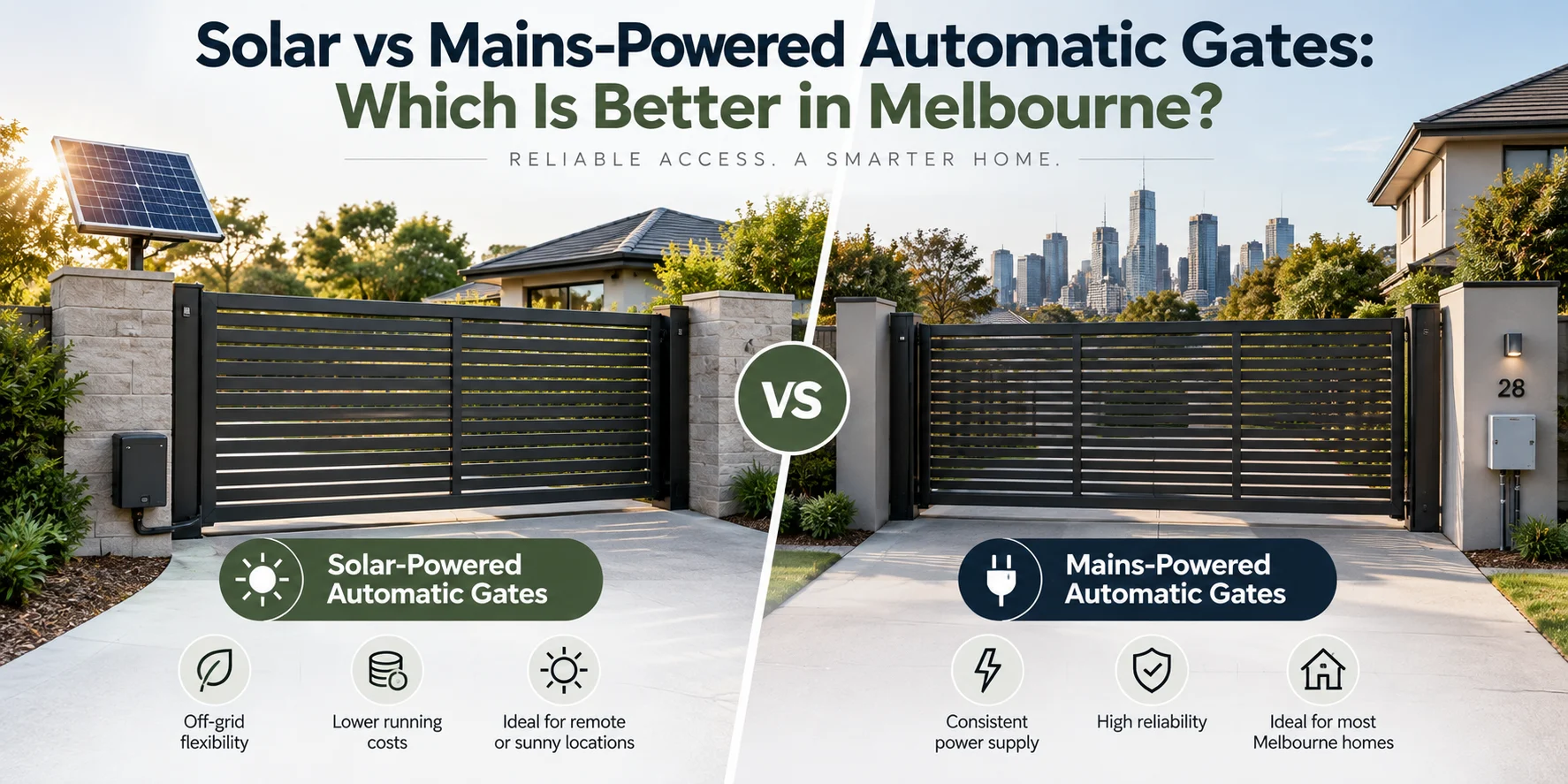
For most Melbourne properties, the solar vs electric automatic gates decision starts with power access. If suitable mains power is already near the entrance, mains is usually the simpler starting point. Solar deserves closer consideration when getting power to the gate requires difficult trenching or reinstatement, provided the site has suitable solar exposure and the battery system can support the gate and its accessories. If you are specifying the entrance at the same time, see Elegance in Iron’s custom wrought iron driveway gates.
Neither option is automatically better. Use the property, gate and expected usage to decide.
Solar vs Mains Automatic Gates at a Glance
| Decision factor | Solar automation | Mains-powered automation |
|---|---|---|
| Best starting point | Power is difficult to bring to the gate | Suitable power is already accessible |
| Main site dependency | Panel position, shade and stored battery energy | Cable route and electrical infrastructure |
| Blackout behaviour | May operate from stored charge | Depends on available battery backup |
| Frequent operation | Must be included in energy sizing | Usually easier to accommodate with suitable equipment |
| Intercoms and controls | Operating and standby loads matter | Generally less constrained by stored energy |
| Maintenance | Gate, operator, panel and battery | Gate, operator and any backup battery |
| Installation consideration | Solar and battery hardware | Cabling, trenching and reinstatement where required |
The quickest way to narrow the choice is to answer six questions: Where is the nearest suitable power? How difficult is the cable route? Where can a solar panel go? How often will the gate operate? What accessories need power? What should happen during an outage?

How Mains-Powered Gate Automation Works
A mains powered gate opener uses the property’s electrical supply as its main energy source. The exact arrangement varies by automation system, and some installations use low-voltage equipment between components.
When Mains Is the Obvious Starting Point
Mains deserves serious consideration when suitable power is already close to the driveway entrance. There is no solar charging capacity to manage, and additional electrical equipment can be easier to accommodate with a correctly designed system.
Fixed electrical installation work in Victoria must be completed by appropriately licensed electrical workers. Energy Safe Victoria also requires a Certificate of Electrical Safety for completed electrical installation work.
“All fixed electrical installation work requires a licensed electrician.”
Official external source: Energy Safe Victoria, Restricted Electrical Worker’s licence (REL). Read the source.
This wording is directly visible on the current Energy Safe Victoria page and supports the article’s rule that fixed mains electrical installation work must be carried out by a licensed electrical worker.
What if Power Is Not at the Gate?
The next question is how it can reach the entrance.
A cable route through accessible ground is very different from one that crosses finished paving, concrete or established landscaping. Some automation equipment can also use a suitable low-voltage supply, so the choice is not always limited to mains power directly at the gate or solar.
How Solar Gate Automation Works
Solar powered automatic gates use a panel and battery as part of the power system. The panel generates energy that replenishes the battery, while stored energy operates the automation.
The Battery Powers More Than Gate Movement
The electrical calculation can include:
- gate motor and control equipment
- safety devices required by the selected system
- intercoms and keypads
- GSM or smart-access equipment
- other powered entrance accessories.
Some equipment may consume energy while the gate is stationary. A solar gate motor should therefore be specified around the complete installation rather than gate movement alone.
Start With Power Access and the Cable Route
Power availability is the most useful first filter.
Mains Power Is Already Nearby
Where a suitable supply is readily accessible and the cable route is practical, mains is often the simpler solution. Choosing solar still may be possible, but it should solve a real site or project requirement.
Power Is Difficult to Reach
Solar becomes more attractive when bringing power to the entrance would require a long or disruptive cable route.
Compare the complete installation. Solar adds panel, charging and battery hardware; mains can involve electrical work, trenching and reinstatement.
For detailed pricing factors, see gate automation cost in Melbourne rather than treating this comparison as a second cost guide.
Reliability Depends on More Than the Power Source
A reliable automation system starts with a mechanically suitable gate and correctly selected operator.
The Gate Still Determines the Motor
Motor selection can be affected by:
- gate configuration and moving weight
- travel resistance and mechanical condition
- wind exposure
- expected operating frequency.
A large swing gate exposed to wind creates different demands from a well-balanced sliding gate. The swing vs sliding driveway gates guide covers that configuration decision separately.
For new custom wrought iron driveway gates, the gate specification and intended automation should be considered together before the power arrangement is finalised.
Where Solar Adds Another Variable
Solar adds energy availability to those mechanical considerations. Panel exposure, battery condition and electrical demand all influence how much stored energy is available for operation.
Mains removes the solar-charging variable, but it does not remove the need for appropriate operator selection and a gate that moves correctly.
Shade, Panel Position and Melbourne Conditions
A solar system should be assessed at the proposed panel position, not simply on whether the property receives sunlight.
Check Persistent Shade
Trees, buildings, walls and other structures can reduce useful solar exposure. A location that receives direct sun for part of the day may still have persistent shading that matters to the proposed equipment.
Panel position should therefore be checked before committing to solar gate automation in Melbourne.
Allow for Seasonal Conditions
Melbourne’s solar conditions vary through the year. Bureau of Meteorology solar-exposure information shows the seasonal difference between summer and winter conditions across southern Australia.
The system should be assessed for less favourable periods rather than judged from its performance on a clear summer day. Avoid assuming that a particular amount of shade is acceptable unless it falls within the requirements of the selected equipment.
Batteries, Blackouts and Manual Release
Backup behaviour should be decided before the automation is installed.
What Happens With Solar?
Solar automation normally operates from stored battery energy. Poor charging conditions do not necessarily stop the gate immediately, but continued operation depends on available charge, battery condition and electrical demand.
Solar should not be described as automatically immune to blackouts.
What Happens With Mains?
A mains gate may lose powered operation during a blackout, but some systems can incorporate gate battery backup.
Ask what the proposed backup actually supports and follow the manufacturer’s specifications rather than assuming every battery-backed system behaves the same way.
Don’t Forget Manual Release
Whether the system is solar or mains, homeowners should know how manual release works if powered operation becomes unavailable.
Gate Use, Duty Cycle and Access-Control Load
Opening frequency affects both operator selection and electrical demand. A private driveway used occasionally has different requirements from a shared entrance operating repeatedly throughout the day.
Before selecting an automatic gate power supply, tell the installer about expected usage and every powered accessory.
An intercom, keypad, GSM controller or smart-access device can change the electrical requirements, particularly with solar because operating and standby consumption must be supported by the charging and battery system.
Installation Cost: Solar Hardware or Cable Work?
There is no useful rule that solar is always cheaper or mains always costs less.
Mains nearby: A straightforward cable route can make mains the simpler installation.
Difficult cable route: If reaching the entrance requires substantial trenching or reinstating paving or landscaping, solar deserves closer consideration.
Solar has its own panel, charging and battery requirements, so compare complete installations rather than motor prices.
For broader gate pricing context, see wrought iron gate cost in Melbourne.
Maintenance and Existing-Gate Conversion
Both systems require attention to the gate, operator, controls and safety equipment according to the manufacturer’s requirements.
Solar adds the panel and battery to the maintenance picture. Vegetation growth can also create shade that did not exist when the system was installed. Mains systems with automation battery backup may still require battery-related maintenance.
Can an Existing Gate Be Converted to Solar?
Potentially, but assess the gate first.
Its structure, movement, configuration and suitability for automation need to be established before choosing a solar panel, battery arrangement or motor. An existing automatic gate may also require assessment of whether its current operator and controls are compatible with the proposed power arrangement.

Which Power Source Suits Your Property?
Use this compact decision flow before requesting quotes:
- Is suitable mains power already near the gate? Start by considering mains.
- Would reaching the gate require difficult trenching or reinstatement? Give solar closer consideration.
- Is there a suitable solar-panel position? Check persistent and seasonal shade.
- How frequently will the gate operate? Include normal and unusually busy periods.
- What else needs electricity? List intercoms, keypads, smart controls and other accessories.
- What should happen during an outage? Confirm battery backup and manual release requirements.
What to Prepare Before an Automation Assessment
Have the following ready:
- photos of the driveway entrance and gate
- approximate gate dimensions and configuration
- location of the nearest available electrical supply
- likely obstacles along a cable route
- areas of significant shade around possible panel locations
- expected gate usage
- required intercom, keypad or smart-access features.
That information helps turn the first discussion into a site-specific power decision rather than a generic solar-versus-mains comparison.
Frequently Asked Questions
Are solar automatic gates reliable?
They can be when the gate, operator, panel position, battery capacity, usage and accessory loads are properly matched. Reliability depends on the complete system and site conditions.
Do solar gates work in winter?
They can. Solar gates operate from stored battery energy, but Melbourne’s seasonal solar conditions need to be considered when the charging and storage system is specified.
Can a solar gate work in shade?
It depends on the amount and duration of shade and the selected equipment. Persistent shading can reduce charging, so the proposed panel location should be assessed first.
Is solar cheaper than mains power for a gate?
Sometimes. Solar may avoid difficult cable installation and reinstatement but adds panel and battery hardware. Compare the complete installation rather than one component.
Do solar gates need batteries?
Yes. The battery stores energy generated by the panel and supplies the automation when the gate operates.
Can a solar gate use an intercom or keypad?
Potentially. The equipment must be compatible, and its operating and standby electrical demand needs to be included in the solar system design.
What happens to an automatic gate during a blackout?
A solar system may continue operating while sufficient stored charge is available. A mains gate may continue if suitable gate automation battery backup is installed. Otherwise, manual release may be required.
Final Thoughts
For solar vs electric automatic gates in Melbourne, start with the site: available power, cable-route difficulty, solar exposure, gate configuration, usage, accessories and backup requirements.
Elegance in Iron can assess those factors during a site measure or automation assessment so the gate, operator and power source are specified as one system rather than separate decisions.


