

Last Updated on September 28, 2026 by Elegance
Neither material has a universally longer lifespan. Aluminium usually has the advantage where corrosion resistance and low maintenance are the priorities, because it does not develop ferrous rust. A properly fabricated, galvanised and coated iron or steel fence, though, can provide long service, strong impact resistance and better repairability. The real answer depends on the fence design, the protective finish, the site’s exposure, installation quality and ongoing maintenance — not the base metal alone.

| Factor | Wrought Iron / Fabricated Steel | Aluminium |
|---|---|---|
| Red rust | Can rust if the protective system is damaged or unsuitable | Does not develop ferrous rust |
| Other corrosion | Depends on coating, moisture and environment | Can still corrode under certain conditions |
| Structural performance | Depends on section size and design; commonly chosen for rigidity and custom fabrication | Depends on alloy, profile and wall thickness; lightweight systems may be more vulnerable to impact |
| Protective finish | Usually requires a suitable galvanising, primer and/or coating system | Often powder-coated, but pretreatment and coating specification still matter |
| Maintenance | Requires inspection and prompt repair of coating damage | Usually lower maintenance, but still needs cleaning and inspection |
| Repairability | Sections, welds and decorative elements can often be repaired or replaced | Damaged modular panels may be replaced; repair options depend on construction |
| Custom detailing | Strong suitability for bespoke and heritage-style designs | Usually based on extruded or modular profiles |
| Coastal exposure | Requires an exposure-appropriate corrosion-protection system | Generally advantageous for low-maintenance coastal use, but not immune to corrosion |
| Longest-lasting choice | Depends on the complete system and maintenance | Depends on the complete system and environment |
First, What Does “Iron Fence” Actually Mean?
Worth clearing up before comparing anything: genuine historical wrought iron and most of what’s sold today as an “iron fence” aren’t the same material. True wrought iron hasn’t been commercially produced at scale since the mid-20th century. What most fabricators, including us, build today is mild steel, shaped using traditional blacksmithing techniques and finished to look and perform like the original. It’s a fair description of the process and aesthetic, not a claim that every “wrought iron” fence on the market is period-correct material. We’ll use “iron fence” through this comparison to mean fabricated steel fencing built in that style, since that’s what most homeowners are actually choosing between. Our guide on the difference between wrought iron and steel covers this distinction in more depth.
Which Lasts Longer: Iron or Aluminium Fencing?
There’s a conditional answer here, not a simple one. Aluminium generally offers lower-maintenance corrosion resistance, which suits a lot of properties well. Iron or steel, properly designed, galvanised and coated for the site, can deliver excellent long-term performance too, often with more rigidity and better repair options. The material name alone doesn’t predict how long a fence will actually last — the complete system does.
Corrosion Is the Biggest Difference
Rust is specific to ferrous metals, iron and steel. Aluminium forms a thin protective oxide film instead, and doesn’t develop red rust. That’s a genuine advantage, but it’s not the same as being immune to corrosion. Under harsher conditions, aluminium can still pit, stain or corrode, particularly where salt, moisture or contact with other metals is involved.
“the corrosion pattern of aluminium is more complex”
This is from the Australian Aluminium Council’s official FAQ page, in direct response to a question about whether aluminium will eventually rust. The Council confirms that aluminium does not rust, and that under normal circumstances a thin oxide layer forms on contact with air, protecting the metal beneath. But it goes on to say that in adverse weather conditions or due to other environmental factors, the corrosion pattern of aluminium is more complex — and that it isn’t possible to put a fixed timeframe on the process without more detail about the specific conditions. That’s the peak-body confirmation behind why “aluminium doesn’t rust” is true but incomplete as a durability claim on its own.— The Australian Aluminium Council, FAQs
Coating damage, salt deposits, moisture traps and dissimilar-metal contact can affect both iron and aluminium systems, just in different ways.
Why the Finish System Matters as Much as the Metal
The metal is only part of the story. Surface preparation, hot-dip galvanising, primer, the powder coating or paint system itself, whether it’s a duplex system, coating thickness, and how well welds and cut edges are covered, all affect how long a fence actually performs. Powder coating does not make steel rust-proof, and coastal suitability varies by product — a distinction we cover in full in our guide to powder coating vs paint for wrought iron. The Galvanizers Association of Australia is explicit that galvanised coating durability depends on the exposure environment and the specification used, not a universal lifespan figure. At Elegance in Iron, our fences are hot-dip galvanised before a primer and topcoat go on, which gives meaningfully better long-term protection than paint or powder coating applied without that base layer.

Seven Factors That Determine Fence Lifespan
Metal, alloy and section thickness. A thin aluminium extrusion and a heavy fabricated steel section aren’t comparable just because they share a material category — thickness and profile matter as much as the metal name.
Pretreatment and protective coating. “Powder-coated” isn’t a complete system on its own; compare the full pretreatment and coating specification, not just the finish description.
Inland, coastal or industrial exposure. The same fence design can perform very differently depending on how far it sits from the coast or from industrial pollutants.
Posts, footings and ground contact. Water accumulation, soil contact and masonry interfaces are common places for corrosion to start, on either material.
Welds, fasteners and dissimilar metals. Mixing incompatible metals or fasteners can cause galvanic corrosion — this matters more than people expect and is worth getting right at fabrication.
Drainage and fabrication design. Horizontal surfaces, crevices and undrained sections trap water. Good design accounts for this from the start, not after problems appear.
Damage, inspection and maintenance. A small, untreated coating failure in one spot can eventually affect a much larger run of fence if it’s left unaddressed.
Maintenance Comparison
Both materials need some ongoing attention, just different amounts. For an iron or steel fence: regular washing to remove salt and dirt, checking the coating for chips or scratches, inspecting welds and post bases, and repairing any damage promptly. For aluminium: washing off salt and grime, checking panel connections, and watching for movement in posts or masonry piers. Aluminium generally needs less of this over time, but “lower maintenance” isn’t the same as “no maintenance” for either material.
Strength, Impact and Security
It’s not accurate to say iron is always stronger — fence performance depends on material grade, whether the construction is solid or hollow, profile dimensions, picket spacing, panel width, post and footing specification, connection details, and overall height and design. A properly engineered iron or steel fence can offer greater rigidity and impact resistance. Aluminium reduces weight and suits many standard residential applications well. Which matters more depends on the property and what the fence actually needs to do.
Customisation and Architectural Fit
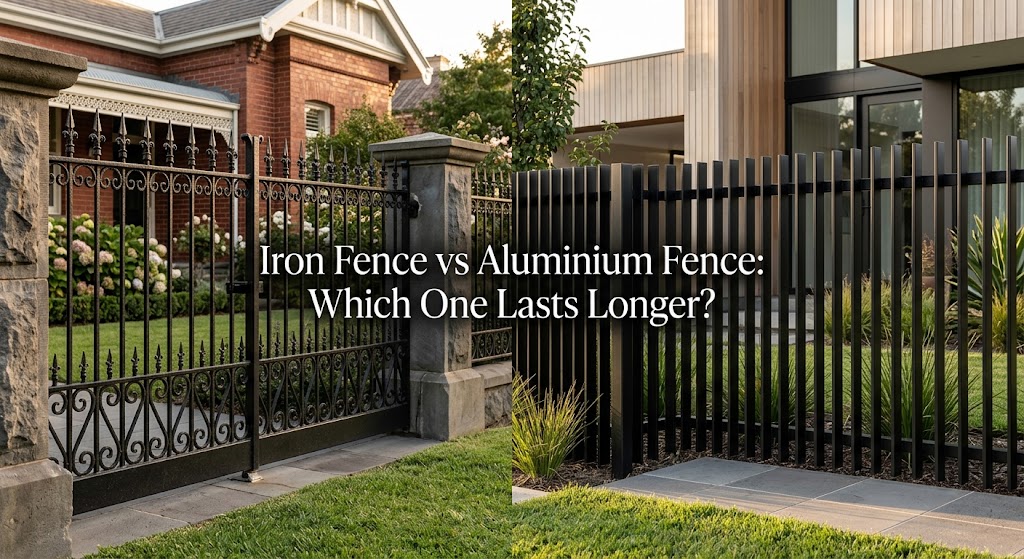
Iron fencing suits heritage and period homes particularly well — hand-forged or custom decorative details, scrollwork, and fencing designed to match existing masonry piers or an established facade. Aluminium typically works from modular or extruded profiles, which is efficient and consistent but offers less scope for one-off decorative work. Neither is automatically the better architectural choice; it depends on whether you’re matching an existing style, starting fresh, and how much you value open visibility versus a more solid, private line. Our beginner’s guide to choosing custom wrought iron products covers this decision in more depth.
Which Material Is Better Near the Coast?
Aluminium generally has the advantage in coastal settings because it doesn’t develop red rust, but it isn’t corrosion-proof. Alloy selection, pretreatment, the specific powder or paint system, fastener choice and ongoing maintenance all still matter. A properly protected iron or steel fence can also be used near the coast, but the coating system has to genuinely suit that exposure level, not just carry a generic “outdoor” label. Coating manufacturers specify different products for different substrates and exposure zones — Dulux, for example, markets its Duratec Zeus range primarily for aluminium but rates it for use on mild steel too, while a primer like E-Prime is suited to specific substrates and requires an exterior topcoat, it isn’t a one-size-fits-all solution. The right product depends on the actual substrate and site, not the phrase “powder-coated” alone. Treat “marine-grade” the same way — ask exactly which specification and standard it refers to before relying on it.
Cost and Whole-of-Life Value
We’re not going to quote fixed prices here — they vary too much project to project, and copying generic per-metre figures from overseas sources wouldn’t be honest. What genuinely drives cost on both materials: design complexity, total fence length, panel and post specification, any masonry work involved, ground conditions, the finish system specified, installation access, and ongoing maintenance and repair over the life of the fence. A cheaper upfront system that needs earlier repair or replacement isn’t necessarily better value once you look at the whole picture. Our Melbourne wrought iron gate cost guide covers what typically drives pricing on the iron side of this comparison.
Decision Guide
Iron or fabricated steel may be the better choice when:
- Bespoke or heritage detailing matters
- Greater rigidity or impact resistance is needed
- The fence needs to match existing custom gates or ironwork
- Repairability and long-term restoration are priorities
- You’re comfortable with periodic inspection and finish maintenance
Aluminium may be the better choice when:
- Low weight and reduced maintenance are the priority
- The property has significant salt or moisture exposure and low-touch performance matters more than custom detailing
- A modular profile suits the architectural style
- The required security level doesn’t need a heavier fabricated system
- The selected alloy, coating and fasteners are genuinely matched to the site
Final Verdict
Aluminium often wins on low-maintenance corrosion resistance, but that’s not the same as automatically winning on absolute lifespan. A correctly specified iron or steel fence can offer excellent durability, rigidity, repairability and custom design potential over decades. The metal label is a starting point, not the whole answer — compare the complete fencing system for your specific property before deciding. This kind of durable investment also tends to hold its value — see our piece on whether a wrought iron fence increases property value.
Discuss your property, its exposure conditions and your preferred design with Elegance in Iron before finalising a fence specification.
Frequently Asked Questions
Does an aluminium fence rust?
No. Rust is specific to iron and steel. Aluminium forms a protective oxide layer instead and doesn’t develop the reddish-brown flaking associated with rust.
Can aluminium fencing still corrode?
Yes. It doesn’t rust, but it can still corrode under harsh conditions, particularly with salt exposure, trapped moisture, or contact with certain other metals. The right alloy and coating specification reduce this risk.
Is wrought iron stronger than aluminium fencing?
Not automatically. Strength depends on section thickness, profile, construction and design, not the metal name alone. A well-engineered fence in either material can perform very differently from a poorly specified one.
Which fence material is better for a coastal property?
Aluminium generally has an advantage because it won’t develop red rust, but it still needs an appropriate alloy and coating for the exposure. A properly protected iron or steel fence can also work near the coast if the finish system is genuinely suited to that environment. Our guide on whether wrought iron rusts covers this in more detail.
Does powder coating make an iron fence rust-proof?
No. Powder coating significantly improves corrosion resistance when properly specified and applied, but it doesn’t make steel immune to rust, especially if the coating is damaged or the substrate wasn’t properly prepared beforehand.
Is an iron fence easier to repair than aluminium?
Often, yes. Sections, welds and decorative elements on an iron or steel fence can frequently be repaired or replaced individually. Aluminium repair options depend on the construction — damaged modular panels are sometimes replaced rather than repaired.


