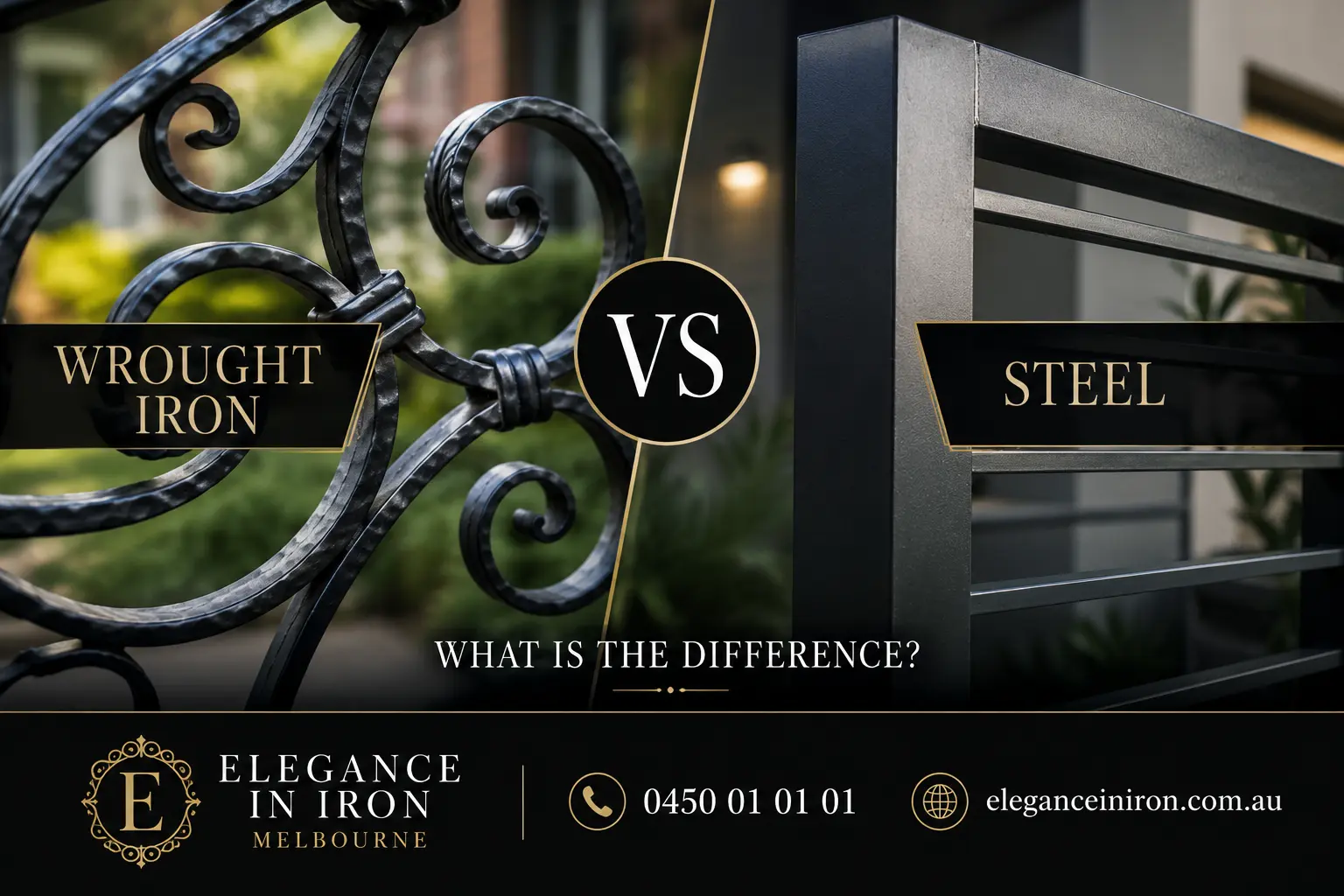
For modern gates, fencing and balustrades, the comparison is usually between traditional wrought iron and mild steel. Mild steel is the material most commonly used today to create what the industry refers to as wrought iron-style architectural metalwork.
It creates genuine confusion, and understandably so. These materials look similar once finished and painted. Their applications overlap considerably. And the decorative ironwork trade has used both terms loosely for decades.
But wrought iron and steel are fundamentally different materials with different compositions, different manufacturing histories, and different properties that affect how they look, how they perform, and how long they last. Knowing the distinction helps you ask better questions, understand what you are buying, and make a more confident decision for your property. This is closely related to our guide on the difference between cast iron and wrought iron — together, these two articles cover the full material picture.
What Is Wrought Iron?
Wrought iron is a low-carbon iron alloy containing less than 0.08% carbon by weight, along with 1 to 2% slag (silicate inclusions) that run through the metal in fine fibrous strands. The word “wrought” is simply the past tense of “work.” Wrought iron is iron that has been physically worked by hand.
To produce it, pig iron was refined in a puddling furnace to burn off excess carbon. The resulting bloom of metal was then hammered, rolled, and shaped repeatedly while still hot. Each pass under the hammer refined the grain structure and aligned those slag fibres into the characteristic fibrous texture you can see on genuinely old wrought iron pieces under close inspection.
This process was entirely handcraft-driven and labour intensive, which is why wrought iron always carried a price premium and why it became synonymous with fine craftsmanship.
Key technical properties of wrought iron:
Carbon content: less than 0.08%
Slag content: 1 to 2% (fibrous silicate inclusions)
Tensile strength: 240 to 350 MPa
Yield strength: 160 to 220 MPa
Ductile: bends before it fractures
Naturally corrosion-resistant due to slag inclusions
Can be re-heated and reworked repeatedly at the forge
Weldable without specialist pre-treatment
The Eiffel Tower, completed in 1889, is one of the most famous wrought iron structures in the world, built from approximately 7,300 tonnes of puddled iron. The fact it is still standing well over a century later tells you something meaningful about how this material performs over time.
What Is Steel?
Steel is an alloy of iron and carbon, where the carbon content sits between 0.02% and 2.1% depending on the type. Unlike wrought iron, steel contains no slag inclusions. It is produced by melting iron and combining it with precise amounts of carbon and sometimes other elements such as chromium, nickel, or manganese to achieve specific performance characteristics.
There are many types of steel. For decorative metalwork and the fabrication of gates, fencing, and balustrades, mild steel (also called low-carbon steel) is the relevant comparison point. Mild steel contains roughly 0.15% to 0.30% carbon, which gives it a tensile strength of 400 to 550 MPa, making it measurably stronger than true wrought iron under tensile load.
Key technical properties of mild steel:
Carbon content: 0.15% to 0.30%
No slag inclusions
Tensile strength: 400 to 550 MPa
Highly ductile and easy to form, bend, and weld
Excellent weldability without pre-heating
Prone to rust without surface treatment
Cost-effective and widely available
The key practical fact: True wrought iron has not been commercially produced at scale since the mid-20th century, when steel manufacturing overtook it entirely. When decorative ironwork companies today use the term “wrought iron,” they are almost universally working with mild steel bar stock, shaped using traditional blacksmithing techniques. The material behaves similarly, the aesthetic results are the same, and the term has become a style and process description rather than a strict material specification.
“For most gates, railings and decorative metalwork, mild steel provides the best combination of strength, versatility, affordability and appearance. With the addition of decorative forged components, it can achieve the classic look associated with traditional wrought iron while offering the advantages of modern fabrication.”
— DC Iron, Wrought Iron vs Mild Steel: Which Material Is Best?, July 2026 | dciron.co.uk
Wrought Iron vs Steel: Key Differences at a Glance
Property
Wrought Iron
Mild Steel
Carbon content
Less than 0.08%
0.15% to 0.30%
Slag inclusions
1 to 2% (fibrous)
None
Tensile strength
240 to 350 MPa
400 to 550 MPa
Ductility
High
High
Corrosion resistance
Natural (slag protection)
Low without coating
Weldability
Good
Excellent
Workability at forge
Excellent
Very good
Design detail possible
Intricate hand-forged forms
Very good, slightly less fine detail
Commercial availability
No longer produced at scale
Widely available
Cost
Higher (historical)
More accessible
Best application
Heritage restoration, finest decorative ironwork
Custom gates, fencing, balustrades, furniture
Is Wrought Iron Stronger Than Steel?
This question comes up often, and the answer requires a small amount of context.
Mild steel has higher tensile strength than true wrought iron. At 400 to 550 MPa, mild steel outperforms wrought iron’s 240 to 350 MPa when it comes to resisting pulling forces, bending, and stretching.
However, wrought iron has a naturally fibrous grain structure (from its slag inclusions) that makes it remarkably tough and resistant to fatigue cracking under repeated loading. This is why 19th-century bridges and gates made from wrought iron have outlasted many of their steel replacements.
For decorative applications including gates, fencing, balustrades, and staircases, the structural demands do not push either material close to its limits. A well-designed and properly installed gate made from mild steel using traditional blacksmithing techniques will perform excellently for decades. The strength difference between the two materials is not the deciding factor for most residential and commercial ironwork projects.
What matters more for gates and fencing in Melbourne:
Quality of fabrication and joinery at connection points
Surface treatment and coating system applied before installation
Hot-dip galvanising as a base layer before painting
Profile design that handles wind load and daily gate movement
At Elegance in Iron, all our ironwork is hot-dip galvanised before finishing, which provides far more durable corrosion protection than paint alone and significantly extends the service life of the metalwork regardless of whether the base material is true wrought iron or mild steel.
Corrosion and Rust: Which Performs Better Outdoors?
This is where the two materials differ in a genuinely meaningful way for Melbourne homeowners.
True wrought iron has a natural advantage against corrosion. The silicate slag inclusions that run through the metal create a physical barrier that slows the progression of rust once it starts. Old wrought iron fences that have not been painted in years often show surface rust but remain structurally sound beneath it, because the corrosion does not penetrate the metal as quickly.
Mild steel has no such natural barrier. Without a protective coating, mild steel corrodes progressively. But in practice, this distinction matters less than it appears — because all quality decorative ironwork, whether based on true wrought iron or mild steel, requires a proper protective coating system. The full story on rust development and prevention is covered in our guide to whether wrought iron rusts and how to prevent it.
In practice, this distinction matters less than it appears, because all quality decorative ironwork, whether based on true wrought iron or mild steel, requires a proper protective coating system to perform long-term. The surface treatment is the real line of defence, not the base material alone.
Elegance in Iron’s coating process: All our ironwork is hot-dip galvanised first, which applies a zinc coating to the metal through a chemical bonding process far more durable than spray galvanising or zinc-rich primers. A primer coat and topcoat are then applied over the galvanising. This system protects mild steel just as effectively as natural slag inclusions protect true wrought iron, with a lifespan measured in decades rather than years.
For Melbourne’s coastal and bayside suburbs including Brighton, Sandringham, Hampton, St Kilda, and Port Melbourne, the combination of salt-laden air and variable humidity accelerates surface corrosion on untreated or poorly treated metalwork. Hot-dip galvanising is not optional in these locations. It is the minimum standard for ironwork that will last.
Maintenance schedule for finished ironwork in Melbourne:
Location Type
Recommended Repaint Frequency
Sheltered inner suburban (Malvern, Hawthorn, Kew)
Every 7 to 10 years
Exposed or elevated positions
Every 5 to 7 years
Coastal and bayside suburbs
Every 3 to 5 years
Properties near heavy traffic or industrial areas
Every 5 to 7 years
Appearance and Design Detail: Where Wrought Iron Has the Edge
For most structural properties, mild steel matches or exceeds wrought iron. But when it comes to fine decorative detail, true wrought iron worked by a skilled blacksmith produces results that mild steel simply cannot replicate to the same degree.
The reason is the material’s behaviour at the forge. Wrought iron’s low carbon content and fibrous texture make it respond to hammer and heat in a way that allows a blacksmith to taper, scroll, twist, and forge weld individual elements with extraordinary precision. The natural slag content also gives finished wrought iron a slightly textured, organic surface that reads as clearly hand-made.
Mild steel can absolutely be shaped into scrolls, curves, collars, spear tips, and ornamental forms using the same blacksmithing techniques. For the vast majority of decorative gates, fencing, and balustrade designs, you will not see a meaningful visible difference between work done in true wrought iron versus skilled blacksmithing in mild steel.
Where the gap shows is in the finest heritage restoration work and in pieces with exceptionally intricate forged detail. If you are restoring a 19th-century iron fence on a heritage-listed Melbourne property to match original construction, true wrought iron (which can still be sourced in small quantities from specialist suppliers for restoration purposes) is the correct material choice.
For new custom ironwork on Melbourne homes, mild steel worked using traditional blacksmithing methods is the standard material, and it produces beautiful, durable results that will last generations.
Wrought iron design characteristics to look for in quality ironwork:
Tapered pickets that narrow to a point, forged rather than cut
Hand-formed scrolls with variation in the tightness of the spiral
Forged collars and rings wrapping elements at junctions
Individually fitted components rather than uniform repeating sections
Hammer marks and surface texture that show the hand of the maker
At Elegance in Iron, every gate, fence, balustrade, and door is designed and built specifically for the property it goes on. No two pieces are identical. That is the defining characteristic of genuine blacksmith-made ironwork compared to fabricated steel tube systems.
Wrought Iron vs Steel: Which Is Right for Melbourne Homes?
The short answer for almost all residential projects in Melbourne is this: custom mild steel worked in the wrought iron blacksmithing tradition is the practical, cost-effective, and excellent-looking choice. It is what the industry uses, what Elegance in Iron builds with, and what will serve your property well for the life of the building.
The longer answer depends on your specific project:
Federation and Victorian Era Homes (Malvern, Toorak, Hawthorn, South Yarra, Carlton)
These homes were originally surrounded by decorative ironwork in the true wrought iron tradition. The scrollwork, picket profiles, finials, and lacework patterns of original Victorian-era ironwork should be the reference point for any new gates or fencing. Mild steel worked by skilled blacksmiths replicates this aesthetic faithfully. Powder-coated black is the historically consistent finish.
Contemporary and Modern Homes
Steel fabrication with clean lines, minimal ornamentation, and powder-coated matte or satin black finishes suits modern architecture. Mild steel is the appropriate choice for geometric designs, flat-bar screens, and contemporary balustrading.
Heritage Restoration Projects
If you are restoring original ironwork on a heritage-listed property and need to match existing wrought iron construction exactly, contact us to discuss sourcing options. For most restoration work, skilled mild steel fabrication matched to the original profile achieves an indistinguishable result.
Commercial Properties
Structural and security-focused applications including car park barriers, commercial entry gates, and industrial screening benefit from the higher tensile strength of mild steel. Our commercial ironwork is engineered for load, access frequency, and compliance with relevant Australian standards.
The Honest Answer About “Wrought Iron” Ironwork Today
Most Melbourne ironwork companies, including Elegance in Iron, use the term “wrought iron” to describe decorative ironwork produced using traditional blacksmithing techniques with mild steel bar stock.
This is not misleading. It reflects how the trade evolved after true wrought iron ceased commercial production in the mid-20th century. The term now describes a process and aesthetic rather than a strict material specification. When you see “wrought iron gates” from any reputable Melbourne ironwork company, you are almost certainly looking at mild steel, hand-formed using blacksmithing methods.
What distinguishes genuine wrought iron-style work from cheap steel tube fencing is not the base material. It is:
Whether the pickets are solid bar stock or hollow tube
Whether scrolls and details are hand-forged or bent cold from tube
Whether the design is custom-built for your property
Whether proper galvanising and coating has been applied
Whether the joints are welded and finished by a skilled tradesperson
These are the questions worth asking. Our guide on what to ask before hiring a wrought iron fabricator walks through exactly how to evaluate any quote you receive — and how to spot the difference between quality ironwork and a catalogue fence.
Frequently Asked Questions
What is the main difference between wrought iron and steel?
Wrought iron contains less than 0.08% carbon and 1 to 2% slag inclusions that give it a fibrous texture, natural corrosion resistance, and excellent workability at the forge. Mild steel contains 0.15% to 0.30% carbon, no slag, and higher tensile strength (400 to 550 MPa versus wrought iron’s 240 to 350 MPa). For decorative gates and fencing, mild steel worked using blacksmithing techniques is the modern equivalent of true wrought iron.
Is wrought iron the same as steel?
No. Traditional wrought iron and steel are different materials. True wrought iron contains very little carbon and includes fibrous slag, while mild steel contains more carbon and no slag. However, most modern “wrought iron” gates, fences and balustrades are made from mild steel that is shaped using traditional blacksmithing and decorative metalworking techniques.
Is wrought iron or steel better for gates and fencing?
For decorative residential gates and fencing in Melbourne, mild steel worked in the wrought iron blacksmithing tradition is the correct choice. It is strong, shapeable, weldable, widely available, and produces beautiful custom results. True wrought iron is no longer commercially produced; modern “wrought iron” gates are mild steel.
Does wrought iron rust faster than steel?
True wrought iron rusts more slowly than bare mild steel because its slag inclusions slow the spread of corrosion. However, both materials require proper surface treatment for outdoor use. A hot-dip galvanised mild steel gate with a quality paint system will outlast any wrought iron gate left without adequate coating.
Why is wrought iron more expensive than steel?
True wrought iron required an intensive, skilled production process. Modern custom ironwork in mild steel costs more than mass-produced steel fencing for the same reason: it is designed, forged, and assembled by hand, one piece at a time. You are paying for a craftsperson’s time and skill, not just the material.
Can you tell the difference between wrought iron and mild steel gates by looking?
In finished, painted work, the difference is very difficult to see. Under close inspection, true wrought iron has a slightly fibrous, layered surface texture compared to the smooth uniformity of mild steel. Hand-forged mild steel work shows hammer marks and slight variation between elements that distinguish it from fabricated tube or machine-pressed steel.
How long does wrought iron-style ironwork last in Melbourne?
Quality custom ironwork in Melbourne, properly installed and maintained, lasts 40 to 60 years or more. Many Victorian-era ironwork pieces from the 1880s are still standing on Melbourne’s heritage streetscapes today. The key factors are quality of fabrication, a proper galvanising and coating system at installation, and repainting on a cycle appropriate to the exposure level of your property.
See the Difference in Person
The best way to understand the quality and character of genuine hand-crafted ironwork is to see it in front of you. Elegance in Iron designs and builds custom gates, driveway gates, fences, balustrades, staircases, balconies, security doors, and decorative ironwork for Melbourne homes and commercial properties across all of Victoria.
Browse our project portfolio to see examples of our work across different home styles, or get in touch to discuss your project. Every piece is built from solid flat bar and round bar stock, hot-dip galvanised before finishing, and custom-designed for your property.
The Elegance in Iron Editorial Team works closely with our experienced designers, fabricators, and installers to provide accurate, practical, and technically informed advice. We share hands-on knowledge of custom wrought iron doors, gates, fencing, balustrades, and architectural ironwork for homes and properties across Melbourne.
I’m currently looking at restoration options for a Victorian-era terrace in Fitzroy. Given that true wrought iron is effectively gone, do you find that your hand-forged mild steel can be textured effectively to mimic that fibrous, layered finish of the 19th-century originals? I’m quite hesitant to mix old and new materials if the visual discrepancy is going to be too obvious to the naked eye.
Really useful distinction between slag inclusions and carbon content. My question regarding the corrosion protection: with hand-forged mild steel, does the hot-dip galvanizing process ever compromise the finer details of the blacksmithing, such as intricate scrolls or hammer marks? I’m looking to balance that authentic artisan aesthetic with the necessary longevity for a high-exposure coastal project


I’m currently looking at restoration options for a Victorian-era terrace in Fitzroy. Given that true wrought iron is effectively gone, do you find that your hand-forged mild steel can be textured effectively to mimic that fibrous, layered finish of the 19th-century originals? I’m quite hesitant to mix old and new materials if the visual discrepancy is going to be too obvious to the naked eye.
Really useful distinction between slag inclusions and carbon content. My question regarding the corrosion protection: with hand-forged mild steel, does the hot-dip galvanizing process ever compromise the finer details of the blacksmithing, such as intricate scrolls or hammer marks? I’m looking to balance that authentic artisan aesthetic with the necessary longevity for a high-exposure coastal project