Last Updated on August 14, 2026 by Elegance
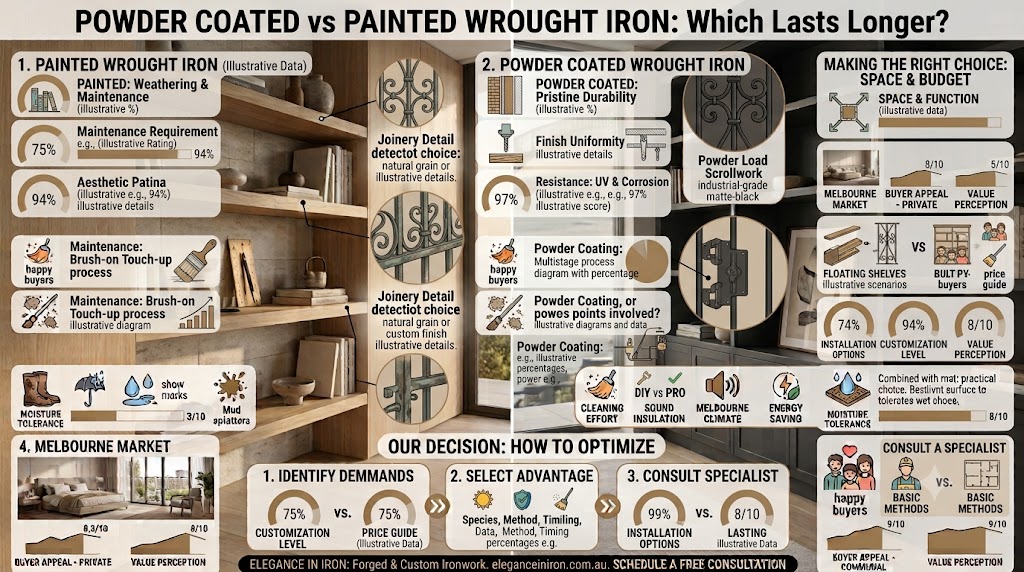
The finish on wrought iron is what determines how well it handles outdoor conditions over time. When weighing powder coating vs paint for wrought iron, the two options can both protect ironwork, but they perform very differently when exposed to moisture, UV, and everyday wear.
The right finish, applied correctly, can significantly extend the life of ironwork while reducing the amount of maintenance required. This guide compares powder coating and traditional wet paint honestly, so you know exactly what you’re paying for either way.
What Is Powder Coating?
Powder coating applies a dry, electrostatically charged powder directly onto the metal, so the powder clings evenly to every surface before it’s ever heated. The piece then goes into an oven, where the powder melts and fuses into a hard, continuous shell as it cools. Well-prepared, powder coated iron gates are one of the more reliable forms of rust protection for wrought iron available today.
That baked-on process is the key difference from paint, which simply air-dries as its solvents evaporate rather than chemically bonding to the metal. The result is a continuous protective layer that adheres tightly to the prepared metal surface, creating strong resistance against chipping, weathering, and corrosion.
What Changes in Real-World Conditions
Wet paint remains a practical option for some projects because it can be applied and repaired on-site. The trade-off is that exterior painted ironwork usually requires more frequent maintenance to prevent peeling, cracking, and rust development.
Once paint fails in one spot, moisture reaches the bare metal underneath, and rust spreads from that point outward. It’s worth noting that some specialist finishers still prefer paint for certain artisan effects, like faux-distressed or textured finishes, that are genuinely harder to achieve with a powder coat.
Preparation matters for both finishes, not just powder coating. Paint applied over existing rust, old flaking coating, or surface contamination will fail early regardless of the product used, which is why so many disappointing paint jobs were doomed before the first coat went on. Our guide on whether wrought iron rusts covers this preparation issue in more depth.
Durability Showdown
The differences between the two finishes show up clearly across three areas that matter most for outdoor ironwork.
| Factor | Powder Coating | Wet Paint |
|---|---|---|
| UV resistance | Strong resistance to fading | More likely to fade and chalk |
| Impact resistance | Better resistance to chips | Easier to chip |
| Corrosion protection | Strong barrier when properly applied | Requires regular maintenance |
| Maintenance | Lower maintenance | More frequent touch-ups |
For Melbourne properties, especially homes exposed to coastal air or changing weather conditions, corrosion protection is an important consideration. Salt exposure, rainfall, and strong sun can all accelerate coating breakdown when ironwork is not properly prepared and protected.
No finish is completely indestructible, though. Both coatings degrade eventually through UV, heat, and moisture exposure, a process known as chalking, which simply happens far more slowly with powder coating.

Long-Term Maintenance Considerations
Wrought iron fence maintenance costs add up over time in a way that’s easy to underestimate upfront. A painted gate typically needs scraping, sanding, and repainting every few years to stay ahead of chipping and rust, and each of those rounds costs labour and materials on top of the original job.
Powder coating costs more initially, largely because proper preparation, usually sandblasting to remove any existing rust or old coating, is part of doing it correctly. Add up a decade of repainting cycles against one powder-coated finish that can last twenty years or more with minimal upkeep, and the “cheaper” option is often the one that costs more in the end. Our Melbourne wrought iron gate cost guide factors finish type into typical pricing.
This is also good news if your existing ironwork already has years of chipped paint or surface rust. That sandblasting step is a restoration process as much as a preparation one, which means older gates and fencing can come back from a powder coat looking better than they have in years, rather than needing full replacement.
Why Powder Coating Is Often Preferred for Outdoor Ironwork
Among the iron gate coating options available, powder coating stands out for straightforward reasons: better adhesion to the metal, a more uniform factory-quality finish without drips or pooling, and genuinely lower long-term maintenance.
“powder coating produces minimal amounts of VOC emissions”
This is from the US Environmental Protection Agency’s Control Techniques Guidelines for Large Appliance Coatings. The EPA explains that this is because powder coatings are applied as dried particles — no VOC (volatile organic compound) is released during application, and volatile emissions from curing, if any, are generally much lower than those from liquid coating systems. The same document notes that industries switching from conventional solvent-based coatings to powder coatings have achieved VOC emission reductions of 90 percent or more, which is the regulatory backing behind why powder coating is treated as the lower-emission choice compared with traditional wet paint.— US Environmental Protection Agency (EPA), “Control Techniques Guidelines for Large Appliance Coatings”
For anyone investing in custom ironwork meant to last, powder coating isn’t an upsell; it’s simply the finish that actually protects the investment.
In custom ironwork projects, the biggest difference between a finish that lasts and one that fails is usually not the product name alone, but the preparation, application process, and suitability for the environment. Our beginner’s guide to choosing custom wrought iron products covers what else to look for beyond the finish.
Frequently Asked Questions
Can old, rusty wrought iron be powder coated?
Yes. Sandblasting removes existing rust and old coatings first, which means even ironwork with years of wear can come back looking better than the original finish.
How long does powder coating actually last?
A properly applied powder coat commonly lasts fifteen to twenty years or more with minimal maintenance, depending on exposure and how well the metal was prepared beforehand.
Can powder coating be touched up on-site like paint?
Not easily. Damaged sections generally need to be removed and reprocessed through the full coating system, which is one of the few practical trade-offs against paint.
Is powder coating worth it for coastal or Melbourne properties?
Particularly there. Salt air and wet winters are exactly the conditions that break down thin paint jobs fastest, which is where powder coating’s corrosion resistance matters most.
Does powder coating limit colour or finish options?
No. Powder coating is available in a wide range of colours, textures, and sheens, well beyond the basic black or grey finishes many people associate with it.
What is the best finish for wrought iron gates?
For most outdoor wrought iron gates and fences, powder coating is the preferred option because it provides a durable, uniform finish with better resistance to weather, corrosion, and everyday wear. The best choice still depends on the location, exposure, and maintenance expectations. Our guide on the difference between wrought iron and steel covers how base material also plays into this decision.
Protecting Your Ironwork for the Long Term
Among outdoor ironwork finishes, the choice you make isn’t a cosmetic afterthought; it’s what determines whether that investment lasts twenty years or needs constant attention within five. For Melbourne wrought iron gates and fencing, powder coating protects against the exact conditions, UV, impact, and corrosion, that make the local climate so hard on painted metal. This kind of long-term protection is also part of what supports whether a wrought iron fence increases property value. Contact Elegance In Iron to discuss the right finish for your project.


Great article, and the 20-year cost comparison chart is incredibly helpful! I have a technical question regarding the sandblasting process for restoring older wrought iron. If the existing rust has caused deep micro-pitting in the metal, does the standard powder coating process fill those pits effectively to create a smooth finish? Or do you recommend applying a specific zinc-rich epoxy primer base coat beforehand to level it out and add extra corrosion resistance?
Since you mentioned Melbourne’s unpredictable weather, I’m curious about the long-term UV resistance. In harsh Australian summers, does a dark matte powder coat suffer from “chalking” or UV fading over that 15-20 year lifespan compared to premium exterior acrylic paints? Also, how well does the powder coat layer handle the natural thermal expansion and contraction of the wrought iron during extreme temperature fluctuations without cracking?