Last Updated on August 23, 2026 by Elegance
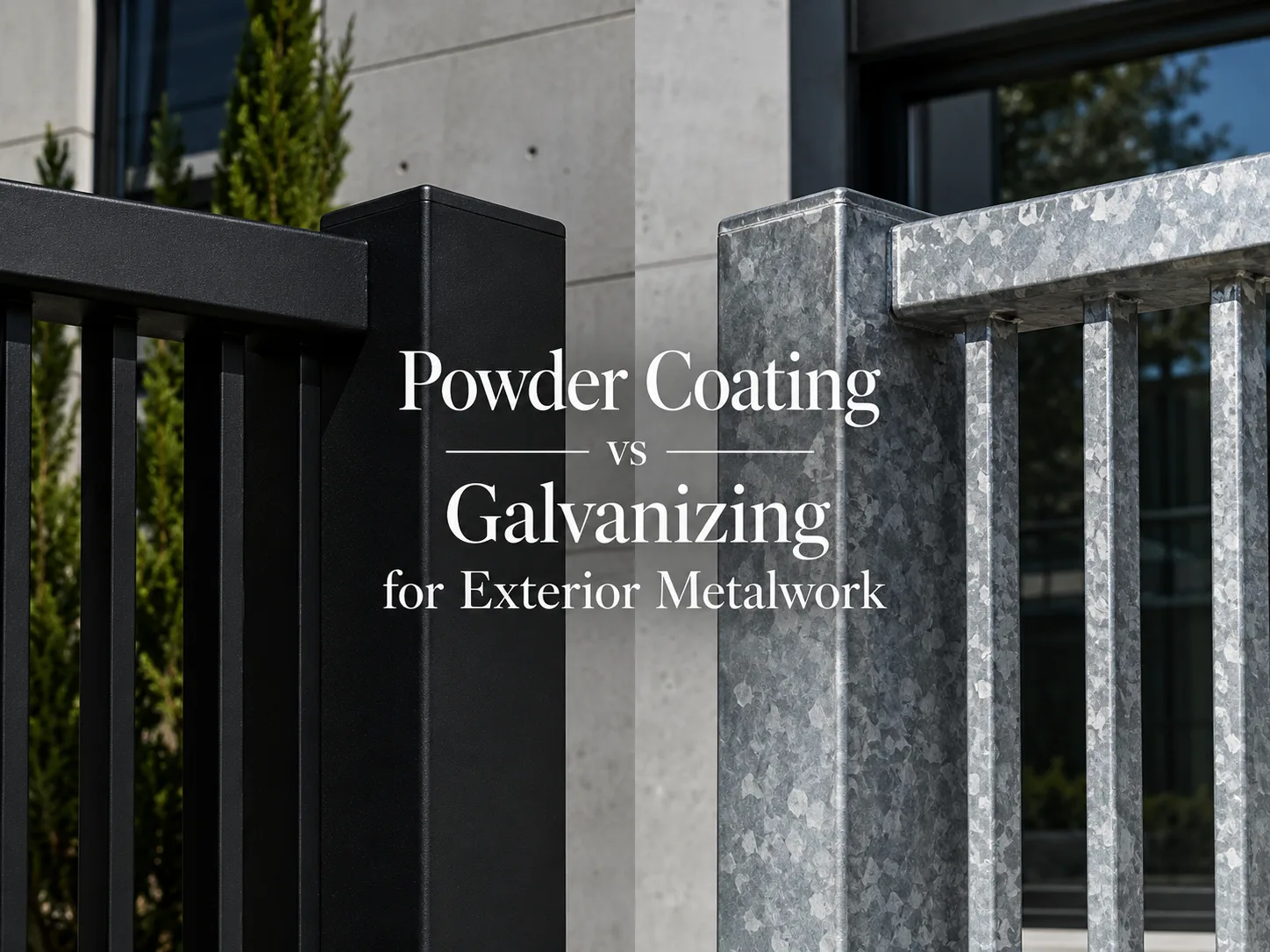
Galvanising generally provides more reliable corrosion protection for exterior iron and steel, because its zinc coating offers both barrier and sacrificial protection. Powder coating provides colour, texture and a smooth architectural finish, but it normally protects the steel as a barrier only, and depends heavily on surface preparation and coating integrity. Where exterior metalwork needs both strong corrosion protection and a decorative finish, a properly specified galvanised and powder-coated system may be more appropriate than choosing only one.
This powder coating vs galvanising comparison applies mainly to ferrous metalwork, iron and steel. Hot-dip galvanising is not a general treatment for aluminium, copper or stainless steel. The Galvanizers Association of Australia confirms non-ferrous materials such as aluminium, brass and copper aren’t suited to the standard process.

This article looks specifically at powder coating against galvanising. For how powder coating compares with conventional wet paint, see our powder coating vs paint for wrought iron guide.
Powder Coating vs Galvanising: Quick Comparison
| Factor | Powder Coating | Hot-Dip Galvanising |
|---|---|---|
| Primary purpose | Decorative barrier finish | Corrosion protection for iron and steel |
| Protection method | Isolates the substrate while the film remains intact | Zinc provides barrier and sacrificial protection |
| Appearance | Wide choice of colours, gloss levels and textures | Natural zinc finish that may vary in colour and texture |
| Behaviour after damage | Exposed steel may corrode if damage reaches the substrate | Surrounding zinc can protect small damaged areas |
| Surface preparation | Critical to adhesion and corrosion performance | Steel is chemically prepared during the galvanising process |
| Exterior suitability | Depends on pretreatment, powder type and exposure | Depends on zinc thickness, steel and exposure environment |
| Maintenance | Requires cleaning and inspection for film damage | Generally low maintenance but still requires inspection |
| On-site repair | Small repairs may not exactly match the original finish | Approved repair methods are required for significant damage |
| Design limitations | Component must normally fit the coating and curing process | Fabrication must allow safe venting, draining and immersion |
| Decorative use | Strong choice for visible architectural metalwork | Limited colour control without an additional topcoat |
| Combined use | Can be applied over suitable galvanised steel | Becomes the corrosion-protection base of a duplex system |
Powder Coating and Galvanising Do Different Jobs
Powder coating is an organic finish forming a protective barrier. Hot-dip galvanising creates a zinc coating metallurgically bonded to the steel, not sitting on top. These are complementary, not always competing, processes. The decision starts with substrate, environment and appearance, not an assumption that one is simply better. Powder coating does not bond to steel the way galvanising does.
What Is Powder Coating?
The surface is cleaned, prepared, and powder is applied electrostatically before curing under controlled heat. Performance depends on pretreatment quality, powder chemistry, exterior-use rating, primer requirements, weld/edge handling, film thickness and correct curing. “Powder-coated” alone is not a complete performance specification. AS 4506:2024 is the current standard covering thermoset powder coatings on metal substrates for atmospheric exposure, excluding architectural aluminium.

What Is Hot-Dip Galvanising?
Understanding this powder coating vs hot dip galvanising comparison starts with the process. Fabricated iron or steel is cleaned, prepared, and immersed in molten zinc, forming zinc-iron alloy layers with an outer layer of pure zinc. This gives two protection mechanisms: barrier protection from the coating covering the steel, and cathodic, or sacrificial, protection from zinc corroding preferentially, even where locally scratched. The Galvanizers Association of Australia confirms surrounding zinc can protect small exposed areas when the coating is damaged.
These terms aren’t interchangeable. Batch hot-dip galvanising after fabrication differs from pre-galvanised steel, continuously galvanised hollow sections, electrogalvanising, and zinc-rich primer. Each has its own performance profile.
Which Protects Better When the Surface Is Scratched?
A powder coating vs galvanised steel comparison looks different once you’re assessing damage rather than a fresh finish. Powder coating relies on the barrier film staying intact. A deep scratch can expose the underlying steel, and moisture reaching that area can cause corrosion. Galvanising behaves differently: zinc is sacrificed in preference to the steel, so small damaged areas may continue receiving cathodic protection after a scratch. Significant damage still requires an approved repair system. Galvanised does not mean permanently maintenance-free.
For more on how corrosion actually develops once a coating is compromised, see our guide to whether wrought iron rusts.
Which Provides the Better Appearance?
A galvanised vs powder coated steel comparison on appearance alone usually favours powder coating for consistency, though that’s only part of the picture. Powder coating offers colour choice, gloss control, and textured finishes. Galvanised steel looks different by nature: bright, matt or mottled areas, variation from steel chemistry, and a zinc patina that changes with weathering. This suits industrial projects well, and isn’t a defect, it’s simply what the process produces.
Which Is Better for Melbourne Exterior Metalwork?
There’s no single best coating for exterior steel that suits every project, and no universal answer based on the city alone. Real decision factors: distance to salt water, sheltered versus rain-washed surfaces, industrial contaminants, moisture traps, ground or masonry contact, likelihood of impact, maintenance access, required appearance, and actual use. Galvanising’s durability depends on zinc thickness and real exposure, not one assumed lifespan.
“painting hot dip galvanized steel can actually accelerate corrosion of the zinc substrate”
This is from the Galvanizers Association of Australia’s official technical guidance on painting and powder coating galvanised steel. The Association’s full point is more specific: in higher corrosivity zones, this only happens unless a judiciously selected, uniformly applied, high-build paint system is used and its integrity is maintained throughout its service life. It’s the exact technical reasoning behind this article’s caution that duplex systems require correct specification, since applying a coating over galvanising incorrectly can leave the fence or gate worse off than galvanising left alone.— Galvanizers Association of Australia, “Painting & Powder Coating Galvanizing”
Australian guidance uses AS/NZS 2312.2 and AS 4312 to assess corrosivity zones, which is why a powder coating vs galvanising decision has to be made project by project.
When Should Powder Coating Be Selected?
Deciding between powder coating or galvanising starts with what matters most for the component. Powder coating suits situations where appearance and colour are priorities, the component is visible architectural metalwork, and an exterior-grade system with correct preparation is available. It isn’t always sufficient for exposed steel in harsher environments.
When Should Galvanising Be Selected?
Galvanising suits situations where corrosion protection is the primary objective, the steel is permanently outdoors, the component may face abrasion, maintenance access is difficult, and a natural zinc appearance is acceptable. Real limitations: bath-size constraints, required vent and drain holes, possible distortion in unsuitable fabrications, and planning galvanising before fabrication is finalised.
Can Galvanising and Powder Coating Be Combined?
Yes, but this isn’t as simple as applying powder to any galvanised surface. The galvanised layer provides zinc protection, and a compatible coating adds colour and a second barrier. The surface needs appropriate preparation, and outgassing, adhesion and product compatibility need consideration, ideally with the galvaniser, powder manufacturer and applicator all involved.
The Galvanizers Association of Australia defines galvanised steel with paint or powder coating as a duplex coating system, warning that incorrect specification or preparation can cause early failure. Not every powder is automatically approved over galvanised steel: Dulux’s Zincshield primer suits blasted galvanised steel, but Dulux recommends consulting them for suitability, and their E-Prime primer suits hot-dip galvanised metals but isn’t rated for exterior exposure without a polyester topcoat. The powder coating vs galvanising debate often comes down to specifying both correctly together, not choosing one. Our beginner’s guide to choosing custom wrought iron products covers what else to ask a fabricator about finish specification.
Application Guide for Exterior Ironwork
| Application | Key Requirement | Finish Decision |
|---|---|---|
| Decorative front gate | Appearance plus corrosion protection | Assess a compatible duplex system |
| Boundary fence | Long runs, posts, welds and ground exposure | Prioritise corrosion system and drainage design |
| Exterior balustrade | Appearance, edges and safety-related maintenance | Project-specific professional specification |
| Security gate | Impact, abrasion and outdoor exposure | Consider galvanising with an appropriate decorative topcoat |
| Outdoor furniture | Appearance and easier refinishing may matter | Depends on fabrication, handling and exposure |
| Canopy or fixed metalwork | Difficult maintenance access | Prioritise long-term corrosion protection |
Selecting a coating doesn’t satisfy structural or balustrade compliance requirements on its own.
The same decision applies whether you’re finishing custom wrought iron fences, driveway gates or security gates. Our guide on the difference between wrought iron and steel is a useful companion read on the base metal itself.
Cost and Whole-of-Life Maintenance
We won’t provide fixed prices without current, documented figures. Cost drivers across both processes: component dimensions, fabrication complexity, bath and oven capacity, surface preparation, primer/topcoat specification, colour, exposure category, and future repair access. For genuine exterior metal corrosion protection over the life of the piece, the cheapest upfront option isn’t always the most cost-effective. Our Melbourne wrought iron gate cost guide outlines what typically drives pricing overall.
Questions to Ask the Fabricator
What is the exact base metal? Is the steel hot-dip galvanised after fabrication or pre-galvanised? Which standard applies? What surface preparation is completed before powder coating? Is a primer required? Is the powder suitable for the site exposure? Is the system approved over galvanised steel? What maintenance is required? What does the warranty cover and exclude? How will damaged areas be repaired?
Final Verdict
Galvanising generally provides the more robust corrosion-protection mechanism, while powder coating provides the stronger decorative finish. The appropriate answer to a powder coating vs galvanising decision isn’t determined by colour or material name alone. For metalwork needing both appearance and corrosion resistance, a professionally specified duplex system may offer the best balance, provided galvanising, preparation, primer and topcoat are all compatible.
Discuss your component, its location and the appearance you need with our team before selecting a finish.
Frequently Asked Questions
Is powder coating better than galvanising for outdoor steel?
Not universally. Powder coating generally offers better appearance and colour control, while galvanising offers more reliable corrosion protection. Is galvanising better than powder coating comes down to your project’s exposure, appearance needs and maintenance access.
Can galvanised steel be powder coated?
Yes, when specified correctly. This becomes a duplex coating system, combining zinc’s corrosion protection with the powder coating’s finish. Not every powder product is automatically approved over galvanised steel, so confirm with the manufacturer.
What is a duplex coating system?
Galvanised steel with a compatible paint or powder coating applied over the top. Zinc provides corrosion protection; the coating adds colour and an extra barrier. Incorrect specification can cause early failure.
Does powder coating prevent rust after it is scratched?
Not reliably. A deep scratch can expose the underlying steel, and moisture reaching that area can cause corrosion. Damage should be repaired promptly rather than left.
Does galvanised steel require maintenance?
Yes. It’s generally low maintenance, but still needs periodic inspection, particularly around any damaged or repaired areas.
Which finish is better for coastal exterior metalwork?
It depends on the exact exposure, not the coast alone. Galvanising with an appropriate duplex topcoat is often considered for higher-exposure coastal applications, but distance from salt water and the specific products involved matter.
Can completed wrought ironwork be hot-dip galvanised?
This depends on the fabrication. Galvanising must be planned before fabrication is finalised, since the component has to fit the bath and allow for safe venting, draining and immersion.


