Last Updated on August 23, 2026 by Elegance
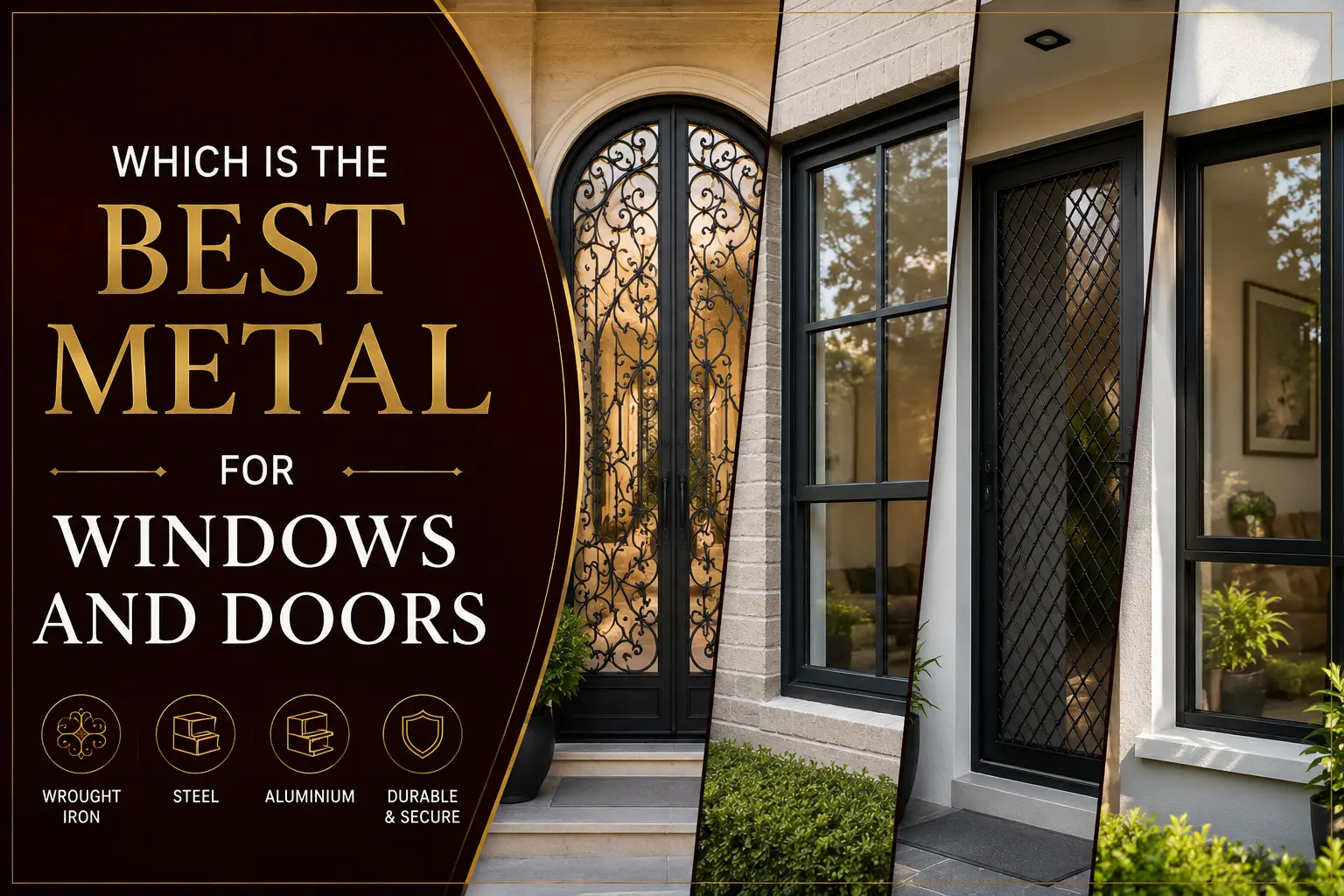
When it comes to windows and doors, the material you choose affects everything: security, longevity, maintenance, appearance, and cost. Metal is generally the strongest option across all four categories, but metal is not one thing. Steel, wrought iron, aluminium, bronze, and stainless steel each behave very differently and suit different applications, budgets, and architectural styles.
This guide compares every major metal option for windows and doors, explains what each one genuinely does well and where it falls short, and gives you a clear recommendation for Melbourne homes based on project type and property style.
Quick Answer: For decorative entry doors and security doors, wrought iron (worked in mild steel) is the best metal: strongest, most customisable, longest-lasting, and the best architectural match for Melbourne’s heritage homes. For window frames, steel and aluminium are the standard choices, with steel offering superior detail and longevity and aluminium offering a lighter, lower-maintenance alternative for contemporary builds.

What Are the Main Metals Used for Windows and Doors?
Five metals are commonly used for residential and commercial windows and doors in Australia:
- Wrought iron (mild steel worked using traditional blacksmithing)
- Mild steel (fabricated steel sections and tube)
- Aluminium (extruded sections and frames)
- Stainless steel (grades 304 and 316)
- Bronze (traditional heritage material)
Each has its own profile of strengths, weaknesses, costs, and ideal applications. The “best” metal depends on whether you are specifying a door or a window, what level of security you need, what your property looks like, and what climate zone you are in.
For a closer look at how wrought iron and mild steel differ in composition, durability and fabrication, see our detailed material comparison.
Wrought Iron and Mild Steel: Best for Entry Doors and Security Doors
Wrought iron, worked today as mild steel using traditional blacksmithing techniques, is the strongest, most durable, and most architecturally expressive metal available for doors.
This is the material Elegance in Iron works with exclusively for our custom entry doors, security doors, driveway gates, and fencing. Every piece is built from solid flat bar and round bar stock, shaped by hand, hot-dip galvanised, and finished to a standard that outlasts all other door materials.
Why Wrought Iron Wins for Doors
Security: Solid wrought iron bar stock is significantly harder to cut, pry, or force than aluminium or hollow steel tube. The solid cross-section of a forged wrought iron door means there is no hollow void to exploit. If you want to understand how wrought iron performs against determined forced entry, our post Are Wrought Iron Security Doors Actually Secure? covers the testing, lock hardware, and frame anchoring requirements in detail.
Longevity: Quality wrought iron doors last 40 to 60 years or more. Many original ironwork installations on Melbourne’s Victorian-era and Federation-era homes from the 1880s and 1890s are still standing. No other door material matches this lifespan. For the full cost-versus-lifespan analysis, see our guide on whether wrought iron doors are worth the investment.
Design capability: Because wrought iron can be heated and shaped at the forge, it produces hand-formed scrolls, tapered pickets, ornate panel fillers, and one-off custom designs that no other door material can replicate. Aluminium and standard steel are extruded or pressed; they can do straight lines and gentle curves, but they cannot produce the fine, organic, handcrafted detail that defines premium decorative ironwork.
Architecture match: Melbourne has one of the largest concentrations of Victorian-era and Federation-era residential architecture in the Southern Hemisphere. The decorative ironwork language of those homes, including lace balconies, scroll-top fences, and ornate entry doors, is built in wrought iron. For these properties, wrought iron is not just the best choice. It is the only choice that looks right.
Where Wrought Iron Needs Attention
Weight: Wrought iron doors are heavy. A full-height custom entry door can weigh 80 to 150kg depending on the design. This requires heavy-duty hinges, appropriate frame anchoring, and in some cases, structural assessment of the door jamb. Our team manages this as part of every installation.
Maintenance: All ironwork needs periodic repainting to maintain its protective coating. In Melbourne’s inner and middle suburbs, this means repainting every 7 to 10 years. Coastal properties in bayside suburbs like Brighton, Hampton, and St Kilda require attention every 3 to 5 years due to salt-laden air. Our wrought iron doors cost guide includes a realistic long-term maintenance cost breakdown alongside upfront pricing.
Cost: Custom wrought iron doors require skilled tradespeople working with design, forging, fabrication, galvanising, and installation. The upfront cost is higher than aluminium or standard steel doors. How a custom door is made explains every step of that process, which helps explain where the cost comes from and why it is justified over a 40-year lifespan.

Aluminium: Best for Window Frames and Contemporary Doors
Aluminium is the dominant material for window frames in modern Australian construction and a strong option for contemporary-style security doors. It is lightweight, naturally corrosion-resistant, widely available, and significantly cheaper than wrought iron or steel for large-span framing applications.
What Aluminium Does Well
Corrosion resistance: Aluminium forms a natural protective oxide layer on its surface when exposed to air. This oxide layer prevents the underlying metal from rusting, even without a paint coating. For coastal properties in Melbourne’s bayside suburbs, this is a genuine advantage for window frames, where salt spray reaches surfaces that are difficult to repaint regularly.
Weight: Aluminium is roughly one third the weight of steel for the same cross-sectional area. This makes it practical for large window openings, bi-fold and sliding door systems, and situations where door weight needs to be manageable for daily operation.
Low maintenance: Once installed with a quality anodised or powder-coated finish, aluminium window frames require very little ongoing attention beyond cleaning. The finish will eventually fade over 15 to 25 years, but this is cosmetic and does not affect structural performance.
Cost: Aluminium extrusions are mass-produced and widely available in Australia. For standard window sizes and contemporary door frames, aluminium is consistently the most cost-effective metal option.
Where Aluminium Falls Short
Strength: Aluminium is a softer metal than steel. It can be dented and scratched more easily than a steel or wrought iron door, and an aluminium security door can be forced or cut more readily than its solid steel or wrought iron equivalent. Products like Crimsafe use high-tensile aluminium mesh rather than standard aluminium, which significantly improves their resistance. For a direct comparison of how these options stack up, see our post Wrought Iron vs Crimsafe vs Aluminium Security Doors.
Design limitation: Aluminium is extruded into sections rather than forged or hand-formed. This limits the design vocabulary to clean lines, geometric shapes, and simple profiles. Intricate scroll detail, tapered pickets, and hand-forged ornamental work are not achievable in aluminium. For Federation, Victorian, Edwardian, and heritage-style Melbourne homes, aluminium looks wrong and undermines the architectural character of the property.
Thermal conductivity: Aluminium conducts heat rapidly, which can create condensation issues on window frames in Melbourne’s cooler months. Thermally broken aluminium frames (where a non-conductive barrier separates the inner and outer sections of the frame) address this, and they are now the standard specification for quality aluminium windows.
Mild Steel: The Mid-Tier Option for Windows and Doors
Mild steel sits between wrought iron and aluminium in most performance categories. It is stronger than aluminium, cheaper than premium custom ironwork, and available in a wide range of section profiles.
For steel-framed windows, mild steel has been used in Australian residential and commercial construction since the early 20th century. The slim sightlines of a Crittall-style steel window are a defining architectural feature of Art Deco and inter-war residential buildings across Melbourne’s inner suburbs. Heritage steel windows in properties from the 1920s to 1950s are still performing today, which speaks to the material’s longevity when properly treated.
For doors, mild steel fabricated from hollow section (tube) is common in budget security doors. The hollow construction allows faster fabrication and keeps weight down, but it is not as resistant to forced entry as solid bar wrought iron construction.
| Property | Mild Steel (Hollow Section) | Wrought Iron (Solid Bar) |
| Forced entry resistance | Good | Excellent |
| Weight | Moderate | Heavy |
| Design capability | Good | Excellent |
| Corrosion resistance | Requires coating | Requires coating |
| Cost | Mid-range | Higher |
| Lifespan | 20 to 40 years | 40 to 60+ years |
Stainless Steel: Best for Coastal Exposure and Modern Balustrading
Stainless steel is an alloy of steel with chromium content of at least 10.5%, which gives it exceptional corrosion resistance even in aggressive environments. It does not rust in the way mild steel does, making it the metal of choice for applications with sustained exposure to salt air, moisture, and high humidity.
In Australian residential applications, stainless steel is most commonly used for:
- Marine-grade wire balustrades (316-grade stainless for coastal properties)
- Pool fencing and outdoor railings
- Hardware components including hinges, locks, and fixings on ironwork installations in coastal areas
For windows and doors in Melbourne’s bayside suburbs, 316-grade stainless steel fittings and hardware are the correct specification. Using standard mild steel hardware on an otherwise quality door installation in Brighton or Sandringham will lead to rust staining and hardware failure well before the door itself needs attention.
Stainless steel is rarely used for full door or window frame construction in residential settings because it is expensive, difficult to weld without specialist equipment, and its aesthetic is clinical and cold. It works for contemporary commercial fitouts and specific architectural applications, but it is not the right choice for most Melbourne homes.
Bronze: The Heritage and Luxury Option
Bronze (an alloy of copper and tin, sometimes with additions of zinc or silicon) has been used for architectural metalwork for thousands of years. Today it is a premium, low-volume material used for heritage restoration and high-end residential projects.
Bronze window frames and door hardware have a characteristic warm golden tone that darkens naturally to a rich patina over time. In Melbourne, bronze is found in heritage commercial buildings, prestige residential properties, and architecturally significant restorations.
Advantages of bronze:
- Naturally corrosion-resistant, even in coastal conditions
- Extremely long-lasting (100+ year examples in active use globally)
- Develops a distinctive patina that improves in character over time
- No painting or coating required
Disadvantages:
- Very expensive (significantly more than wrought iron)
- Limited to a small number of specialist fabricators in Australia
- Heavy
- Patina changes over time (some owners prefer a controlled appearance)
For most Melbourne residential projects, bronze is not the practical choice unless the project is a heritage restoration with original bronze components, or a high-budget prestige build where the material’s unique properties are the specification.

Best Metal for Windows and Doors: Summary by Application
Rather than a single answer, the right metal depends on what you are specifying and where:
| Application | Best Metal | Why |
| Custom decorative entry door, Federation or heritage home | Wrought iron (mild steel, hand-forged) | Security, longevity, design capability, architecture match |
| Contemporary front door, modern home | Mild steel or aluminium | Clean profiles, cost-effective, good security |
| Security door, any home style | Wrought iron (solid bar) | Strongest resistance to forced entry |
| Window frames, modern or contemporary home | Aluminium (thermally broken) | Lightweight, corrosion-resistant, cost-effective |
| Window frames, heritage or inter-war home | Mild steel (Crittall-style) | Correct sightlines, architectural authenticity |
| Coastal property (Brighton, Hampton, St Kilda, Port Melbourne) | Aluminium frames + 316 SS hardware, or hot-dip galvanised ironwork | Salt-air corrosion resistance |
| Pool fencing and outdoor balustrades | 316-grade stainless steel or hot-dip galvanised ironwork | Moisture and UV exposure |
| Heritage restoration | Match original (wrought iron or bronze) | Architectural integrity |
How to Choose the Right Metal for Your Melbourne Home
Three questions will help narrow the decision quickly:
1. What architectural style is the property?
Victorian, Federation, Edwardian, and inter-war properties in suburbs like Malvern, Hawthorn, South Yarra, Toorak, Carlton, and Fitzroy have an established ironwork language. Aluminium does not belong on these homes. Wrought iron or Crittall-style steel is the correct choice. For guidance on buying the right gate or ironwork for your specific style, our post on buying the right wrought iron gate walks through the design considerations for different architectural periods.
Contemporary builds in newer suburbs or architect-designed homes with modern profiles are better served by aluminium or clean mild steel fabrication.
2. What is the primary need: security, appearance, or both?
If security is the main driver, wrought iron is the strongest option for doors. If appearance is the main driver and security is a secondary concern, the material choice follows the architecture. If both matter equally, wrought iron delivers on both. Our post Why Wrought Iron Fence Is the Best Security Fence covers the security case for iron in detail.
3. What is the property’s exposure to the elements?
Coastal and bayside properties have more demanding requirements than sheltered inner-city locations. Salt air, humidity, and UV exposure accelerate corrosion on any unprotected metal. The solution is not to avoid metal; it is to specify the right protective treatment. Hot-dip galvanised ironwork with a quality topcoat handles coastal Melbourne conditions very well.

Why Elegance in Iron Builds Exclusively in Wrought Iron
Every door, gate, fence, balustrade, and window grille we make at Elegance in Iron is built from solid mild steel bar stock using traditional blacksmithing techniques, hot-dip galvanised, and custom-designed for the property it is going on.
We do not fabricate from hollow tube. We do not use catalogue parts. We do not offer a standard range of sizes. Every piece is measured, designed, and built specifically for your doorway, your facade, and your brief.
That approach produces ironwork that looks different from everything else on your street because it genuinely is. The combination of solid bar construction, hand-formed ornamental detail, and a quality multi-coat finish gives our work a level of substance and refinement that cannot be produced any other way.
View our entry and security doors See how a custom door is made Read our wrought iron door cost guide Contact us for an obligation-free consultation
Showroom: 1367 Malvern Road, Malvern VIC Phone: 0450 01 01 01 | (03) 9809 1936 Hours: Mon to Fri 10am to 5pm | Sat 10am to 3pm
Frequently Asked Questions
Which metal is best for a security door in Australia?
Wrought iron built from solid bar stock is the strongest and most durable option for security doors in Australia. Solid forged bar is harder to cut or pry than hollow steel tube, aluminium, or mesh-based products. For a detailed comparison of how wrought iron performs against Crimsafe and aluminium alternatives, see Wrought Iron vs Crimsafe vs Aluminium Security Doors.
Is aluminium or steel better for windows?
For contemporary homes, aluminium with a thermal break is the standard choice for window frames: lightweight, corrosion-resistant, low-maintenance, and cost-effective. For heritage homes with inter-war or Federation character, slim-profile mild steel Crittall-style frames are more architecturally appropriate. Steel window frames from the 1920s to 1950s are still in service across Melbourne’s inner suburbs, demonstrating the material’s longevity with proper maintenance.
Does wrought iron rust more than aluminium?
Aluminium does not rust because it forms a natural oxide layer on its surface. Wrought iron and mild steel will corrode without a protective coating. However, a hot-dip galvanised mild steel door with a quality paint system provides excellent long-term protection and will outlperform an aluminium door in terms of security and structural integrity over its lifespan.
Is wrought iron good for windows?
Wrought iron and mild steel are excellent choices for window security grilles, window frames in heritage-style homes, and decorative window surrounds. For standard residential window frames in modern homes, aluminium is more practical. For security grilles and feature windows on Federation or Victorian properties, wrought iron provides security and an aesthetically correct finish.
How long do metal windows and doors last?
- Wrought iron doors: 40 to 60+ years with maintenance
- Steel windows: 50 to 100+ years with maintenance (original 1920s steel windows are still in service)
- Aluminium windows: 30 to 50+ years with quality finish
- Bronze: 100+ years (examples from the early 1900s in active use globally)
- Standard steel security doors (hollow tube): 20 to 40 years depending on coating quality and maintenance
What metal is used for decorative entry doors on Federation homes in Melbourne?
Wrought iron, worked today as mild steel using blacksmithing techniques, is the correct and historically consistent material for decorative entry doors, gates, and fencing on Federation-era Melbourne homes. The scroll patterns, picket profiles, and finial styles of original Victorian and Federation ironwork are all produced using forging techniques that only work in iron and steel. Aluminium cannot replicate these design details.


