Last Updated on October 8, 2026 by Elegance
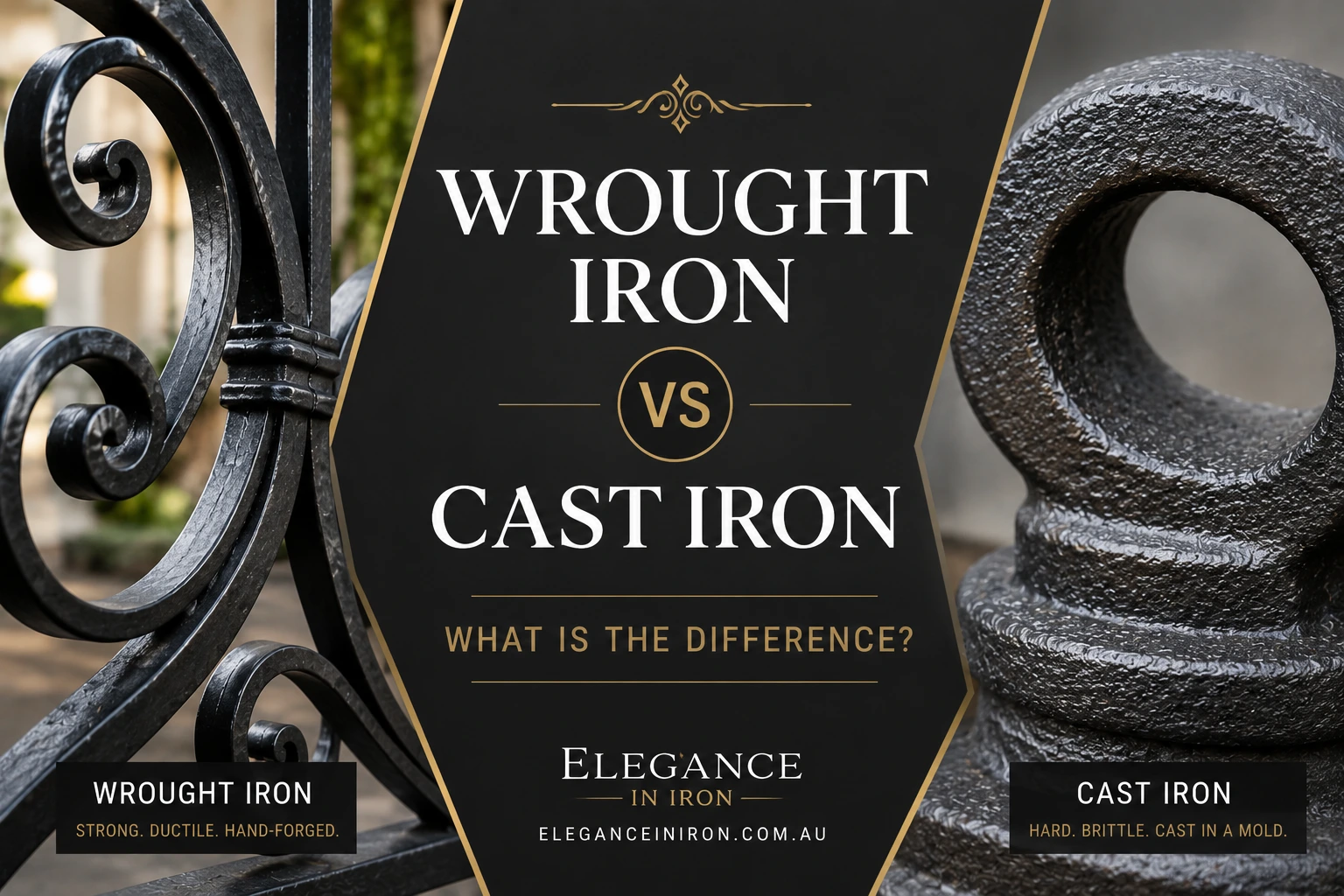
Wrought iron and cast iron are different iron-based materials produced through very different processes. Traditional wrought iron is worked and shaped while hot, giving it high ductility and allowing it to be forged into decorative forms. Cast iron is melted and poured into moulds, with a higher carbon content that makes it harder but generally more brittle.
For homeowners, the key difference is not simply which material is “stronger.” It is how each material behaves, how it is manufactured, and where it is best suited. It is also important to know that much of the decorative “wrought iron” used in modern architectural metalwork is actually mild steel fabricated in the traditional wrought-iron style, rather than historical wrought iron itself.
If you are choosing ironwork for your home, knowing this distinction matters. The wrought iron security gates, balustrades, fences and staircases you see on Melbourne’s finest properties are almost always wrought iron. Here is why.

| Comparison Factor | Wrought Iron | Cast Iron |
|---|---|---|
| Composition | Traditional wrought iron has very low carbon content and contains fibrous slag inclusions. | Contains a higher carbon content, typically around 2%–4%. |
| Manufacturing | Heated and mechanically worked, forged or shaped. | Molten iron is poured into moulds and allowed to cool. |
| Mechanical Behaviour | More ductile and able to deform before fracture. | Harder and generally more brittle, with lower ductility. |
| Design Flexibility | Well suited to forged curves, scrolls and individually worked decorative details. | Well suited to repeatable, complex shapes produced from moulds. |
| Typical Uses | Historically used for gates, railings, decorative metalwork and structural applications. | Commonly used for cookware, pipes, machine components and cast decorative elements. |
| What the Term Means Today | True wrought iron is uncommon in modern fabrication; many products described as “wrought iron” are made from mild steel worked in a traditional decorative style. | Cast iron still refers to iron alloys produced by casting molten metal into moulds. |
| Best Choice Depends On | Fabrication method, design requirements, complete assembly and intended application. | Shape, loading conditions, production method and intended application. |
What Is Wrought Iron?
Wrought iron is a low-carbon iron alloy containing less than 0.08% carbon by weight, along with slag inclusions (roughly 1 to 2%) that run through the metal in fibrous strands. The word “wrought” comes from the past tense of “work.” That name tells you exactly what it is: iron that has been physically worked.
To make wrought iron, pig iron is refined in a puddling furnace to burn off excess carbon. The resulting bloom of iron is then hammered, rolled and shaped repeatedly while hot. Each pass under the hammer refines the grain structure and aligns those slag fibres, which is what gives wrought iron its distinctive toughness and resistance to cracking.
If you’re also comparing materials for gates, fencing or architectural metalwork, our guide to wrought iron vs steel explains the key differences in strength, fabrication, maintenance and practical use.
This is a labour-intensive process. That is precisely why wrought iron has always carried a premium over cast iron. You are paying for time, skill and a material that responds to the hands of a craftsman.
Key properties of wrought iron:
- Carbon content: below 0.08%
- Tensile strength: approximately 300 MPa (comparable to structural steel)
- Ductile: bends before it breaks
- Naturally corrosion-resistant due to slag inclusions
- Can be welded, heated and reworked repeatedly
- Suitable for intricate hand-forged designs
What Is Cast Iron?
Cast iron is produced by melting iron in a furnace and pouring the molten metal into pre-shaped moulds. The carbon content is much higher, sitting between 2% and 4% by weight. Once cooled, the metal takes the exact shape of the mould and cannot be reworked.
That high carbon content gives cast iron its hardness. It is excellent at handling compressive loads, which is why it was used for columns, pipes and engine blocks throughout the industrial revolution. It also holds heat exceptionally well, which is why cast iron cookware remains popular to this day.
The downside is brittleness. Because the internal carbon forms graphite particles at grain boundaries within the metal, cast iron fractures before it bends. Drop a cast iron pan hard enough and it cracks. That same behaviour makes it unsuitable for structural components that need to flex under load.
“Cast iron is harder, more brittle, and less malleable than wrought iron. It cannot be bent, stretched, or hammered into shape, since its weak tensile strength means that it will fracture before it bends or distorts.”
— Reliance Foundry Co., Ask a Metallurgist: Wrought Iron vs Cast Iron | reliance-foundry.com
Key properties of cast iron:
- Carbon content: 2% to 4%
- Hard but brittle
- Cannot be bent, hammered or reworked after casting
- Fractures under tensile stress
- Excellent compressive strength
- Good heat retention
- Lower production cost than wrought iron

Wrought Iron vs Cast Iron: Key Differences at a Glance
| Property | Wrought Iron | Cast Iron |
| Carbon content | Below 0.08% | 2% to 4% |
| Manufacturing | Hand-worked under heat | Poured into mould |
| Tensile strength | High (approx. 300 MPa) | Low (fractures before bending) |
| Compressive strength | Good | Excellent |
| Ductility | High (bends without breaking) | Low (brittle) |
| Corrosion resistance | Natural slag protection | Prone to rust without coating |
| Workability | Can be re-heated and shaped | Cannot be reworked after casting |
| Design detail | Forged curves, scrolls, hand detail | Repeatable complex cast patterns |
| Cost | Higher (labour-intensive) | Lower (mould production) |
| Best for | Gates, fences, balustrades, furniture | Cookware, pipes, heavy industrial parts |
Which Is Stronger: Wrought Iron or Cast Iron?
The honest answer is that it depends on the type of strength you are measuring.
Wrought iron has significantly higher tensile strength than cast iron. Tensile strength measures how well a material resists being pulled apart or bent. At approximately 300 MPa, wrought iron performs comparably to modern structural steel. This is why historical bridges and structural frameworks built from wrought iron in the 19th century are still standing today.
Cast iron has higher compressive strength, meaning it handles being pressed or squeezed very well. But it has poor tensile strength, which means it fractures suddenly rather than deforming gradually. Engineers describe this as brittle failure, and it is the reason cast iron was phased out of structural construction once steel became widely available.
For decorative ironwork on Australian homes, tensile strength is what matters. Gates flex on their hinges. Fence pickets take lateral wind pressure. Balustrades carry the weight of a hand gripping the rail. All of those loads require a material that can absorb stress without snapping. Wrought iron handles all of them. Cast iron does not.
Appearance: Can You Tell Them Apart?
To the untrained eye, finished wrought iron and cast iron products can look similar, especially once painted. But there are differences worth knowing about.
Wrought iron has a slightly fibrous, layered surface texture that becomes visible under close inspection or after ageing. The forms tend to be flowing: tapered scrolls, curved bars, hand-forged leaves and pointed finials. Because a blacksmith shapes each piece individually, no two elements are exactly identical. That subtle variation is part of the character. Browse our gallery of wrought iron driveway gate designs to see the range of hand-forged scrollwork, finials and custom patterns that define this style.
Cast iron surfaces are smoother and more uniform because they replicate the mould exactly. The designs tend to be more symmetrical and highly detailed, with sharp repeating patterns that would be extremely difficult to produce by hand. Ornate Victorian cast iron lacework on heritage terraces is a good example of what the casting process does well.
In practice, most high-quality decorative ironwork today uses mild steel or steel bar stock worked in the tradition of wrought iron techniques, because true wrought iron is no longer commercially produced at scale. At Elegance in Iron, our work follows traditional wrought iron blacksmithing methods, producing the characteristic handcrafted forms that define classic decorative ironwork.

Wrought Iron vs Cast Iron for Gates and Fences
If you are shopping for gates or fencing for your home, here is a straightforward way to think about it.
Wrought iron (and steel worked in wrought iron tradition) is the right choice for gates, fencing, balustrades and staircases because it is strong, flexible and can be custom-designed from scratch. Every custom wrought iron gate Elegance in Iron produces is designed and built specifically for the property it goes on. The proportions, the scroll patterns, the height and the hardware are all matched to the architecture of the home. Because wrought iron gates are heavier than aluminium alternatives, they require engineered hinges and footings — and if automation is planned, see our guide to gate automation costs in Melbourne before finalising the specification.
Cast iron components do appear in decorative ironwork, but usually as individual ornamental pieces welded onto a wrought iron or steel framework. Decorative rosettes, post caps and ornate panel fillers are often cast because the mould process reproduces complex detail efficiently. The structural frame, however, is always wrought iron or steel.
Choosing genuine cast iron for an entire gate or fence is not practical for residential use. The brittleness is a real problem: a car reversing into a cast iron gate, a branch falling on a cast iron fence, or just the cumulative stress of daily use and Melbourne wind loads will crack cast iron components in ways that wrought iron simply would not. If you are also weighing up materials for a new entrance, our guide to wrought iron vs aluminium gates covers how the two compare on cost, maintenance and style.
Maintenance: Which One Rusts More?
Both wrought iron and cast iron will rust if left unprotected and exposed to moisture. The difference is that wrought iron has some natural corrosion resistance built into its slag inclusions, while cast iron has no such protection and corrodes faster when bare. For a full walkthrough of how rust develops and how the right finish prevents it, see our guide to whether wrought iron rusts and how to prevent it.
In both cases, proper surface treatment is the real answer. All Elegance in Iron work is primed and finished with appropriate protective coatings before installation, and we recommend a maintenance repaint every 5 to 7 years depending on the level of exposure to weather and salt air. Coastal Melbourne properties need more attention than sheltered inner-city installations.
The maintenance discipline required is one reason powder coating has become popular for decorative ironwork. A quality powder coat sits over a zinc phosphate primer and provides far more durable protection than oil-based paint alone.

Which One Costs More?
Wrought iron products cost more than cast iron products, and that price difference reflects real differences in how they are made.
Producing a cast iron part is relatively quick. You make a mould, pour in the molten metal, let it cool, and you have your piece. The same mould can be used thousands of times. That repeatability and low labour input is why cast iron cookware and industrial components are affordable.
Wrought iron work is slower. A blacksmith heats bar stock, shapes it at the anvil, welds sections together, refines the detail and finishes the surface by hand. There are no shortcuts. A custom gate from Elegance in Iron reflects the time of skilled tradespeople who have spent years developing their craft. For a full breakdown of what that means in practice for gate projects, see our guide to how much wrought iron gates cost in Melbourne.
That cost difference should not discourage you. The lifespan of quality wrought iron work is genuinely exceptional. A properly installed and maintained wrought iron gate or fence will outlast the house it stands in front of. The value calculation over 30, 40 or 50 years is very different from what the upfront price comparison suggests. Our full guide on how long wrought iron gates last covers exactly what affects that timeline.
A Short Note on “Wrought Iron” Today
True wrought iron has not been commercially produced in meaningful quantities since the mid-20th century, when steel manufacturing overtook it entirely. When decorative ironwork companies today refer to “wrought iron gates” or “wrought iron fences,” they are almost universally referring to mild steel bar stock that is worked using traditional blacksmithing techniques.
The material behaves similarly: low carbon content, good tensile strength, can be heated and shaped repeatedly. The aesthetic result is the same: tapered scrolls, curved forms, handcrafted detail. The term “wrought iron” in the context of decorative ironwork is now effectively a style and process description rather than a strict material specification.
This is not deceptive; it is simply how the trade has evolved. What matters is that the work is hand-forged using traditional methods rather than bent from tubing or assembled from standard catalogue parts.
Frequently Asked Questions
Is wrought iron stronger than cast iron? Wrought iron has higher tensile strength (approximately 300 MPa) compared to cast iron, which has low tensile strength and fractures before bending. Cast iron has better compressive strength. For gates, fencing and balustrades, wrought iron is the stronger and more suitable material.
Why is wrought iron better for decorative gates than cast iron? Wrought iron can be bent, scrolled and shaped into flowing custom designs without breaking. Cast iron is brittle and cannot be worked after casting. Cast iron also fractures under the lateral loads and flex that gates and fences experience in everyday use.
How can you tell wrought iron from cast iron? Wrought iron has a slightly fibrous, layered surface texture and shows subtle variation between individual elements because each piece is hand-forged. Cast iron has a smooth, uniform surface that exactly replicates the mould, and repeating patterns are perfectly identical across multiple pieces.
Does cast iron rust faster than wrought iron? Yes. Wrought iron has some natural corrosion resistance due to its slag inclusions. Cast iron has no such protection and corrodes faster when bare. Both materials need protective coatings for outdoor use, and both benefit from regular maintenance.
Is real wrought iron still made today? Genuine wrought iron is no longer commercially produced at scale. Decorative ironwork sold today as “wrought iron” uses mild steel worked by traditional blacksmithing methods. The result looks and performs the same as historical wrought iron for decorative applications.
How long does wrought iron last? With proper installation and maintenance, quality wrought iron gates and fencing can last 50 years or more. Many Victorian-era wrought iron fences from the 1880s are still standing across Melbourne today.
Wrought Iron Work for Melbourne Homes
Elegance in Iron designs and builds custom gates, fences, balustrades, staircases, entry doors and balconies for Melbourne homes and commercial properties. Every piece is made by hand using traditional blacksmithing techniques, which means your gate or balustrade is not assembled from off-the-shelf parts. It is built specifically for your property, your architecture, and your brief.
If you are planning a renovation, a new build, or simply want to improve your property’s street appeal and security, get in touch for an obligation-free consultation.


