

Last Updated on August 25, 2026 by Elegance
Solid metal infill gives the most screening. It is not the only option.
Close-spaced battens, angled louvres, perforated panels and layered wrought iron all reduce views while keeping light and airflow. The right choice depends on where the unwanted view comes from, and how the gate needs to operate.

Quick Comparison
| Privacy Idea | Privacy | Airflow | Key Consideration |
|---|---|---|---|
| Solid metal infill | High | Low | Greater wind exposure |
| Close-spaced battens | Medium to high | Moderate | Spacing determines visibility |
| Horizontal slats | Adjustable | Moderate | Views may change from angles |
| Angled louvres | High, selected direction | Good | Blades must match the actual view |
| Perforated metal | Medium to high | Moderate | Pattern and open area affect privacy |
| Laser-cut panels | Adjustable | Moderate | Some patterns reveal more than expected |
| Layered wrought iron | Medium to high | Good | Requires careful alignment |
| Iron with timber infill | High | Low to moderate | Materials need different maintenance |
| Part-solid, part-open | Targeted | Good | Privacy must sit at the right height |
| Open gate with planting | Soft | High | Plants take time and maintenance |
These are general comparisons, not engineering specifications.
Decide What You Actually Want to Hide
Define the problem before picking a design.
- Can people see straight into the living area or driveway?
- Is the view straight-on, or from an angle?
- Does overlooking come from a neighbouring upper level?
- Is privacy only needed at standing eye height?
- How does the gate look after dark, when lit up?
A gate can look private from the street and still show angled views.
Full, Directional or Filtered Privacy
Full privacy blocks most direct views. Think solid panels, timber infill, or closely joined battens. It reduces airflow and adds visual weight.
Directional privacy blocks one line of sight while keeping airflow. Angled louvres and offset bars work best here, once the actual viewing angle is assessed.
Filtered privacy keeps the entrance lighter. Perforated metal, laser-cut panels and fine mesh reduce visibility without fully blocking it.
Solid Infill, Battens, Slats and Louvres
Solid metal infill suits modern homes and hides vehicles or side passages well. It adds wind load, bulk, and demands more from posts, hinges and automation. It is not automatically more secure than an open design.
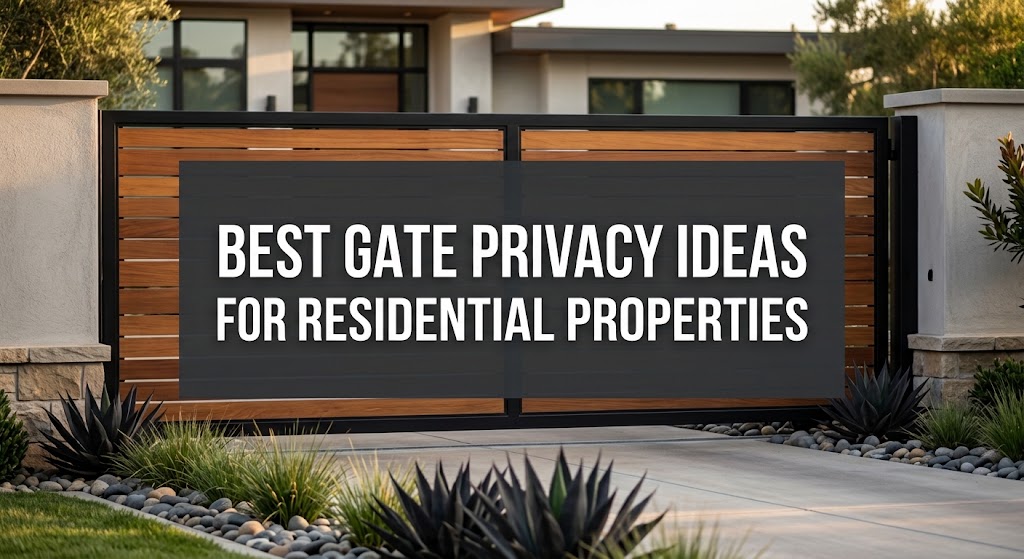
Close-spaced vertical battens suit contemporary homes. Width, depth and spacing all control how much is visible, and deeper battens block angled views better.
Horizontal slats give a clean, modern look. Narrow gaps can still reveal the property from some angles, and night lighting makes this more noticeable.
Angled louvres block a specific view while allowing airflow. Blade direction has to match the real sightline. Louvres do not give full privacy from every angle.
Laser-Cut, Perforated and Mesh Panels
Elegance in Iron’s own driveway gate designs use laser-cut panels, close-spaced bars and frosted glass behind iron to balance privacy with an open feel. For additional examples, see wrought iron driveway gate designs.
Pattern density controls privacy. Very detailed patterns can be harder to clean. Perforated sheet, expanded metal and fine mesh filter views rather than block them completely, and mesh alone does not guarantee security or insect protection.
Layered Iron and Timber Infill
Privacy does not require hiding the ironwork. Offsetting two rows of bars, or placing scrollwork in front of a partial backing panel, adds screening while keeping the decorative detail visible.
Elegance in Iron also builds wood-and-iron fusion gates, which combine a metal frame with timber infill for a warmer look. The main wrought iron driveway gates service shows the broader gate offering. Timber and metal weather differently and need different maintenance, so this is worth planning for. For a broader material comparison, see wrought iron vs timber gates.
Zoned Privacy and Landscaping
Privacy does not need to cover the whole gate. A solid lower section with open ironwork above, or denser screening at eye height, often looks lighter than a fully solid design.
Landscaping can support privacy too, through hedges or layered planting. Keep plants clear of moving parts, tracks, sensors and underground services.
Privacy Versus Security and Visibility
Privacy and security are related, but not the same thing. A solid gate can reduce natural surveillance from the street, even while it screens the property.
Victorian urban design guidance favours front fences that support informal surveillance, through lower or partly transparent designs. Locking, lighting and gate height affect security separately from privacy. A privacy gate does not prevent burglary on its own. For the dedicated security-focused range, see security gates Melbourne.
“use fence types that are low height or partially transparent.”
This wording appears in Section 6.4.3, “ensure front fences support informal surveillance to the street and public spaces,” of Victoria’s Urban Design Guidelines for Victoria page “6.4 Barriers and fences,” last updated 28 October 2025. The accompanying guidance explains that low or transparent fences create opportunities for informal surveillance of streets and public spaces. That directly supports the trade-off discussed in this section: a privacy gate can screen views, but a fully opaque street boundary may reduce visibility between the property and the street.
Source: Planning Victoria — Urban Design Guidelines for Victoria: 6.4 Barriers and fences.
How Privacy Infill Affects Gate Operation
Swing gates catch more wind as they become more enclosed, which adds load to hinges, posts and automation. The swing area must stay clear of the street. For the installation process and site considerations, see driveway gate installation.
Sliding gates need enough side return, and added infill changes the gate’s weight. Tracks and automation need to suit the finished design. For measurement guidance, see how to measure for a driveway gate.
On any gate, privacy infill should not make the latch or handle hard to reach or operate.

Matching the Gate to Your Home
- Victorian or Edwardian: decorative iron frame, denser scrollwork, selective backing panels
- Contemporary: battens, horizontal slats or geometric laser-cut panels
- Coastal: more open or directional screening, given wind exposure
- Small urban frontage: partial screening, with a clear house number and entry point
For coastal exposure and finish planning, see protect exterior metalwork from salt air. For compact frontages, see front gate ideas for small homes.
No single style suits every property.
Check Planning and Council Requirements
Front-gate and front-fence rules depend on your zone, overlays, heritage controls and street classification. Victorian planning guidance considers fence height and neighbourhood character, and local schedules can change what applies. Some councils, including Wyndham, require that gates do not swing beyond the title boundary or across the footpath.
No single height limit applies to every Melbourne property. Check with your council before finalising a design.
Final Recommendation
- Solid infill: when blocking direct views is the priority
- Close-spaced battens: adjustable privacy with a clean look
- Louvres: privacy from one known direction
- Perforated or laser-cut panels: filtered privacy
- Layered or zoned screening: balancing privacy, airflow and street presence
Confirm planning, wind and automation requirements before approving a final design.
Frequently Asked Questions
What type of gate provides the most privacy?
Solid infill or iron with timber panels blocks the most direct view. Coverage still depends on gaps, height and the angle it is viewed from.
Are slatted gates private?
Slats can provide good privacy straight-on, but angled views may still show through, especially with wider spacing.
Can a wrought-iron gate provide privacy?
Yes. Laser-cut panels, backing panels, timber infill or layered ironwork can all add privacy without losing the decorative detail.
Are louvre gates private from every direction?
No. Louvres block a specific line of sight based on blade angle, not every possible viewing direction.
Do solid gates create more wind load?
Yes. A more enclosed surface catches more wind, which affects posts, hinges and automation requirements.
Is a solid gate more secure than an open gate?
Not automatically. Security depends on the whole system, including locks, hinges, posts and how the gate is installed.
Can privacy panels be added to an existing gate?
Sometimes, but added weight and wind load need professional assessment before infill is fitted to an existing frame.
Do I need council approval for a privacy gate?
Often yes, depending on your zone, overlays and street classification. Check with your council before finalising the design.


