Last Updated on August 18, 2026 by Elegance
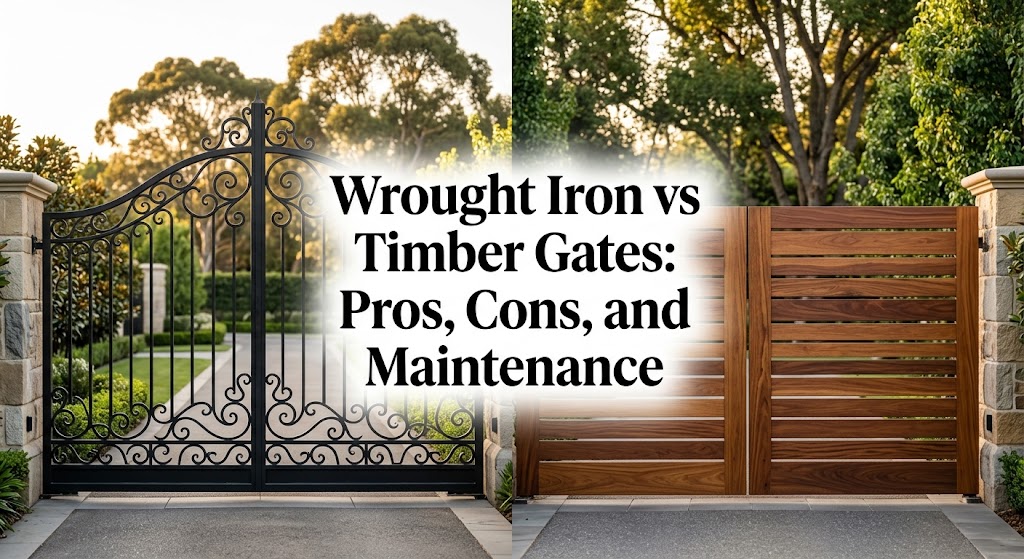
Choosing between a wrought iron and timber gate usually comes down to one key decision: do you want the strength and custom character of metalwork, or the warmth and privacy of natural timber? Neither is automatically the right call for a Melbourne home. Iron tends to win when strength, custom detailing and long-term structural stability matter most. Timber brings natural warmth and can create real privacy, though how well it performs depends heavily on species, treatment and how consistently it’s maintained. The better choice usually comes down to a few practical questions: how much privacy you want, your home’s architectural style, how exposed the entrance is, the gate’s size, whether it will be automated, and how much upkeep you’re realistically prepared to do.
| Factor | Wrought iron gate | Timber gate |
|---|---|---|
| Appearance | Decorative, custom scrollwork or clean modern lines | Natural grain, warm and solid-looking |
| Privacy | Usually open, unless infill is added | Commonly gives strong visual privacy |
| Security | Rigid, custom-built barrier when the whole system is designed well | Depends on frame, timber condition and hardware |
| Weather behaviour | Needs an appropriate corrosion-protection system | Depends on species, treatment and moisture management |
| Maintenance | Coating checks, cleaning, prompt repair of chips | Cleaning plus finish, joint and moisture checks |
| How it moves over time | Doesn’t swell or shrink with the weather | Can move as moisture conditions change |
| Automation | Finished weight, geometry and wind load need assessing | Weight and moisture movement need assessing |
| Design detail | Excellent for scrollwork and custom patterns | Excellent for natural grain and solid panels |
| Upfront cost | Driven by fabrication and design complexity | Driven heavily by species and construction |
| Best suited to | Custom, security-focused, architectural entrances | Natural-looking, privacy-focused entrances |
This is a starting point for comparison, not a rulebook — the row that matters most will depend on your property.

Wrought Iron vs Timber Gates: What You’re Actually Choosing Between
“Wrought iron” today can mean genuinely forged ironwork, or fabricated steel shaped and finished to give a similar look. Quality varies between workshops, so it’s worth asking how a gate is actually made. Our guide on the difference between wrought iron and steel covers this distinction in more depth.
“Timber gate” is even less of a single product. Performance depends on species, whether the wood is heartwood or sapwood, the preservative treatment, how the frame and joinery are built, the finish, and ground clearance. Australian timber durability is classed by species and exposure, so it’s not safe to assume all hardwoods, or all treated timbers, will perform the same way in the same spot.
“The untreated sapwood of all timber species is regarded as class 4”
This is from the Queensland Government’s official guide to natural durability ratings, based on Australian Standard AS 5604-2005. The standard rates heartwood on a scale from Class 1 (over 40 years’ above-ground service life) down to Class 4 (0–7 years), but this note applies regardless of species: untreated sapwood is always treated as the least durable class, irrespective of how durable that same species’ heartwood is rated. It’s a useful technical backdrop for why “the timber is a durable species” isn’t a complete answer on its own — which specific piece of that species, heartwood or sapwood, was actually used matters just as much.— Queensland Government, Department of Agriculture and Fisheries (QTimber), “Natural durability ratings”
Appearance and Architectural Fit
Wrought iron isn’t limited to period homes. It suits Victorian and Edwardian properties and European-inspired facades, but also works well on modern homes with clean, geometric lines. Timber tends to suit rustic settings, rural properties, contemporary slatted facades, and homes that already use timber cladding, where it adds a warmer note than metal.
Privacy and Visibility
Privacy is largely a design decision, not something baked into the material. Solid timber panels usually block more of the view straight away. Open wrought iron allows sightlines between street and property, but can just as easily be paired with steel, timber or mesh infill to close that up. The trade-off runs both ways: solid designs increase wind load, while very open designs can make a small entrance feel less enclosed.
Strength and Security
Security is a property of the whole gate system, not the material alone — the frame, posts and foundations, hinges, locking hardware, height and geometry, bar spacing, and installation quality all matter. A well-built iron gate offers a rigid structure, but iron alone doesn’t guarantee security. A properly framed, maintained timber gate can still control access effectively; it isn’t inherently the weaker option.
Weather Resistance in Melbourne
Melbourne properties can face very different conditions depending on location. A coastal home exposed to salt air may need different material and finish considerations than a sheltered suburban property just a few kilometres inland.
Wrought iron
Longevity here comes down to surface preparation, an appropriate corrosion-protection system (galvanising where suitable), and an exterior-grade paint or powder coating suited to the site. Powder coating performance depends on the specific product, substrate preparation, application process and environment — coastal and industrial-adjacent sites often need a different specification to a sheltered suburban block, so “it’s powder-coated” isn’t a complete answer on its own. Chips and exposed metal are worth treating promptly, since that’s usually where corrosion starts. Our guide on whether wrought iron rusts covers this in more detail.
Timber
Timber absorbs and releases moisture as conditions change, which drives natural expansion and movement caused by the seasons and, over time, risks like checking, splitting, cupping or warping. UV exposure will also grey and gradually break down an unmaintained finish. Heartwood, sapwood and treated products behave differently, and good drainage and ventilation in the gate’s design matter as much as the timber itself. None of this means a timber gate will necessarily warp or rot — the outcome depends on species, detailing and upkeep.
Maintenance, Realistically
A wrought iron gate generally needs gentle cleaning, a periodic check of the coating for chips or wear, an inspection of welds, fasteners, hinges and moving parts, and prompt touch-up wherever bare metal is exposed — following the coating manufacturer’s care instructions rather than guesswork.
A timber gate needs its own routine: checking for moisture-related movement, inspecting joints and fasteners, watching for splitting or surface deterioration, maintaining the coating per the manufacturer’s guidance, and paying attention to bottom edges and any spot where water can sit. There’s no single recoating interval that applies to every timber gate — it depends on species, finish and exposure.
What Actually Drives the Cost
Published price ranges for gates tend to be more misleading than useful, since so much depends on the specific job. For wrought iron, the main cost drivers are dimensions, design complexity, whether it’s a solid or decorative build, the finish specification, posts and foundations, automation, and site conditions during installation. For timber, it’s the species, thickness and grade, frame construction, joinery, finish, hardware, and the ongoing maintenance and eventual board replacement the gate will need over its life. Neither material comes out cheaper by default once total ownership is counted. Our Melbourne wrought iron gate cost guide breaks down typical pricing for the iron side of this comparison.
Automation and Wind Load
Both materials can be automated. What matters for motor selection is the finished gate’s weight and operating geometry, not the material label. A solid timber gate can create significant wind load, and an iron gate with solid infill can be just as heavy — it’s the amount of solid surface catching the wind that counts.
Posts, hinges and foundations all need to be sized for the completed, in-service gate, so this is worth confirming with whoever is designing and installing it rather than assuming either material is automatically the easier option. Accurate site measurements are the starting point for this — see our guide on wrought iron gate measurements.
Sustainability, Without the Slogans
A fair comparison looks at whether the timber is certified and responsibly sourced, how species choice affects replacement frequency, what treatments are needed over the gate’s life, the recycled content and recyclability of the metal, expected service life, repairability, and how far components travelled to reach the site.
Neither “timber is sustainable” nor “metal lasts longer so it’s greener” holds up as a blanket claim — both depend on the specifics above. Any specific carbon-footprint claim should be backed by product-specific evidence, not a general statement about the material.

A Combined Timber-and-Iron Gate
A metal frame with timber infill is worth considering if you want iron’s rigidity and custom detailing alongside the warmth and privacy of natural timber — it can also tie visually to timber elements elsewhere on the property and use replaceable infill panels for more flexibility down the track. The trade-offs are real: the two materials move and weather differently, so connections need to accommodate timber movement, the infill still needs its own maintenance, solid infill affects wind load the same way a solid timber gate would, and colours and finishes need to be coordinated. Not every wrought iron workshop builds hybrid gates in-house, so if this option appeals, it’s worth asking a fabricator directly. Our beginner’s guide to choosing custom wrought iron products is a useful starting point for that conversation.
Which Gate Fits Your Situation?
This is a starting point for a conversation with a fabricator, not an engineering specification — site conditions, exposure and your home’s architecture will still shape the final recommendation.
| If your priority is… | A reasonable starting point |
|---|---|
| Decorative, custom entrance | Wrought iron |
| Natural, organic appearance | Timber |
| Full visual privacy | Timber, or iron with suitable infill |
| Open sightlines to the street | Wrought iron |
| Low tolerance for upkeep | Wrought iron with an appropriate finish |
| Heritage-style property | Depends on the original architecture |
| Contemporary, solid-looking gate | Timber, metal infill, or a combined design |
| Highly exposed entrance | Site-specific material and finish assessment |
| Warm look with a rigid structure | Wrought iron and timber combination |
Frequently Asked Questions
Are wrought iron gates better than timber gates?
Neither is universally better. Wrought iron tends to suit homeowners who want custom metalwork and an open, architectural look, while timber tends to suit those wanting natural warmth and solid privacy.
Which gate requires more maintenance?
It depends on the finish, exposure and construction rather than the material alone. Timber usually needs ongoing checks of coatings, joints and moisture movement; wrought iron needs coating care and prompt attention to any exposed metal.
Can timber and wrought iron be used in the same gate?
Yes — a metal frame can be combined with timber infill, provided the design accounts for timber movement, drainage, the connections between materials, weight and wind load.
Which gate is better for privacy?
Solid timber usually gives more immediate visual privacy, but wrought iron can also incorporate closely spaced elements or a privacy infill to achieve a similar effect.
Can both timber and wrought iron gates be automated?
Yes. The motor, hinges, posts and foundations all need to be selected around the finished gate’s weight, size, geometry and exposure to wind — whichever material it’s made from.

