

Last Updated on July 30, 2026 by Elegance
A well-designed front gate can make a small home feel more spacious, polished, and inviting. The key is not to install the largest or most imposing gate possible, but to choose a design that respects the scale of the house, maintains visual openness, and complements the architecture. For bungalows, cottages, row houses, and compact urban properties, the right pedestrian gate becomes more than a security feature — it acts as the front door to the entire property.
| Design Element | Best Approach for Small Homes | What to Avoid |
|---|---|---|
| Gate height | Low to medium height that relates to the house | Full-height gates that dominate the frontage |
| Visual privacy | Filtered views through slats or metalwork | Completely solid, fortress-like panels |
| Materials | Refined timber, slim steel, or custom ironwork | Bulky, industrial, mass-produced designs |
| Hardware | Compact hinges, latches, and handles | Oversized hardware that overwhelms the gate |
| Dimensions | Custom-built to fit the exact opening | Standard gates with filler panels or awkward gaps |
Why Front Gate Design Matters for Small Homes
On a large property, an oversized gate may be balanced by a wide driveway, substantial landscaping, or a long boundary wall. On a small frontage, however, every element carries more visual weight. A gate that is too tall, too solid, or too decorative can quickly make the entrance feel narrow and defensive.
The most successful front gate ideas for small homes create definition without isolation. They mark the boundary of the property while still allowing light, depth, and architectural details to remain visible. Rather than hiding the home, the gate should introduce it — an idea covered further in our roundup of wrought iron front door design ideas for Melbourne.
“Everybody intuitively knows curb appeal matters, but nobody had quantified it.”

This is Dr. Sriram Villupuram, a University of Texas at Arlington real estate finance professor, discussing his peer-reviewed study in The Journal of Real Estate Finance and Economics. The research found that homes with strong curb appeal — including a well-kept, inviting entryway — sold for an average of 7% more than comparable homes nearby, and that premium climbed even higher in slower markets. A front gate is one of the first things a visitor or buyer sees, which is exactly why its scale and proportion matter so much on a small frontage.— Dr. Sriram Villupuram, University of Texas at Arlington, quoted in “First impressions pay: Curb appeal adds 7%” (UTA News Center; link verified live)
The Golden Rule of Scale
Proportion is the most important consideration when designing a gate for a compact property. The gate should relate naturally to the height of the fence, the width of the pathway, the scale of the porch, and the horizontal or vertical lines of the house.
A narrow cottage entrance may suit a simple pedestrian gate with slim vertical boards, while a wider bungalow frontage may benefit from a lower double gate with open spacing. Custom dimensions allow the gate to follow the existing architectural lines instead of competing with them. Getting these measurements right the first time is covered in our guide on wrought iron gate measurements.
Match the Gate to the Width of the Entrance
A small opening does not need a visually heavy gate. Thick framing, wide boards, and large posts can consume valuable space and make the pathway appear tighter than it actually is. Slimmer structural members can provide security while preserving a lighter appearance.
The gate should also open comfortably without colliding with steps, planting, letterboxes, or nearby walls. Measuring the full movement of the gate — not only the width of the opening — is essential in a compact entrance.
Consider the Height of the House and Fence
A full-height gate can look appropriate beside a tall boundary wall, but it may overwhelm a low bungalow or cottage. In many cases, a gate that sits level with the surrounding fence or slightly below nearby architectural features creates a more balanced result.
The aim is to establish a clear entrance without creating the impression that the house is concealed behind a barrier. A lower or partially transparent gate often delivers enough separation while keeping the property welcoming.
The Power of Verticality
Vertical lines are especially effective in small spaces because they draw the eye upward rather than across the limited width of the entrance. Narrow timber slats, slim steel bars, or refined iron pickets can make a compact gate appear taller and more elegant without adding excessive visual weight.
Vertical designs also work well with many architectural styles. Clean, evenly spaced slats can complement a modern townhouse, while traditional iron pickets may suit a cottage or period row house. The spacing, thickness, and finish can be customised to create anything from a minimalist appearance to a more classic character — see more approaches in our security gate design ideas for modern homes.
Use Narrow Slats to Create Rhythm
Narrow vertical slats create a sense of repetition and movement. This visual rhythm helps soften the boundaries of a small entrance and makes the gate feel integrated rather than block-like.
The spacing between each slat can be adjusted according to the required privacy level. Tighter spacing offers more screening, while wider spacing allows more light and a clearer view into the garden.
Extend Existing Architectural Lines
A custom gate can repeat the proportions already present in the home. Vertical cladding, porch posts, window frames, or fence battens can provide inspiration for the gate layout.
Repeating these details creates visual continuity. Instead of appearing as a separate object added to the boundary, the gate feels like an intentional extension of the house.
Strategic Transparency and Filtered Views
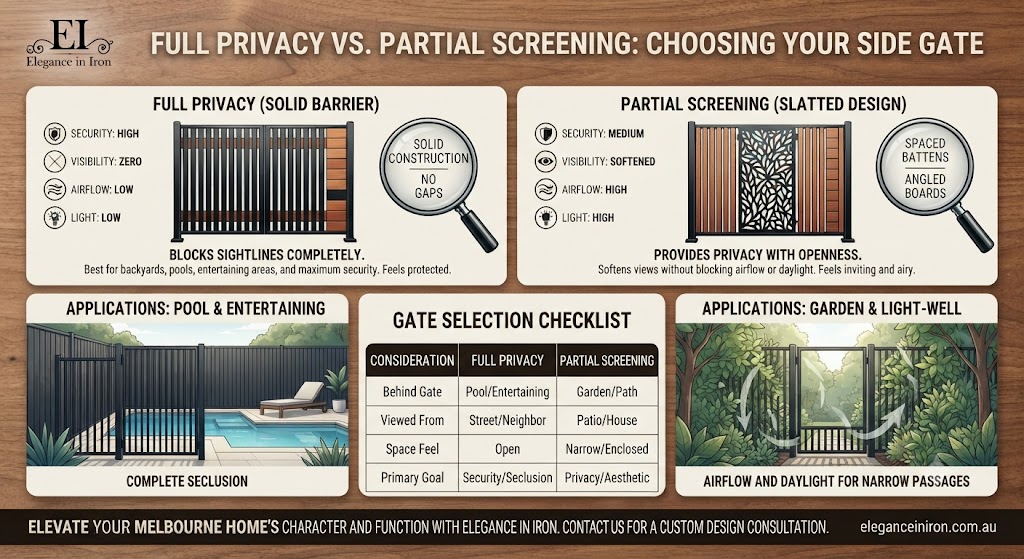
One of the most effective ways to make a small frontage feel larger is to allow filtered views through the gate. A glimpse of a pathway, garden, porch, or front door creates a sense of depth that a completely solid gate would remove.
Transparency does not mean sacrificing privacy. Carefully positioned slats, perforated panels, open ironwork, or mixed-material designs can obscure direct views while still allowing light and movement to pass through.

Spaced Timber Slats
Spaced timber boards provide warmth and partial privacy without creating a solid wall. The boards can be installed vertically for a taller appearance or arranged with subtle variations in spacing to control visibility.
Premium timber is particularly effective in a small entrance because its natural grain adds detail without requiring ornate decoration. A well-finished hardwood gate can feel sophisticated while remaining visually calm.
Slim Iron or Steel Members
Metal gates can provide security with less material than a heavy timber design. Slim steel bars or refined ironwork allow the home and garden to remain visible while clearly defining the property boundary.
For small homes, simplicity is important. Clean geometric patterns usually work better than dense scrollwork or oversized decorative elements, which can make the entrance look crowded. Our beginner’s guide to choosing custom wrought iron products covers how to weigh these options.
Timber and Metal Combinations
A combination of timber and metal can balance warmth, strength, and transparency. A slim metal frame can support narrow timber slats, creating a gate that feels substantial without appearing bulky.
This approach is also highly adaptable. The timber can reference the front door, decking, or architectural cladding, while the metal frame can coordinate with window frames, fencing, or exterior lighting.
Low-Profile Elegance
A tall gate is not always necessary. In areas where maximum privacy is not required, a lower gate can create a welcoming boundary while keeping the home connected to the street.
Low-profile gates work particularly well for cottages, bungalows, and properties with attractive front gardens. They signal where the private property begins without blocking views of the landscaping or architecture.
When a Lower Gate Works Best
A lower gate may be suitable when the main goal is to contain pets, guide visitors, protect garden areas, or create a visual boundary. It can also be paired with taller planting to provide softness and additional screening where needed.
The top edge of the gate should relate to nearby fence lines, porch rails, or window sills. Aligning these elements helps the frontage appear wider, more organised, and architecturally considered — the same principle we apply when planning a gate alongside wrought iron fencing along the rest of the boundary.
Simple Shapes Create a Refined Appearance
Straight top rails usually produce a clean, contemporary look, while a subtle arch may suit a cottage or traditional home. The shape should remain restrained, particularly when the frontage already includes detailed brickwork, decorative trim, or extensive planting.
A small gate does not need multiple patterns, contrasting inserts, and elaborate ornamentation to feel special. Precise proportions and high-quality materials often create a stronger impression than decorative excess.
Choosing Materials for a Small Front Gate
Because a compact gate is viewed at close range, material quality becomes especially noticeable. Grain, texture, welds, joints, coatings, and hardware all contribute to the overall appearance.
Premium timber and refined metalwork generally perform better visually than mass-produced alternatives. They can be shaped, spaced, and finished according to the dimensions of the property rather than forcing the entrance to accommodate a standard product.
Premium Timber Gates
Timber brings natural warmth to small urban properties and can soften brick, render, stone, or metal fencing. It is particularly suitable for homes that need a welcoming entrance rather than an industrial-looking security barrier.
The timber species and finish should be selected for exterior durability as well as appearance. Proper construction, sealing, drainage, and maintenance help reduce movement, weathering, and premature deterioration.

Refined Ironwork and Steel
Custom iron or steel gates can offer excellent strength while maintaining an open profile. Thin members, clean joins, and a durable finish create a secure gate that does not visually close off the property.
Metalwork can also be designed to reflect existing exterior details, such as black window frames, balcony rails, fence panels, or house numbers. This coordination makes the entire frontage feel more intentional. It’s also worth understanding the difference between wrought iron and steel before deciding which material suits your home.
Avoiding an Industrial Appearance
Metal does not have to look cold or utilitarian. The scale of the frame, spacing of the bars, choice of finish, and integration of timber or landscaping can significantly soften the design.
Heavy mesh, oversized frames, exposed hardware, and generic security patterns may make a small home feel more commercial than residential. A custom approach allows security features to be integrated discreetly.
Hardware Scale Matters
Hinges, latches, handles, locks, and gate stops may seem like minor details, but they are highly visible on a small gate. Oversized hardware can overpower the design and make the gate appear heavier than intended.
Hardware should be selected according to the weight and style of the gate. Compact components with sufficient strength can provide reliable operation without distracting from the materials and proportions.
Choose Discreet, Well-Integrated Hardware
A latch can be recessed, aligned with the gate frame, or finished to match the surrounding metalwork. Hinges can also be positioned to reduce their visual impact while still supporting the gate correctly.
Hardware placement should remain comfortable and accessible. A custom gate allows the handle and lock to be positioned at a practical height without disrupting the balance of the design.
Prioritise Smooth Operation
A beautiful gate quickly loses its appeal if it drags, rattles, slams, or fails to close properly. Correct hinge selection, accurate alignment, durable posts, and suitable clearances are essential.
Small properties often have uneven paths, tight side walls, or limited swing space. These conditions should be considered during the design stage rather than corrected after installation.
The Custom Difference
Standard-sized gates are rarely designed around the exact proportions of a small property. When the dimensions do not match, installers may need to add filler panels, widen posts, leave awkward gaps, or position the gate off-centre.
These compromises are particularly obvious on a narrow frontage. A bespoke gate is measured and designed for the actual opening, allowing every element — from the frame thickness to the slat spacing — to remain balanced. Budget is naturally part of that decision, and our Melbourne wrought iron gate cost guide outlines what typically affects the final price.
Built to Follow the House
A custom gate can align with fence rails, masonry joints, window proportions, pathways, and front-door details. This creates a continuous visual relationship between the boundary and the building.
The design can also account for slopes, steps, uneven ground, restricted opening directions, and unique security requirements. Instead of adapting the property to the gate, the gate is adapted to the property.
Better Control Over Privacy
Custom construction allows privacy to be adjusted precisely. Slats may be closer together at eye level and more open near the top, or angled to block direct views from the street while admitting light.
This level of control is difficult to achieve with an off-the-shelf gate. It is especially valuable for small homes where a completely solid design could make the entrance feel enclosed.
Front Gate Styles for Different Small Homes
The best design should respond to the architecture of the property rather than follow a trend in isolation. Material, height, spacing, and detailing can all be adjusted to suit the character of the home.
Modern Urban Homes
For a modern row house or townhouse, consider slim vertical timber battens within a powder-coated metal frame. A simple rectangular shape, concealed fixings, and minimal hardware will maintain a clean appearance.
Dark metal can provide definition, while natural timber introduces warmth. Keeping the spacing consistent helps the narrow frontage feel organised and visually taller.
Traditional Cottages
A low timber gate or simple iron picket gate can complement a traditional cottage without hiding its charm. Gentle curves, carefully proportioned posts, and subtle detailing may reference the architecture without becoming overly decorative.
Paint colours can be coordinated with the front door, window trim, or fence. Soft neutrals and traditional dark finishes often work well, but the final choice should reflect the home’s existing palette.
Compact Bungalows
Bungalows generally benefit from gates with strong horizontal alignment and moderate height. A low-profile gate that follows the fence line can make the frontage feel wider and more open.
Vertical slats may still be used to add height, but the overall form should respect the low roofline. Combining a simple gate with layered planting can create privacy without building a tall visual barrier.
Narrow Side-by-Side Properties
For houses positioned close to neighbouring properties, the entrance needs clear definition. A custom gate can help distinguish the pathway without consuming valuable width.
Slim posts, precise framing, and an inward or outward swing planned around the available space are important. A transparent or semi-transparent design also prevents the narrow entrance from feeling like a corridor.

Common Front Gate Mistakes to Avoid
- Choosing a gate that is too tall or solid for the frontage
- Installing chunky posts that reduce the usable entrance width
- Using dense ornamentation on an already detailed façade
- Selecting industrial mesh or heavy security patterns
- Adding oversized hinges, handles, or latches
- Filling gaps around an incorrectly sized standard gate
- Ignoring the gate’s swing path and surrounding landscaping
- Using materials that conflict with the front door or fence
Creating a Secure Gate Without the Fortress Effect
Security does not depend solely on visual heaviness. Strong framing, quality locks, stable posts, correct hinge installation, and thoughtful spacing can create a secure entrance without making the home appear inaccessible.
A gate can also be designed to reduce climbing points, prevent easy access to the latch, and control visibility from specific angles. These features can be incorporated subtly so the entrance remains warm and residential. A well-proportioned gate also plays into a home’s long-term value — see our piece on whether a wrought iron fence increases property value.
Final Thoughts
The most successful front gate ideas for small homes are based on restraint, proportion, and architectural consistency. Vertical lines can make the entrance feel taller, filtered views can add depth, and a low-profile design can establish a boundary without hiding the home.
Custom construction provides the freedom to fit the exact opening, control the level of privacy, use appropriately scaled hardware, and reflect the lines of the property. Rather than overcrowding a compact frontage, a carefully designed gate can make the entire exterior feel more spacious, refined, and complete.
Your front gate is the first impression of your home. Let’s design a custom entrance that fits your space perfectly. Contact Elegance In Iron for a consultation on your custom front gate.
Frequently Asked Questions
What type of front gate makes a small home look bigger?
A gate with vertical lines, slim framing, and partial transparency can make a small frontage feel larger. Spacing between timber slats or metal members allows the eye to continue into the garden, creating more visual depth.
Should a small home have a solid front gate?
A solid gate may be appropriate when maximum privacy is required, but it should be carefully proportioned. For most small homes, a semi-transparent design provides a better balance between privacy, security, light, and openness.
How tall should a front gate be for a small property?
The ideal height depends on the fence, house, and privacy requirements. Low to medium-height gates often suit compact homes because they define the boundary without dominating the architecture.
Why is a custom gate better for a narrow entrance?
A custom gate is manufactured to fit the exact dimensions of the opening. This avoids oversized posts, filler panels, uneven gaps, and other compromises that can make a narrow entrance feel even more cramped.


