

Last Updated on July 18, 2026 by Elegance
Accurate driveway gate measurements affect far more than whether the gate fits the opening, and this matters just as much for a Melbourne property as anywhere else.
A small measuring mistake can change how the gate opens, closes, aligns, and works with automation. Here is what actually matters when you measure for a driveway gate, and why final numbers should still be confirmed by a professional.
Space Requirements at a Glance
These are general reference figures. Actual space needed depends on your specific gate, hardware, and site.
| Gate Type | Space Beyond the Opening | Ground Requirement |
| Swing gate | Clear arc equal to gate width | Relatively flat, minor slope tolerated |
| Sliding gate (tracked) | Run-back roughly equal to opening width | Level, prepared ground for track |
| Cantilever sliding gate | Adds 30% to 50% to total gate length | Works on sloped or uneven ground |
How to Measure for a Driveway Gate: Start With Width
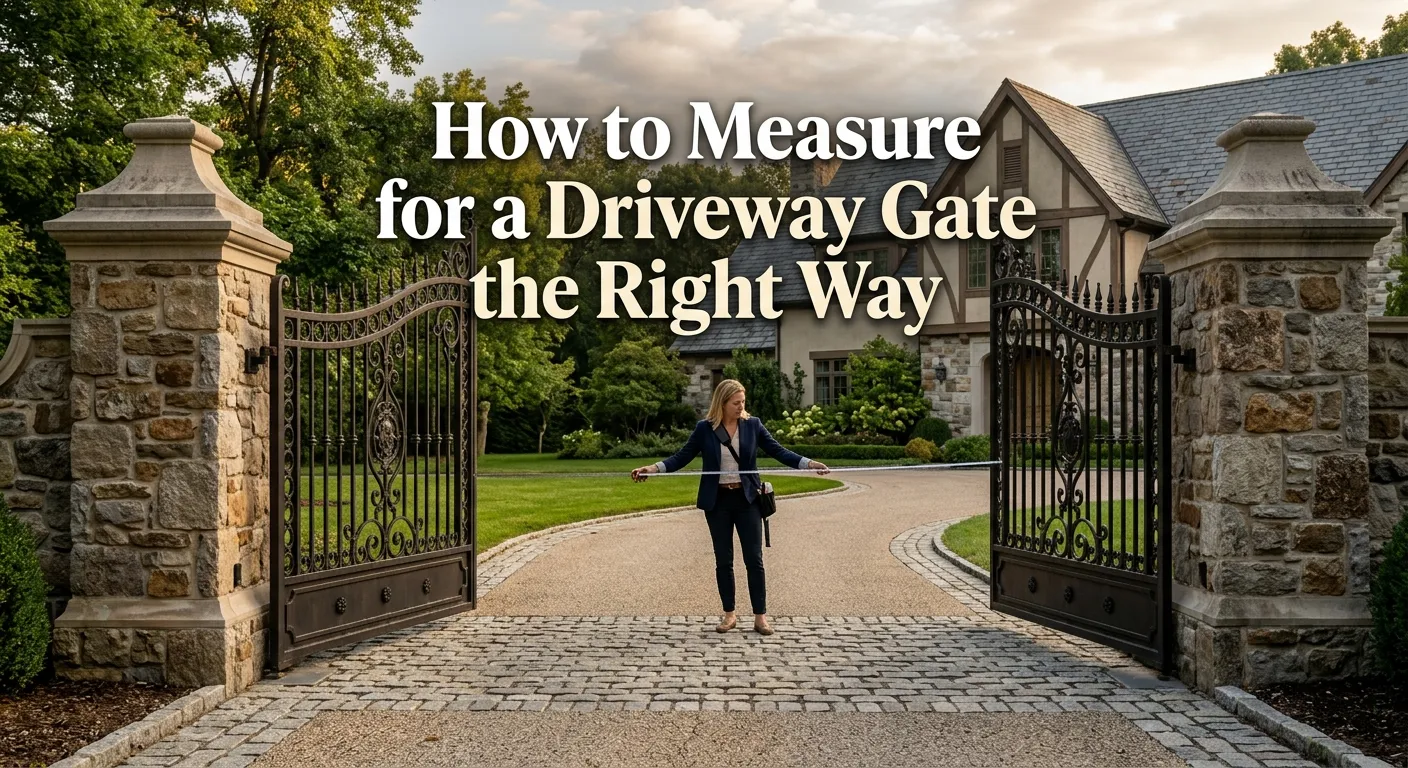
Measure the distance between existing posts, pillars, walls, or fence ends at the top, middle, and bottom of the opening.
Driveway openings are rarely perfectly square, so these three readings often differ slightly. Use the narrowest of the three as your reference point, since building to the tightest measurement avoids a gate that binds anywhere along its path.

Swing or Sliding: How the Gate Type Changes What You Measure
Gate type changes what actually needs to be measured next.
• Swing gates, need clear space for the gate to travel through as it opens.
• Sliding gates, need side run-back space instead, since the gate travels sideways rather than through an arc.
• Sloped driveways, can affect both options differently, which is worth discussing early with your installer.
This decision shapes almost everything else in the measuring process, so it is worth settling before moving on to specific dimensions.
Measure the Available Swing Space
For a swing gate, direction matters as much as distance.
Check whether the gate will open inward or outward, then measure the distance behind the gate for that full swing gate space, including room for a parked vehicle if relevant.
Driveway slope and any obstructions, such as garden beds, bins, steps, or landscaping near the swing path, all need to be accounted for.
Measure the Sliding Run-Back Space
A sliding gate needs enough room along the fence line to travel fully open.
This includes the run-back space itself, the track area beneath it, and how level the ground is along that path. Side obstructions and fence alignment both matter here too.
A cantilever gate changes this calculation for sliding gate run-back space. Because it does not run on a ground track, it typically needs 30 to 50 percent more total length for the counterbalance section.
In return, it tolerates sloped or uneven ground far better than a tracked sliding gate does.

Check Ground Clearance
Driveway gates need clearance above the ground to avoid scraping as they open and close.
Sloped driveways, uneven concrete, gravel, pavers, and drainage channels can all affect gate ground clearance requirements, and Melbourne properties see a fair mix of all of these depending on the suburb and block.
If resurfacing is planned for the future, it is worth mentioning this before final measurements are taken, since a change in surface height later can affect an already-fitted gate.
Measure the Desired Gate Height
Driveway gate height affects privacy, security, style, and how the gate reads against the rest of the property.
Decorative tops, arches, spear tops, and custom patterns can all change the final height even when the base measurement is the same, so it helps to settle on a style early in the process.

Account for Posts, Hinges, Tracks, and Hardware
One thing that surprises people when they measure for a driveway gate is that the gate panel itself is rarely the same size as the full opening.
• Posts, hinges, and latches, all take up real space that needs to be planned for.
• Lock boxes and stops, add further requirements depending on the hardware chosen.
• Tracks, rollers, and motors, for sliding and automated gates specifically.
When you measure for a driveway gate, recording figures to the nearest few millimetres rather than rounding broadly helps avoid small errors compounding across all this hardware.
Consider Automation Requirements
An automated driveway gate needs planning beyond the gate and hardware alone.
Motor placement, power supply, sensors, keypads, and intercoms all need dedicated space and access. Remote access setup and safety clearances around moving parts should be factored in from the start, along with clear stopping points for the gate itself.
Note Slope, Drainage, and Site Conditions
Site conditions can influence gate type, design, installation method, and cost, sometimes more than homeowners expect.
Before you measure for a driveway gate for the final time, it helps to clear the area of debris, gravel, or loose material, since this can shift readings or hide uneven ground.
Common Measuring Mistakes to Avoid
When homeowners measure for a driveway gate themselves, a handful of mistakes come up often enough to be worth calling out directly.
• Measuring only once, instead of checking multiple points across the opening.
• Ignoring slope, which affects clearance and hinge or track placement together.
• Forgetting hardware space, for posts, hinges, tracks, and motors.
• Measuring before landscaping or paving changes, then finding the numbers no longer match.
• Assuming posts are straight or strong enough, without actually checking.
• Forgetting automation equipment, when planning an automated driveway gate.
Most of these come down to rushing the process, and a second check before finalising numbers catches nearly all of them.
Why Professional Measuring Still Matters
Homeowner measurements are genuinely useful for early planning and getting a rough quote.
But final fabrication should be based on professional gate measuring rather than homeowner estimates alone. A local installer who knows common Melbourne site conditions checks structural support, hardware compatibility, and site conditions together, a different level of detail than a tape measure reading alone.
How to Measure for a Driveway Gate: Getting the Fit Right
The right measurements are what make a driveway gate fit well, operate smoothly, and suit the property it sits on.
Whether it is a swing gate, sliding gate, or cantilever system, measure for a driveway gate yourself to start the conversation, then let a professional confirm the final numbers before anything is built.
Frequently Asked Questions
Can I measure for a driveway gate myself before contacting an installer?
Yes, rough measurements are useful for an initial quote and planning conversation, but final dimensions should be confirmed on site through professional gate measuring before fabrication begins.
How much extra space does a cantilever gate need compared to a tracked sliding gate?
Typically 30 to 50 percent more total gate length, since the counterbalance section needs somewhere to sit when the gate is open. In exchange, cantilever gates tolerate sloped or uneven ground much better.
What is the most common mistake homeowners make when they measure for a driveway gate?
Measuring the opening only once rather than at multiple points. Since driveway openings are rarely perfectly square, a single reading can miss variations that affect the final fit.
Does ground slope affect swing gates and sliding gates differently?
Yes. Swing gates need enough clearance across their full arc to avoid scraping on a slope, while sliding gates need a level path for the track unless a cantilever system is used instead.
Why does automation need extra measuring consideration?
Motors, sensors, keypads, and intercoms all need dedicated space and power access, plus safety clearances around moving parts, which go beyond the measurements needed for a manual gate.


