

Last Updated on September 18, 2026 by Elegance
Security door standards Australia sets are currently the AS 5039 series, which covers three linked parts: product classification and performance, installation, and methods of test. In practice, a genuine security door should be backed by testing evidence and a compliance label showing it has been assessed against the applicable standard. Industry guidance treats a missing label as a clear warning sign, regardless of how strong a door looks or what it’s made from.
Quick Answer: What Standard Should a Security Door Meet in Australia?
A compliant security screen door Australian standards recognise should meet the current AS 5039 series, which is split into three linked parts: performance and classification, installation, and test methods. All three matter, since a product tested to the performance standard still needs to be installed correctly to remain compliant. Exact titles and years should always be re-checked against the current official source immediately before making a purchase, since standards are periodically revised.

The Current AS 5039 Series Explained
| Part | Title | What It Covers |
|---|---|---|
| AS 5039.1:2023 | Classification and performance | Sets the performance benchmarks a product must meet |
| AS 5039.2:2024 | Installation | Sets requirements for how a compliant product must be installed |
| AS 5039.3:2023 | Methods of test | Sets out how products are tested against the performance benchmarks |
AS 5039.1:2023 supersedes the older AS 5039:2008, and AS 5039.3:2023 supersedes the older AS 5041:2003. AS 5039.2:2024 similarly replaces the old installation standard, AS 5040:2003. A surprising number of guides and product listings online still reference the 2008 or 2003 numbers as though they’re current, so it’s worth checking which version a specific claim is actually referring to.
“If it is not labelled, it is NOT a security door.”
External standards-industry reference: National Security Screen Association, Buying a Security Door. Read the source.
The quoted wording is directly visible on the current NSSA page. That same page identifies AS 5039.1:2023, AS 5039.2:2024 and AS 5039.3:2023 and lists the current test categories used in its consumer guidance.
What Does “Tested to the Standard” Actually Mean?
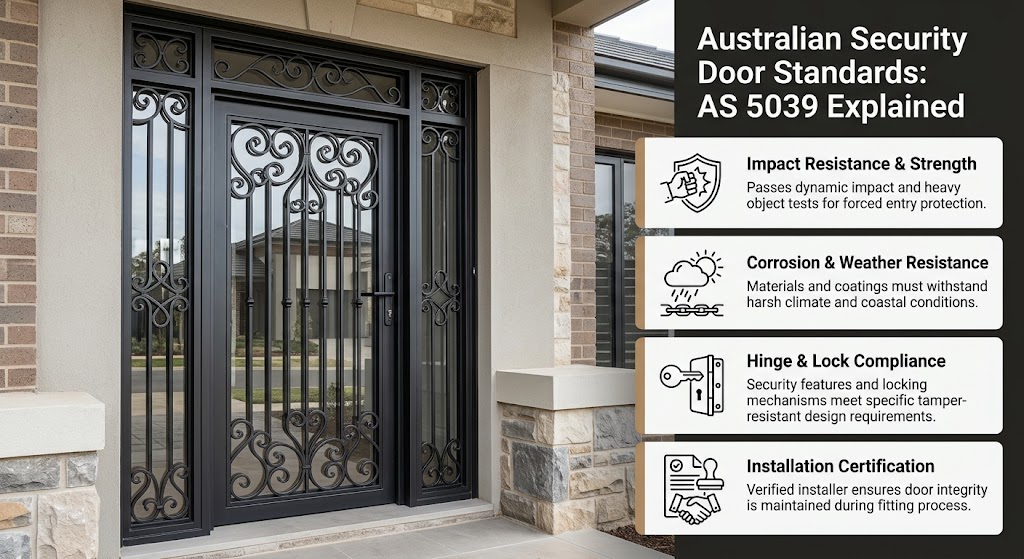
Compliance is demonstrated through performance testing, not visual inspection or appearance. Current NSSA guidance lists testing categories that include impact, jemmy, pull, probe, knife shear, and corrosion resistance. A product that passes has documented proof that its complete system, not just the mesh or the frame alone, holds up against these forms of attack. A door that merely looks heavy-duty hasn’t demonstrated any of this.
Product Compliance vs Installation Compliance
A genuinely compliant product can still end up non-compliant if it isn’t installed to the applicable installation standard, which is why AS 5039.2:2024 exists as its own separate part. Installation licensing requirements vary by state and territory and aren’t universal across Australia. Whether a specific licence or registration applies to a given installer in Victoria depends on the type of work involved, so this is worth confirming directly with the installer or the relevant authority rather than assuming a particular category automatically applies.
Compliance Labels and Documentation
Before buying, it’s reasonable to ask for:
- Which standard and part number the product is tested to, including the year
- Documented proof or certification for that specific product
- A physical compliance label supplied and installed with the door
- Installer details, including licensing or registration where applicable
- Warranty and maintenance information in writing
A genuine compliance label will often show a security level marking, such as SL100 or SL200, alongside the standard reference. If a supplier can’t produce a label or supporting documentation for the specific product, that’s a reasonable basis to ask further questions before purchasing.
Security Door vs Barrier or Safety Door
A barrier or safety door hasn’t been shown to meet the rigorous testing and performance requirements of the current standard, even if it’s marketed using similar language. A decorative metal door isn’t automatically a security door just because it looks strong or heavy; the term only applies where test evidence and a compliance label back it up.
Locks, Hinges, Frames, and Infill: What Matters?
A compliant security door works as a complete system rather than any single strong-looking part. Current NSSA guidance points to a 3-point lock as standard rather than an optional extra, hinges designed to resist tampering, and a frame with a reinforced receiver channel and strong corner joints. Infill can be steel, aluminium, or stainless steel mesh depending on the product, but no single component alone proves the whole system is compliant.
| Component | Why It Matters |
|---|---|
| Frame | Transfers load and holds the overall structure together under force |
| Locking system | Resists deliberate attempts to lever or force the door open |
| Mesh / infill | Resists cutting, piercing, and impact while allowing visibility or airflow |
| Installation | Determines whether the tested performance of the product actually holds up on site |
When comparing custom security doors, it helps to look beyond design options alone and ask how the proposed system has been tested and documented, not just how it looks in a showroom.
For iron or steel components exposed to weather, does wrought iron rust explains the underlying corrosion mechanism separately from security-standard compliance.
Where finish selection is part of the specification, powder coating vs galvanizing for exterior metalwork compares two protective approaches without treating either one as proof of AS 5039 compliance.
Common Buyer Mistakes
- Judging a door by appearance or weight rather than test evidence
- Accepting an outdated standard reference (like AS 5039:2008) without checking if it’s current
- Not asking to see the compliance label before purchase
- Focusing on the product while overlooking installation quality
- Assuming a particular brand or material automatically guarantees compliance

Security Door Buyer Checklist
- Does the product reference the current AS 5039 series, with year and part number?
- Is a physical compliance label supplied and fitted?
- Can the supplier provide test evidence for this specific product?
- Is the lock a 3-point system with at least a 5-pin cylinder?
- Are the hinges tamper-resistant, with at least three fixed pins?
- Is the frame reinforced at the corners and receiver channel?
- Is the infill material suited to your location, including coastal corrosion resistance if relevant?
- Is the installer appropriately licensed or registered for your state?
- Is warranty and maintenance information provided in writing?
What to Ask Elegance in Iron Before Specifying a Security Door
When discussing a custom security door, it’s reasonable to ask which standard and test evidence applies to the exact door being proposed, since custom and decorative features shouldn’t come at the expense of a documented, tested system. Understanding security door standards Australia sets makes that conversation more productive. Elegance in Iron’s wrought iron security doors Melbourne are custom designed around the entrance and property, and any compliance question for a specific product should be confirmed directly with the supplier for that exact system.
For the commercial service itself, see Elegance in Iron’s wrought iron security doors melbourne. This link identifies the service owner only; it does not imply that every door or configuration is AS 5039 compliant without product-specific evidence.
Frequently Asked Questions
What is the Australian Standard for security doors?
The current framework is AS 5039, made up of three parts covering classification and performance, installation, and test methods, published in 2023 and 2024.
Are AS 5040 and AS 5041 still current?
No. Both belong to the earlier standards series and have been superseded, along with the older AS 5039:2008, by the current three-part AS 5039 series.
What tests does a compliant security screen door need to pass?
Current testing includes categories such as impact, jemmy, pull, probe, knife shear, and corrosion resistance, assessed on the complete door system rather than individual components.
Does a security door need a compliance label?
Yes. Industry guidance from the NSSA is direct on this point: a product without a physical compliance label shouldn’t be treated as a verified, compliant security door, regardless of other claims made about it.
Is a three-point lock enough to make a door compliant?
No single feature makes a door compliant on its own. A 3-point lock is a standard expectation, but the frame, hinges, infill, and installation all need to meet the requirement together.
Can a decorative wrought iron door automatically be called a security door?
Not automatically. Decorative strength and visual weight aren’t the same as tested performance; the term security door depends on test evidence and a compliance label for that specific product.
For homeowners in Melbourne and across Victoria, ask for the exact security specification, current test or compliance evidence, and installation details relevant to your proposed door before ordering.


Does AS 5039 apply differently to wrought iron security doors compared with aluminium or steel mesh security doors? I’m mainly trying to understand whether the testing requirements for impact resistance and forced entry are the same regardless of the door material.
I’m currently comparing security doors for our home in Melbourne. When checking whether a door meets AS 5039, should homeowners only look for certification on the finished security door, or should the locks, hinges and frame components also have their own compliance information?